

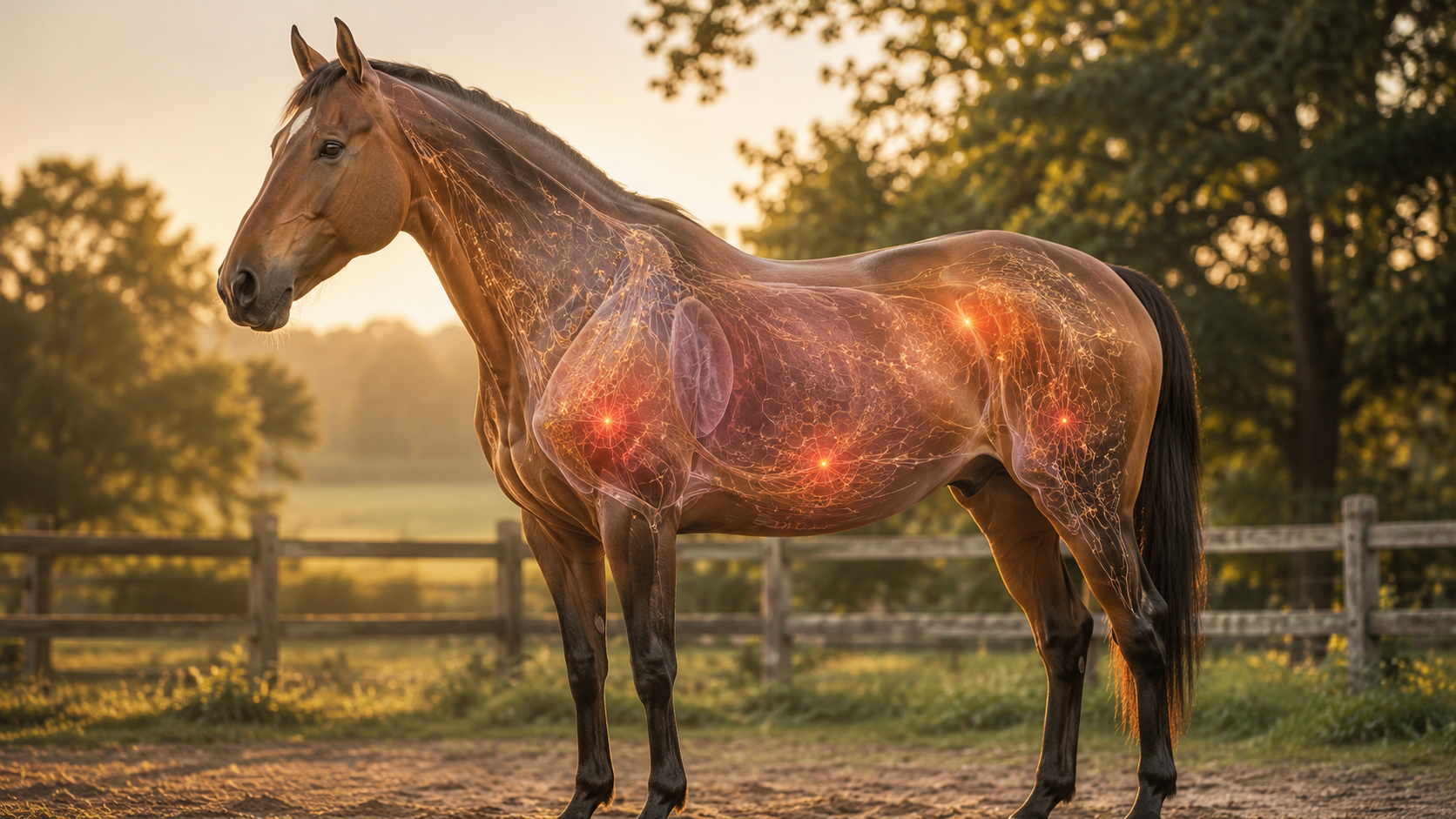
Low-grade inflammation in horses – what is really behind it?
Maybe you know this feeling: you're standing in front of your horse and you can't really tell what's going on. It eats, it runs, it doesn't have a fever and there's nothing else that would make you immediately say: Something is definitely sick. And yet you think, “Something’s wrong.”
Maybe your horse has become stiffer and is taking longer and longer to relax his back while riding. Maybe the fur changes, the skin becomes more sensitive or there are recurring minor digestive problems. Another horse suddenly appears stressed more quickly, less resilient or somehow tired. And yet another always has a small construction site somewhere: today muscles, tomorrow intestines, at some point skin or joints.
Of course, each of these problems can have its own cause. But at some point it's worth taking a step further and no longer just looking at the individual symptom. The question then becomes interesting as to whether various abnormalities are perhaps related to one another and whether processes are taking place in the body that are not initially visible from the outside.
This is exactly where the so-called silent inflammations come into play.
Inflammation does not always have to be visible
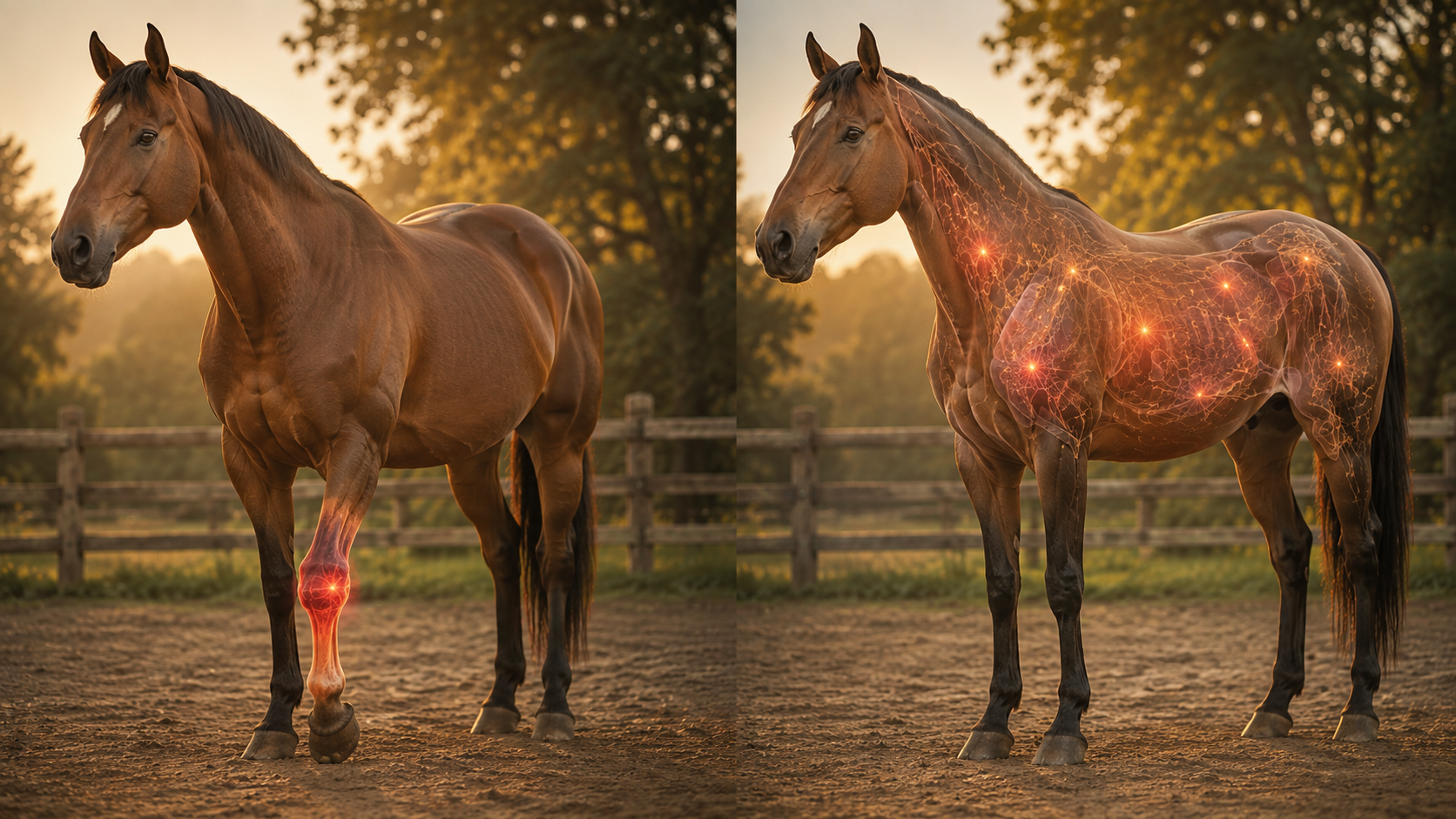
When we horse people hear the word inflammation, we usually immediately have a pretty specific image in mind: a hot joint, a thick leg, an inflamed tendon or a wound. A classic acute inflammatory reaction initially even makes sense. It is part of the body's repair and defense system. When tissue is injured or pathogens need to be fought, we need this response.
It becomes problematic when inflammatory processes do not completely calm down and the organism remains permanently in a subthreshold state of alert. This can look much less noticeable. There isn't necessarily a single point at which you can say: "This is where the inflammation is."
Instead, you may see small changes over and over again. The horse regenerates more slowly, the muscles remain firm, the skin or digestion react sensitively or the stress is handled more poorly than before.
And that's exactly why I don't like a sentence at all that you hear quite often in the stable:
“That’s just the way it is.”
Sometimes he actually is like that. After all, horses have character, temperament and individual physical requirements. For example, Spirit is a completely different horse than Valea. But the more important question is: Was the horse always like this or has something changed?
Changes tell us something. And if several changes occur together over a longer period of time, you should take a closer look.
Horse health is never just feeding
Something is particularly important to me at this point: When we talk about silent inflammation, metabolism or omega-3, we must not make the mistake of reducing horse health to nutrition.
That would be far too easy.
A horse is an entire system. What it eats plays a big role. But husbandry, movement, training, stress, social conditions, pain and environmental factors can be just as important. For example, a horse that is constantly under stress because the herd constellation is not working cannot be viewed in isolation through feed optimization. Likewise, even the best supplement will not help if a horse is subjected to incorrect physical stress every day.
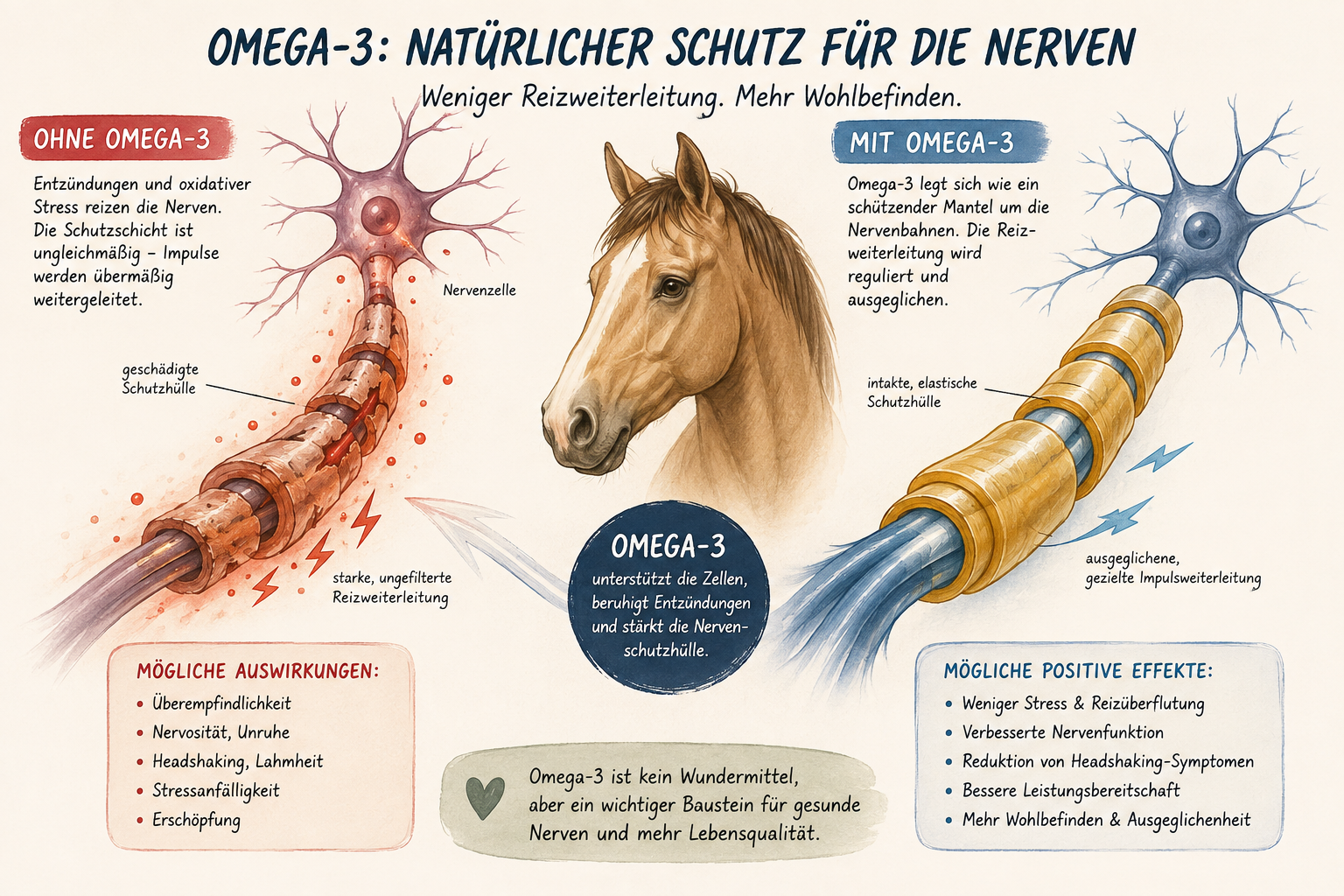
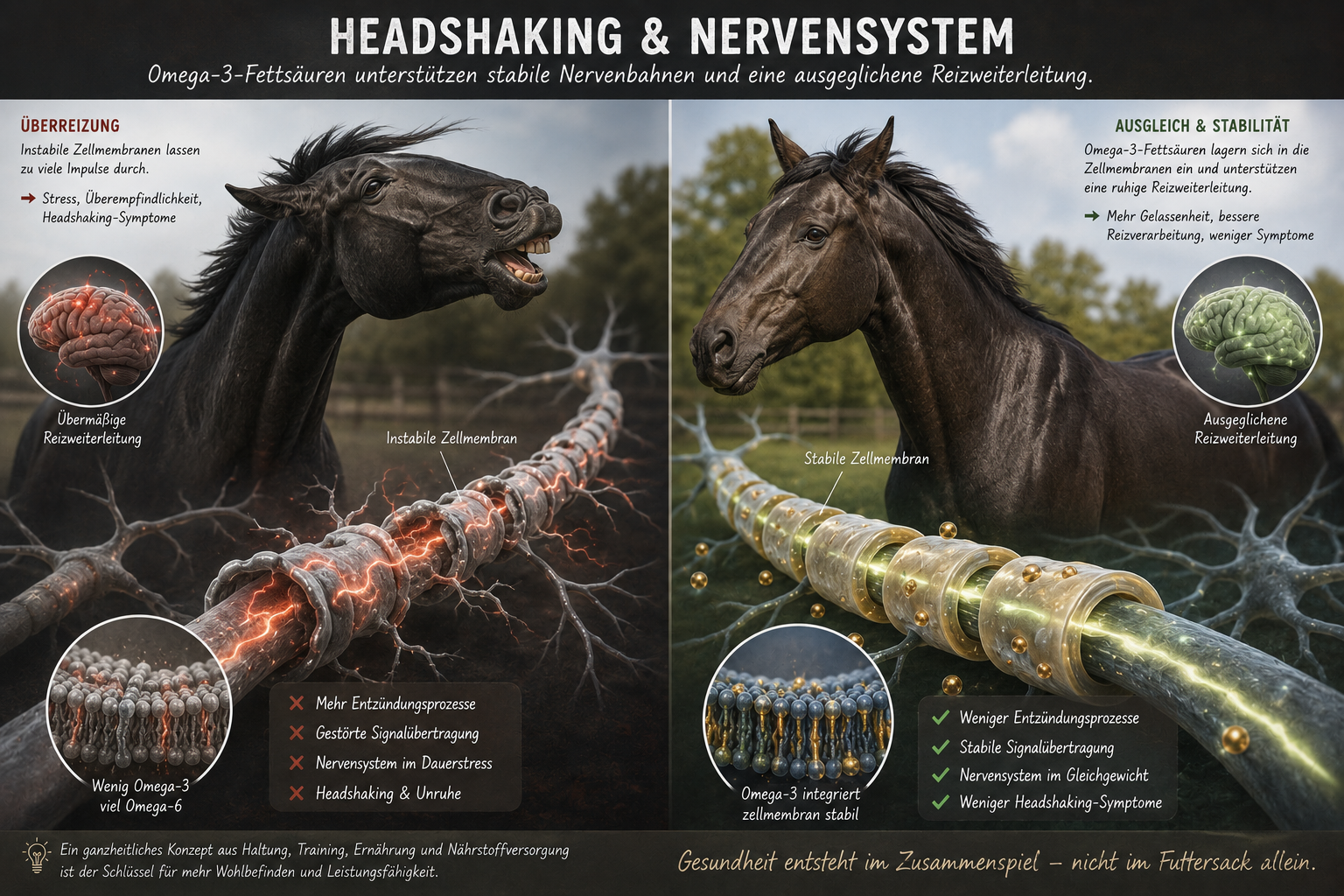
A good example of this is head shaking. Unfortunately, we know the topic of Spirit very well. Of course, headshaking is a complex medical condition and not a problem that can simply be “trained away”. However, there are training approaches that can sometimes reduce symptoms surprisingly quickly. A targeted, correctly structured training concept, such as that developed by Dr. Disc flight, developed in Austria, can provide some horses with noticeable relief within just a few days. This does not eliminate the cause, but the horse initially receives concrete help.
And that's exactly what I'm talking about: sometimes nutrition is an important lever, sometimes training, sometimes attitude - and usually it's worth looking at several areas at the same time.
The crucial question is therefore not: “What remedy do I need for this symptom?”
But rather: “What factors are causing this body to no longer regulate optimally?”
What do fatty acids have to do with it?
This brings us to an area that plays an important role in the regulation of inflammatory processes: omega-6 and omega-3 fatty acids.
And right away: Omega-6 is not bad.
The body needs omega-6 fatty acids. They are involved in normal physiological processes and play a role in, among other things, inflammatory and repair reactions. At the same time, certain omega-3 fatty acids such as EPA and DHA in particular have an important function in the regulation of such processes.
So it's not about declaring one fatty acid the villain and another the miracle cure. What is more important is the interaction.
The fatty acid analysis we use therefore does not simply measure “omega-3”. A total of eleven different fatty acids are determined and several parameters are calculated, including the omega-6:3 balance, the omega-3 index, the cell membrane fluidity and the arachidonic acid index.
What is particularly interesting is the relationship between arachidonic acid from the omega-6 group and EPA from the omega-3 group. In the test documents, this relationship is explicitly described in connection with the regulation of inflammatory processes.
And so we are suddenly no longer talking about some “healthy oil”, but in the middle of cell biology.
The cell membrane – much more than packaging
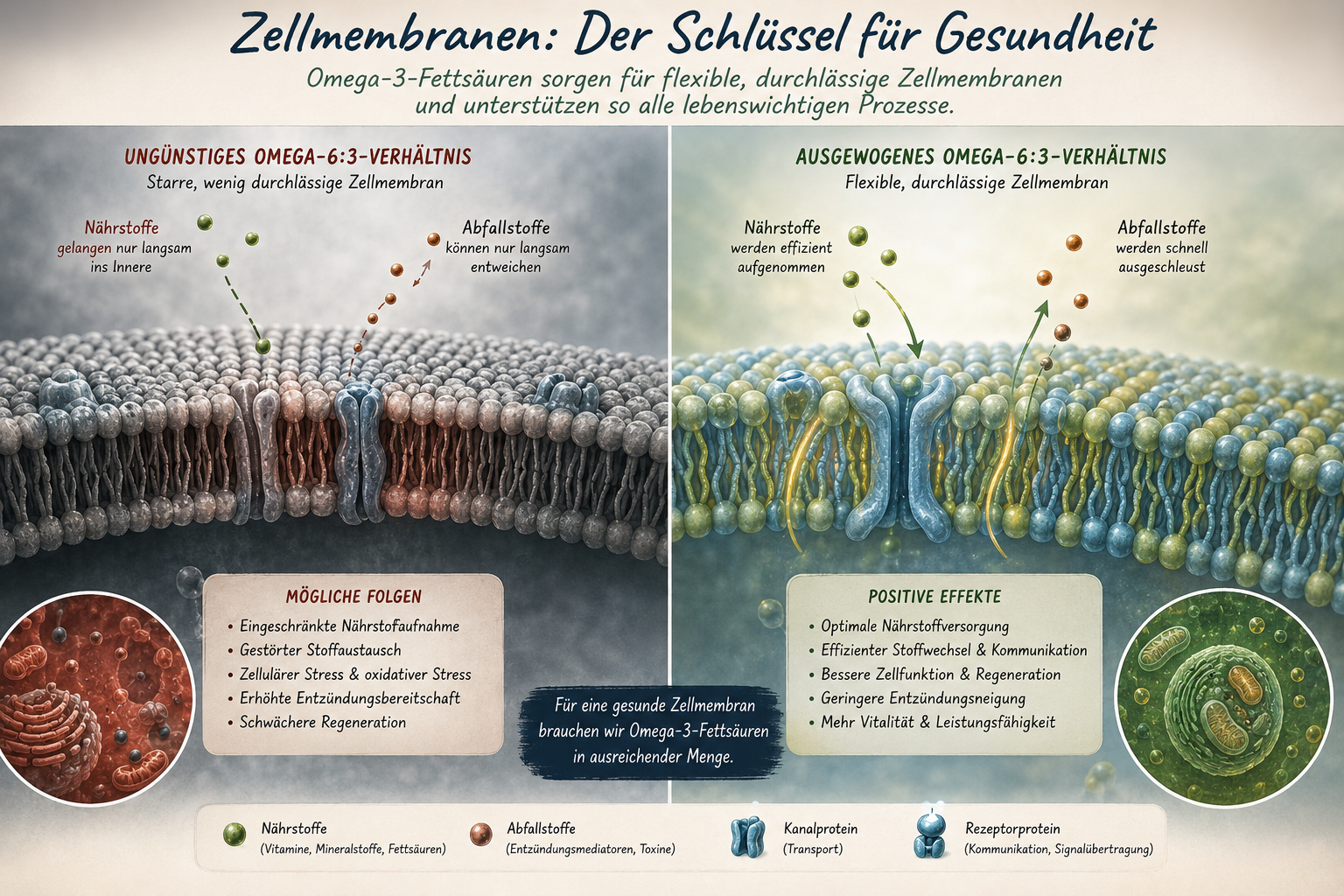
Every cell in the body has a cell membrane. However, you can't imagine it like a solid plastic bag that just holds everything together. It is a highly active component of the cell. Through them, substances are absorbed and released, information is passed on and numerous metabolic processes are controlled.
The composition of the fatty acids also influences the properties of this membrane.
A cell membrane must be stable, but at the same time remain sufficiently flexible and mobile. This is precisely why the so-called cell membrane fluidity is also considered in fatty acid analysis. The ratio of certain saturated fatty acids to EPA and DHA is used as an indication of how fluid the membrane is. The test description explicitly establishes the connection to the cell's uptake and release processes.
This thought changed a lot for me.
Because if we always just ask ourselves what supplement we can give a horse, we may be overlooking a much more fundamental question: What does the body's supply situation actually look like and under what conditions does its cells have to work?
Valea has shown us exactly that quite clearly
Valea is one of those horses where at some point you stop thinking in individual boxes.
There have been various issues with her over the years. Digestion, muscles, stress and, last but not least, the hormonal situation around the ovaries and uterus have always concerned us. And of course each of these topics could be treated individually. For every problem there is a powder, an herbal mixture or some new bucket.
Anyone who has several horses will at some point be familiar with these feed rooms, where they feel like they could open their own specialist shop.
But it became increasingly clear to us at Valea that we had to look at the basics first. In addition to keeping, training and feeding, this also included the supply of omega-3 fatty acids.
After we began to make targeted changes to this care, we saw developments that caught our attention. Not according to the motto “Put the oil in and fix the horse”. No organism works like that. But her overall condition stabilized and areas that we had previously considered separately developed positively.
Their hormonal history in particular has shown us one thing clearly: an ovary does not live alone in the horse. An intestine does not live alone in a horse. The muscles do not live alone in the horse.
Everything is connected.
And that's why we look at Valea completely differently today than we did a few years ago.
Spirit also taught us to stop thinking in boxes
With Spirit the story was different. Headshaking was a massive topic for us for a long time.
And no: I would never claim that headshaking is simply an omega-3 deficiency. This clinical picture is far too complex for that.
But Spirit showed us very impressively what a difference it can make if you change several adjustment screws at the same time. Training and movement management played a role, husbandry and stress played a role, as did feeding, intestinal health and nutrient supply.
Today, when I have a health problem, I am no longer just interested in: “What can I do about it?”
I'm much more interested in:
How does this horse live? How is it trained? Is the load appropriate? What does the herd look like? How much exercise does it get? How is digestion? What is being fed? Are there known pains? How is the nutrient supply? And are there measurable values that can give us additional information?
This is exactly what I mean by holistic horse health.
Not some esoteric idea that everything is somehow connected, but a very practical look at the entire horse.
Why we prefer to measure rather than guess
I like measurable results.
Not because I think you can reduce a horse to a lab note. I know Spirit better than any laboratory in the world. And Sandra also knows Valea better than any blood test.
But subjective observation and objective values do not have to be opposites. On the contrary: together they become really interesting.
For example, a fatty acid test doesn't say, "Your horse has silent inflammation here and there."
That's not his job either.
He shows us a fatty acid profile and various parameters derived from it. This includes not just Omega-3 and Omega-6, but several values that can be viewed together.
By the way, this is exactly what you can see in a real result. In Sandra's analysis at the time, the omega-6:3 ratio was 17:1, the omega-3 index was 2.0 percent and the calculated value for cell membrane fluidity was also well outside the target range. At the same time, the arachidonic acid index was in the optimal range. A single value would not have shown the entire picture.
And that's exactly why I like this type of diagnostics.
Not because it gives us all the answers.
But because it enables better questions.
What does this mean for your horse now?
If you are thinking about your own horse as you read this, then my advice would not be to immediately order any bottle of Omega-3 tomorrow.
First, really look at your horse – as a whole.
Has his performance changed? Does it get worse during training? Are there recurring muscular problems? Has digestion changed? What does the skin look like? How is the fur? Are there weight fluctuations? How does the horse react to stress? Does the herd fit? Does it get enough exercise? Does the training really suit this horse? Is there pain or recurring symptoms?
And then you don't just look at every single point.
You look for the pattern behind it.
Perhaps the biggest construction site actually lies in feeding. Maybe it's in training. Maybe in husbandry. Perhaps nutrient supply plays an important role. And sometimes there are several small factors that reinforce each other over months.
That's exactly why I don't believe in thinking about horse health just in terms of individual products.
Health does not come about in the feed bag alone
This is probably one of the most important sentences I want to convey at ProBalance:
Good health management looks at the whole horse.
This includes husbandry, environment, exercise, sensibly structured training, feeding, nutrient supply, psychology and of course sensible medical and therapeutic support when it is necessary.
Sometimes the saddle needs to be checked first. Sometimes training needs to be changed. Sometimes a horse needs to get out of an unsuitable herd. Sometimes we need a vet. And sometimes a blood or fatty acid analysis shows us an area that we would never have thought of before.
Spirit and Valea taught us exactly that.
Today we no longer want to simply make any symptom disappear as quickly as possible.
We want to understand why it came about.
Because when we start looking at a horse as a whole, it becomes “What can I do about it?” a much better question at some point:
“What does this horse need so that his body can regulate itself as well as possible again?”
And that's exactly where real horse health begins for me.
If you would like to know which products we use, please take a look here in the ProBalance shop .
Sources and further literature
Would you like to find out more about the topic and also read the scientific evidence and studies on this article? Click here.