

Is your older horse losing weight despite eating? What to check before winter
Why feed intake, chewing ability and the entire supply are connected - and where targeted supplements can have a useful place.
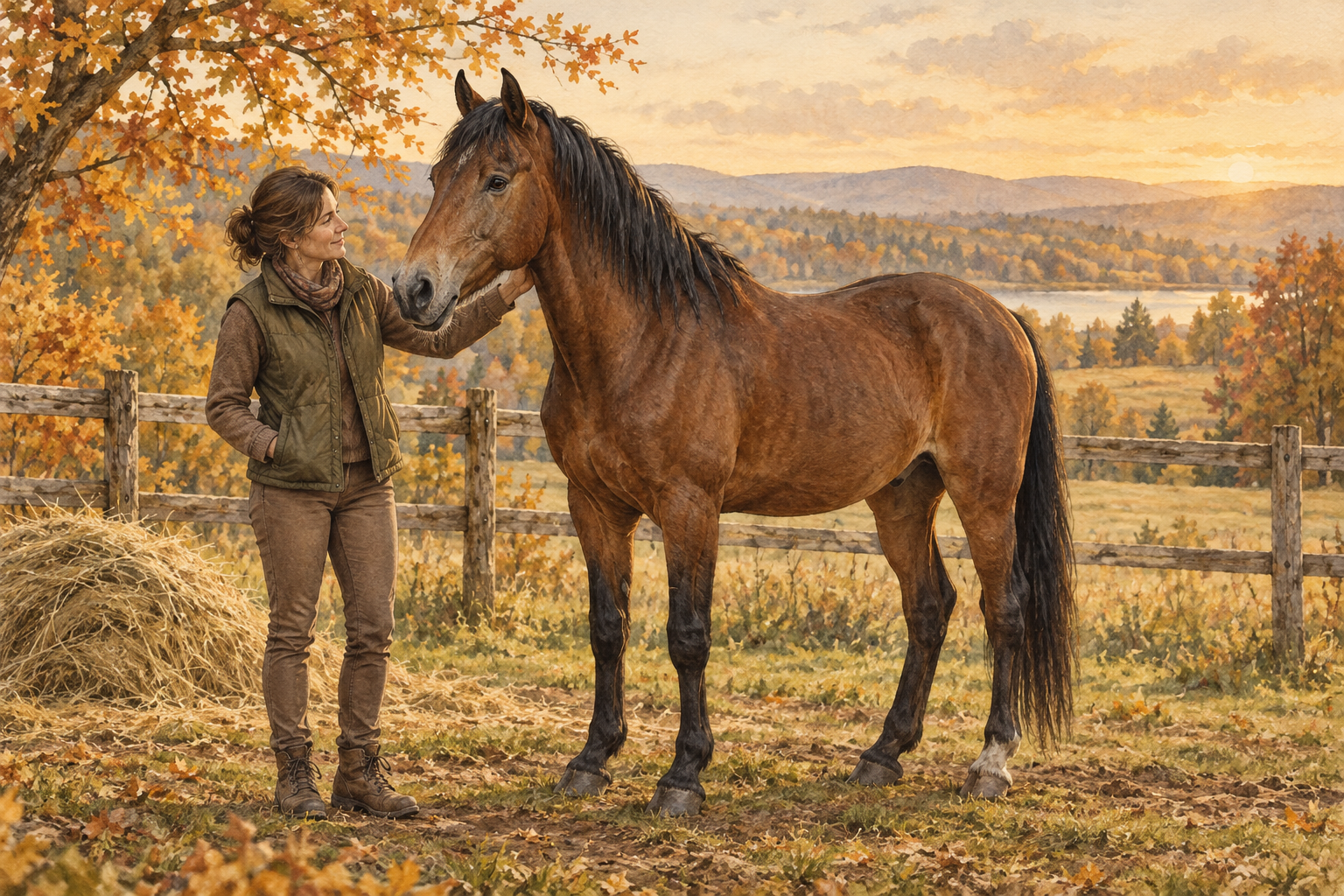
You stand next to your horse, stroke its back and think: Was it that angular a few weeks ago? It does eat though. There's hay, a little extra has long since ended up in the trough - and yet it's getting less. “He’s just getting old,” you quickly hear. This explanation would not be enough for me.
Of course a horse changes over the years. But when weight is lost, I want to understand what's behind it. What does it actually eat? What else can it chew well? Does the herd get its food in peace? And does what we provide every day still fit this horse?
We've already talked about shedding and too much weight here. Today we look at the other side: at horses where we would be happy to have every little bit more on their ribs. It's worth taking this look, especially before winter, before any changes under the thick fur go unnoticed.
“It does eat” is just the beginning
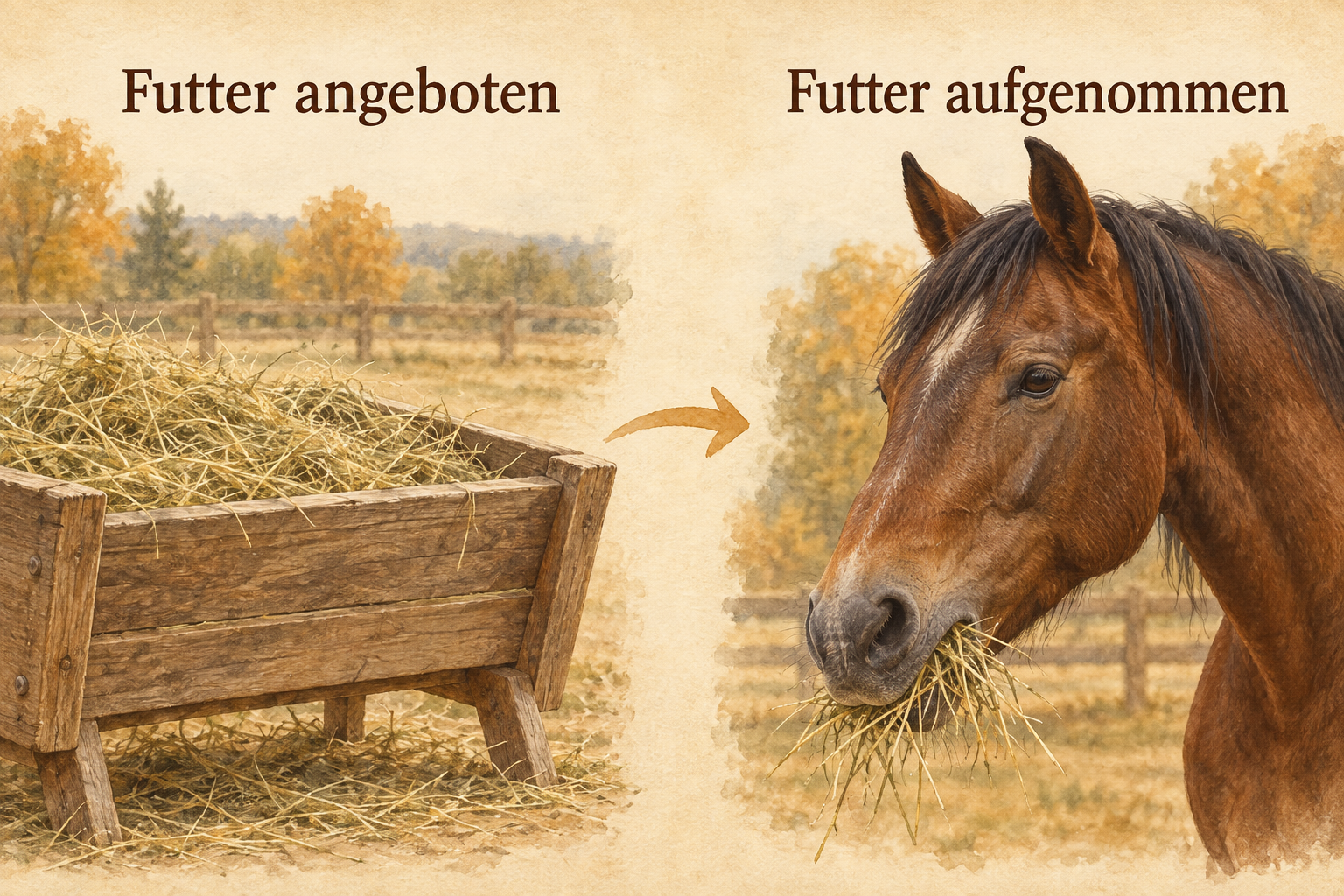
Seeing a horse standing by the hay is calming. Understandably. But it doesn't tell us how much it actually absorbs. Imagine an older gelding who stands at the rack for a long time, has to make room every now and then and keeps dropping food. From a distance it looks like a normal feeding day. Only when you take a closer look do questions arise.
That's why I would consciously observe a meal. Does your horse chew for a noticeably long time? Do little hay wraps fall out of your mouth? Is something left behind that was previously eaten? Switching from soft pasture grass to hay can reveal difficulties, especially if teeth function is limited. This also describes the interest group for functional equine dentistry. [1]
Then the dental check-up is part of it. Depending on the findings, prepared roughage can help to secure supplies. Soaked hay cobs are one option, for example; Preparation and quantity must suit the product and the horse. If necessary, they replace part of the hay and are not just a little extra for in between. [1]
What matters is not just what we put there. What matters is what this horse can actually eat and use.
What we know at Spirit and Valea ourselves
Sandra and I know the question of different needs from our everyday lives. Spirit increases very quickly. Valea stands with him in a paddock box and tends to be too thin. So one needs less, the other more. The same space does not necessarily mean the same need.
This is not a story about a horse losing weight due to age. This is the reason why I would ask more questions about “They all get enough”. How much does each individual receive? Which agreements work in the stable? And how can individual care be organized if the horses need to stay together?
I know that questions like these are sometimes more tedious in everyday life than buying a new feed bag. Nevertheless, for me they belong in any good conversation about feeding. After all, a suggestion has to be feasible even if you have to go to work in the morning and can't stand next to every meal.
Losing weight and losing muscle are not the same thing
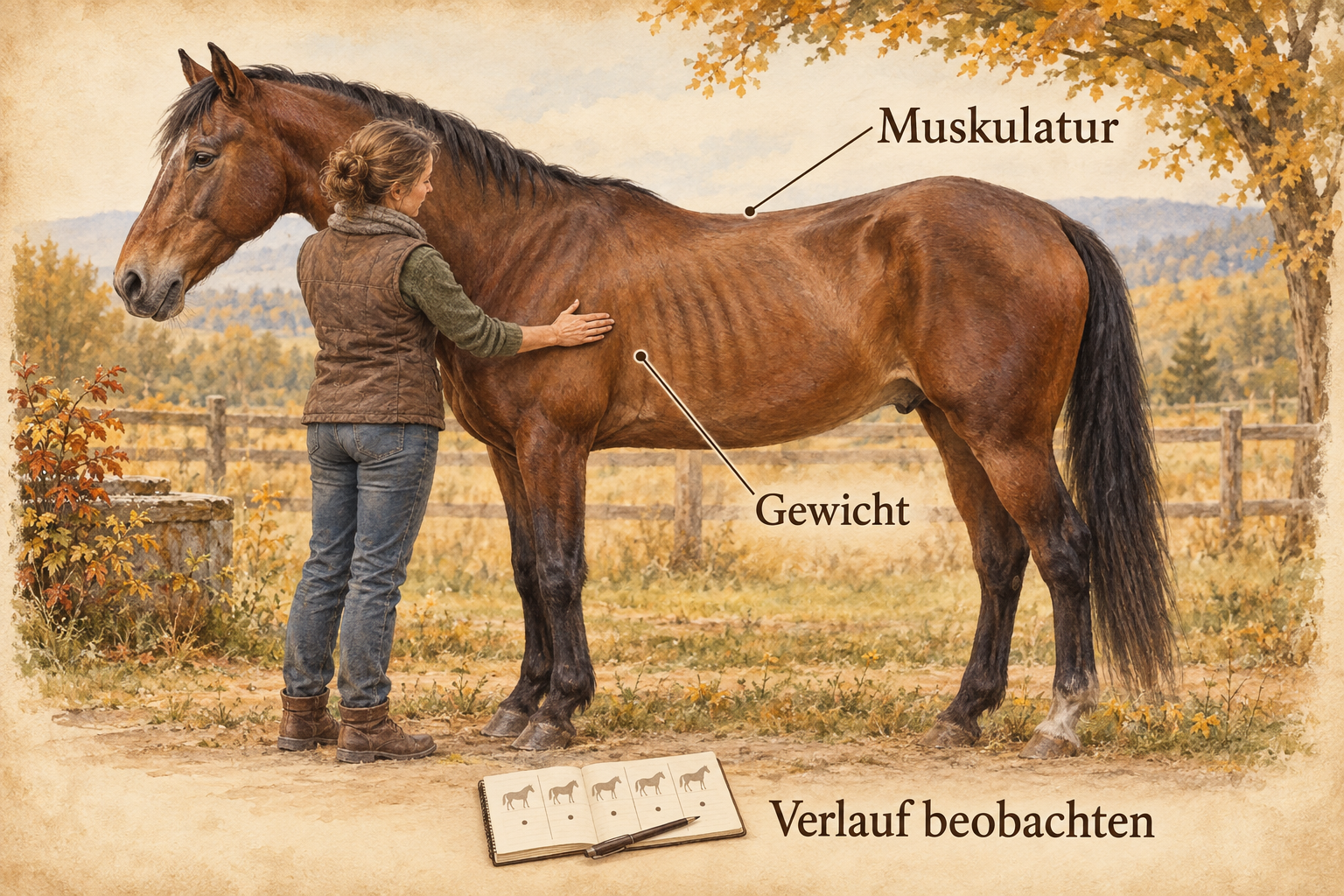
A round belly can hide the fact that a horse is narrowing in other areas. When assessing the condition of the body, we don't just look from the side, but also look at and feel the ribs, neck and base of the tail, among other things. A scale helps with weight control; a weight tape measure is more likely to provide an estimate. Repeated measurements under comparable conditions can make changes visible. [2]
It is also worth taking a look at the top line and the muscles. More weight doesn't automatically mean more muscle. In addition to care, health and appropriate exercise are also important for maintaining muscles. An older horse needs a daily routine that suits his abilities. [3, 4]
Take comparable photos and keep brief notes. When did you notice the change? Has your horse's movement changed? Was there a move to another stable, different hay or an illness? Information like this turns the vague feeling that 'something is wrong' into a record of changes we can discuss properly.
When more food alone doesn't help
If your horse loses weight without explanation, the veterinary assessment is part of it. Dental problems, pain, hormonal disorders such as PPID, and other health causes can affect care. An overview of the nutrition of older horses also mentions limited feed intake due to competition in the herd or pain from osteoarthritis. “Old” is therefore not a sufficient explanation for weight loss. [4]
If a horse loses weight quickly, eats significantly less or appears sick, the examination should not wait for a later consultation. If signs of colic occur, immediate veterinary attention is required. A severely emaciated horse also needs a professionally monitored feeding regimen; a sudden large increase in feed can be dangerous. [2]
In practical terms, this means for our conversation: What has already been examined? What was discovered? What recommendations are there? I would like to include this information. Then we can start where support during feeding and everyday life can be usefully supplemented.
First the basis, then the addition
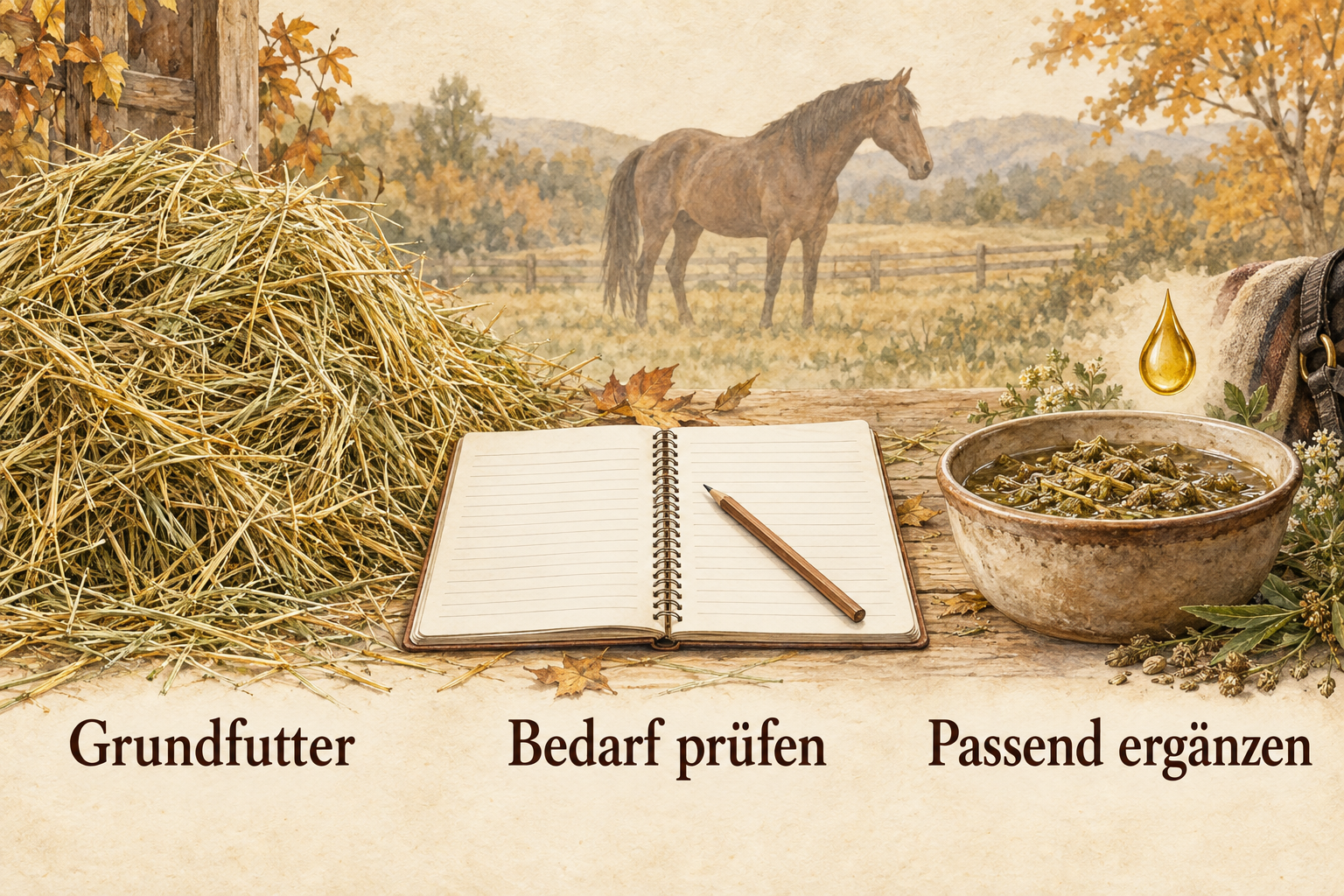
In order to be fed, there must be sufficient usable energy and suitable nutrients. Roughage, protein supply, minerals and the rest of the ration belong together. Oil, for example, provides energy but does not replace protein or roughage. Even a particularly lovingly put together trough is not yet a balanced daily ration. [5]
I would therefore first write down everything: hay, pasture time, soaked feed, concentrated feed and all supplements. If possible, use weighed quantities instead of “a scoop”. When hay is fed together, individual intake is more difficult to assess - that's exactly what should be on the note. We don't have to pretend we have every answer.
Then you can differentiate: Is there actually a lack of energy? Is the food easy to chew? Does protein supply need to be looked at more closely? Or is the combination overall not right? Changes should be gradual and monitored. An older horse that gets along well with its current ration does not automatically need a different feed just because of its birthday. [4, 5]
The intestines age with time – but not according to a fixed calendar
Microorganisms participate in fiber digestion. That's why I'm also interested in what changes there over the course of life. A 2024 study compared 50 horses between six and 30 years old under comparable housing and feeding conditions. The horses examined had no digestive problems and were able to chew their food adequately. Nevertheless, there were age-related differences in the bacterial communities of the feces. [6]
This is an interesting note, not proof of a “broken intestine” in the elderly. The research also did not test any treatment for weight loss. So we cannot conclude from this that every older horse needs the same fiber mixture or that it will gain weight again.
When it comes to advice, the specific question remains: What does this horse's feeding look like, how does it tolerate it and is there a sensible place for supplementary fibers? A small portion of fiber powder cannot replace a missing kilogram of basic feed. The entire supply remains the basis. [5]
Where Omega-3 and a fatty acid profile fit in
When it comes to oil, I would ask two questions: Do we want to change the energy intake or take a closer look at the composition of the fatty acid supply? Both can be related, but they are not the same. Simply giving more oil does not automatically answer the question of which fatty acids the horse absorbs. [5]
A study of 50 healthy adult horses shows that the supply can be reflected in blood values: with a supplement containing EPA and DHA, the corresponding fatty acid levels in the whole blood increased. Different amounts and the change in blood values were examined - not the feeding of losing seniors. [7]
A suitably selected and professionally classified fatty acid profile for horses can therefore help with a specific question about supply. It is not a general deficiency test and does not automatically explain why your horse is losing weight. For me it becomes interesting when the result supports a decision: What is the horse already getting, what do we want to change and how do we check this change?
A suitable supplement has a clear task. We should be able to name this task before it ends up in the feeding trough.
With a clear overview of the winter
You don't have to have all your food questions solved before you get in touch. Especially when there are already several additions on the shelf and there is still uncertainty, a joint look can provide relief. Bring your observations, current feeding and the results of previous examinations.
Sandra and I will look with you to see which information fits together and where something is still missing. Perhaps what is needed above all is better organization of meals. It may be worth taking a closer look at the ration or fatty acid supply. And perhaps this will result in a targeted supplement, the composition and quantity of which must suit the horse.
My wish is that the worried look at the ribs becomes an understandable next step. Write to us using the contact form what you noticed about your older horse. Then we will clarify together whether and how we can support you in a meaningful way.
Sources and further literature
-
IGFP: feeding when dental function is impaired
https://www.igfp-ev.de/infopool-fuer-pferdebesitzer/fuetterung
-
University of Minnesota Extension: Caring for the underweight horse
https://extension.umn.edu/agriculture/animals-and-livestock/horse/caring-for-the-underweight-horse
-
AAEP (2021): 10 Tips for Caring for the Older Horse
https://aaep.org/resource/10-tips-for-caring-for-the-older-horse/
-
Jarvis (2009): Nutrition of the aged horse - overview of care and causes of weight loss
-
Merck Veterinary Manual: Nutritional Requirements of Horses and Other Equids
-
Baraille et al. (2024): Changes of faecal bacterial communities and microbial fibrolytic activity in horses aged from 6 to 30 years old
https://journals.plos.org/plosone/article?id=10.1371/journal.pone.0303029
-
Pearson et al. (2022): Dose-Dependent Increase in Whole Blood Omega-3 Fatty Acid Concentration in Horses Receiving a Marine-Based Fatty-Acid Supplement
This article provides general knowledge. Unexplained weight loss should be clarified by a vet. Our support complements the examination and treatment.
The microbiome study describes connections with age; the Omega-3 study examines blood values. Neither shows evidence of weight gain from a particular supplement. A consultation can include paid analyzes and supplements.
All images are AI-generated illustrations. They show simplified connections and no documented treatment results.
For stables, clubs and practices
Free introductory talk at your location (German)
Understanding equine health. Making a difference together.
Do you run a riding stable, are you involved in a riding club or work in a veterinary practice, in animal physiotherapy or animal osteopathy? And would you like to give your adjusters, members, customers or your team understandable health knowledge?
Then bring us to you for a free introductory talk (German). We talk about feeding, fiber, intestinal health, obesity and the role of exercise - with reference to everyday stable life and space for your questions. We will coordinate the topic, scope and date together.
Select “Free introductory talk (German) for stable, club or practice” in the form and write to us where you are and who you would like to reach.
Is your older horse getting narrower?
Are you already feeding a lot and are still unsure whether it is right for your older horse? Write to Sandra and me what you noticed and what is currently happening. Then we will clarify together whether and how we can support you in a meaningful way. You can also request a introductory talk (German) for your stable, club or practice team here.
Contact: marc@probalance24.com · Write to us via our contact page.
If you would like to know which products we use, please take a look here in the ProBalance shop .
Would you like to find out more about the topic and also read the scientific evidence and studies on this article? Click here.