

What Spirit teaches us about leadership
Why more pressure doesn't always help - and what we learn with Spirit and Valea about clarity, trust and our own impact.
You have a clear idea. You know where you're supposed to go. And your horse stops. Maybe you know this moment: You look at the gate, the horse looks at the hay, and suddenly your beautiful idea of a shared direction is just your imagination. Now you could be more emphatic. Or think briefly about what actually just arrived.
I find moments like this exciting. Not just when dealing with horses. They remind me of situations from my job: a task has been explained, everyone has nodded, and yet everyone goes in a different direction afterwards. Why? There's a lot to talk about. In addition to a horse, some of these things can also be experienced.
Spirit does not read my résumé
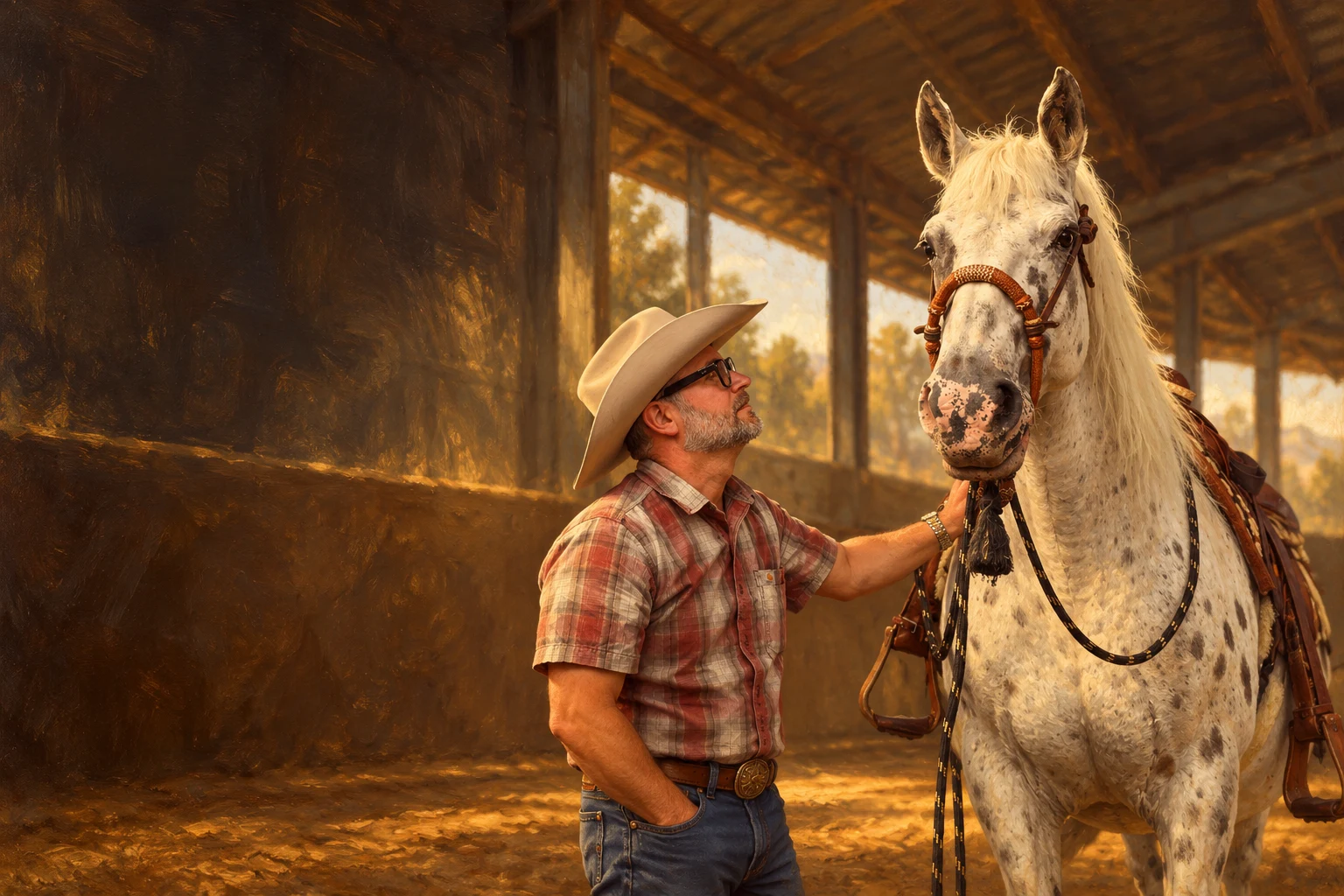
I can explain things, make a case and help people understand connections. I have done this professionally for many years. None of that particularly impresses Spirit. Our light-colored Knabstrupper mare does not know my résumé. She experiences me as I stand before her: my pace, my movements and the signals I give her.
That is what I like about our horses. Sandra and I cannot simply rely on having meant well. We have to pay attention. Was the task clear? Are we actually connecting with one another? Is the timing right? What does the horse need at this moment? When something does not work, asking these questions is often more useful than adding more pressure.
A clear intention is a good start. Understanding only occurs with each other.
Sometimes the path takes less
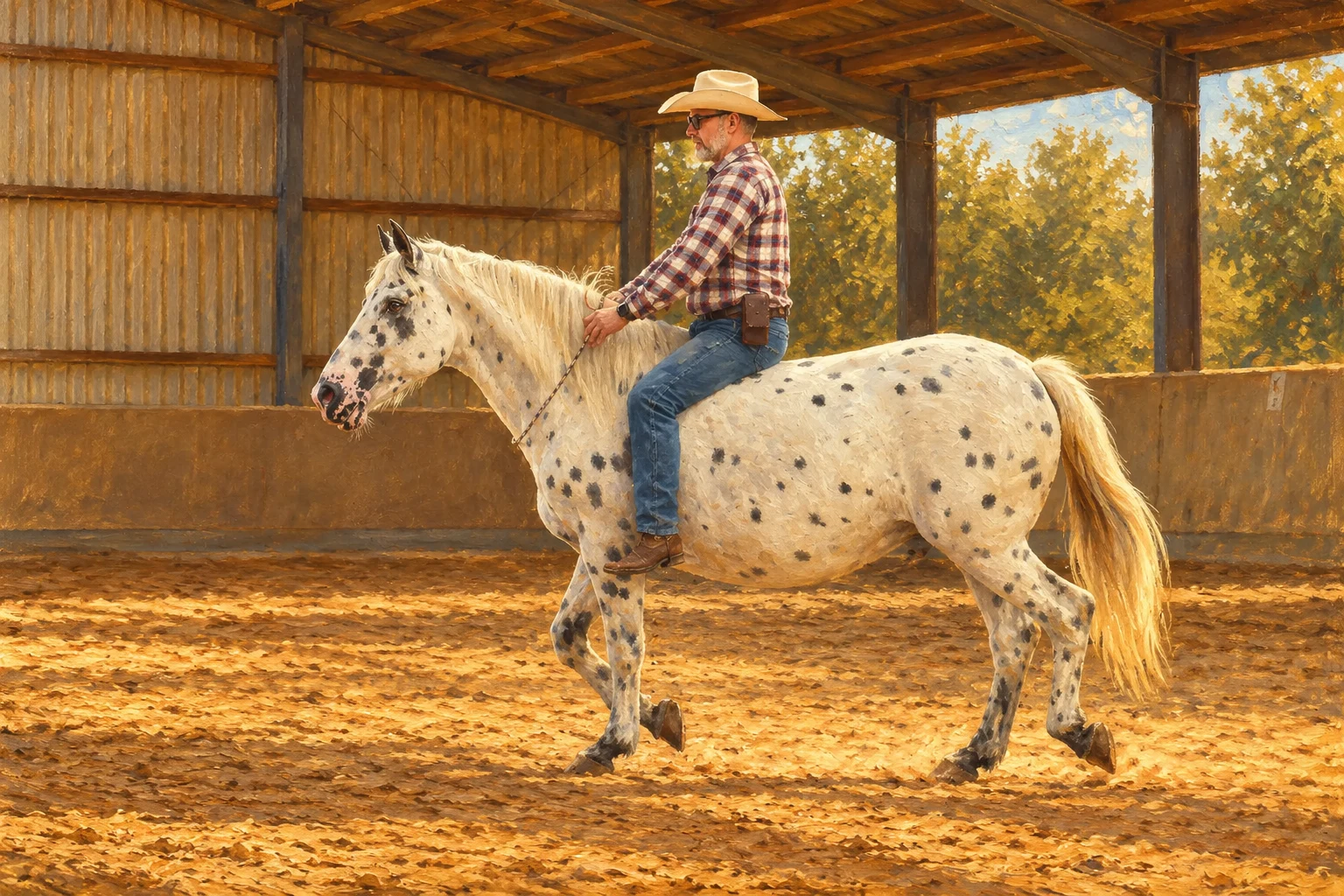
Sandra and I ride bitless. With Spirit, there are now moments when I sit on her without a saddle or bridle, communicating through familiar aids and a neck rope. These moments are special to me. Not because we need to prove anything to anyone, but because I can feel how much shared work and growing trust they represent.
We got there in many small steps. Even with a neck ring, the riding aids don't disappear: my seat, my weight and the rope on my neck still have an effect. And of course, different equipment does not automatically make someone a worse rider. What interests me most about these experiences is the question of how we deal with the resources we have.
Sometimes the answer is to ease off. To ask for fewer things at once. To make a signal clearer. To wait for the right moment. The same applies in my professional life: when someone gets stuck on a task, I can keep asking for updates every hour. Or I can work out what is missing — information, a decision or the freedom to find their own way.
Less pressure does not mean less commitment. A clear goal and a calm agreement can provide a lot of guidance. This also includes noticing whether the other person understands the task in the same way as I do.
What Jenny keeps reminding us of
Our trainer and friend Jenny Drees has had a great influence on our path with Spirit and Valea. Through groundwork, classic handwork and her eye for fine communication, we continue to learn. What I particularly appreciate about her is her willingness to take a closer look before simply demanding more of the same.
Has the horse understood what we are asking? Is the next step possible yet? What do we change in ourselves while waiting for a response? Questions like these can suddenly make a seemingly difficult moment easier to understand. They remind me that becoming impatient does not make learning happen faster.
Trust arises in everyday life. If we remain comprehensible, notice small answers and give our horse time to learn. I also find this attitude valuable when dealing with people.
From everyday stable life to leadership tasks
Maybe you lead a team. Maybe you will take on responsibility in the club or organize something together with others at the stable. Then you probably know situations in which your intentions and the reactions of others do not match. You want to help and are experienced as controlling. You want to be friendly and leave expectations so open that no one knows what has been agreed upon.
An imaginary example: You give someone a task, but then correct every single step in between. You want independence, but you hardly noticeably deprive your counterpart of the freedom to do so. The helpful question then is: Have we just agreed on the goal - or have I already specified every step?
In horse-assisted coaching, a practical task can be an opportunity to observe your own behavior more closely. How fast will I be? When do I lose patience? Am I giving guidance or am I constantly changing my signals? The horse does not provide a finished assessment of my personality. A situation arises that we can look at together.
When a horse stops, it is first an observation. The interesting question is what can I learn from it?
What coaching with horses can look like
At the beginning there is your concern. For example: I want to stay calmer when something goes differently than planned. Or: I want to communicate more clearly without constantly putting more pressure on. This is followed by getting to know each other, a safety briefing and a suitable task from the ground. You don't need any riding knowledge. [1]
A task could be to cover a distance together with a horse or to prepare a change of direction. The important thing is not to create an obstacle as quickly as possible. What will be interesting is what you notice, try out and then discuss with the coach.
The Timmerherm Academy offers horse-assisted coaching individually and in very small groups. There is also horse-assisted team finding for teams. The destination, location, support and time frame are agreed upon personally. Our own ranch continues to be a vision of the future; Coaching takes place at the agreed location. [1]
The horses are also part of it
It is important to me that the horse and its needs are also seen. A task must fit his constitution. This includes breaks, opportunities to retreat and safe handling. When we talk about respectful leadership, this respect should be evident in the encounter with the horse.
Humans also need a suitable framework. Fears, allergies or physical limitations are discussed in advance. Nobody has to force closeness. It's about providing an experience that you can then do something with.
How it should be used in everyday life
For me, the real work doesn’t end at the hall gate. A special day is beautiful. It becomes valuable when it results in a concrete experiment: the next time I delegate, I clarify the goal and scope. In the next tense conversation, I take time to ask a question. Or I endure a pause instead of immediately filling it with another instruction.
Research also makes you curious: A study with 106 people found higher self-efficacy expectations after horse-assisted coaching - i.e. more confidence in their own options for action. The comparison was made with a group without coaching. It has not been shown whether it is superior to other forms of coaching or improves leadership performance in the long term. [2]
A 2025 publication looks at six cases to explore how equine-assisted coaching can work. It offers interesting ideas for support and reflection, but it is not a large efficacy study. For me, a sensible aim remains to notice something about myself, try a new approach and see what changes in everyday life. [3]
Maybe it starts with a different question
Spirit and Valea continually remind Sandra and me that collaboration requires attention. Our horses have their own history, their needs and their daily form. That's exactly why an encounter with them can set so many things in motion - if we're willing to look at ourselves too.
Maybe the next question isn't immediately: How do I get my counterpart to do this? But rather: What can I make more understandable? Where is a clear agreement needed? And where could I let go of some control without relinquishing responsibility?
If this idea appeals to you, you will find further examples from companies and job centers as well as information about horse-assisted coaching in the detailed academy article. Or write to us here about what concerns you. Together we will clarify which framework suits your concerns.
Read more and deepen
Jenny Drees: What we take away from groundwork
Read the ProBalance article
Understanding bridles: How do our signals arrive?
Read the ProBalance article
Understanding the Bosal: Balance and fine riding aids
Read the ProBalance article
Sources and further literature
-
Timmerherm Academy: Leadership training with horses – personal initial contribution, process and linked offers.
https://t-akademie.de/wissen-impulse/fuehrungskraeftetraining-mit-pferden-coaching
-
Schütz and Steinhoff (2019): Influence of horse-assisted coaching on self-efficacy. Comparative study with 106 people; no long-term measurement of leadership performance.
-
Friesenhahn (2025): Empirical investigation of the effectiveness of horse-assisted coaching Part 2. Exploratory process research with six cases from an earlier dissertation project.
The personal experiences concern our everyday life with Spirit and Valea. The professional situation is a developed example, not a report about a coaching participant.
The research provides information on self-efficacy and possible coaching processes. It does not prove guaranteed success for every manager.
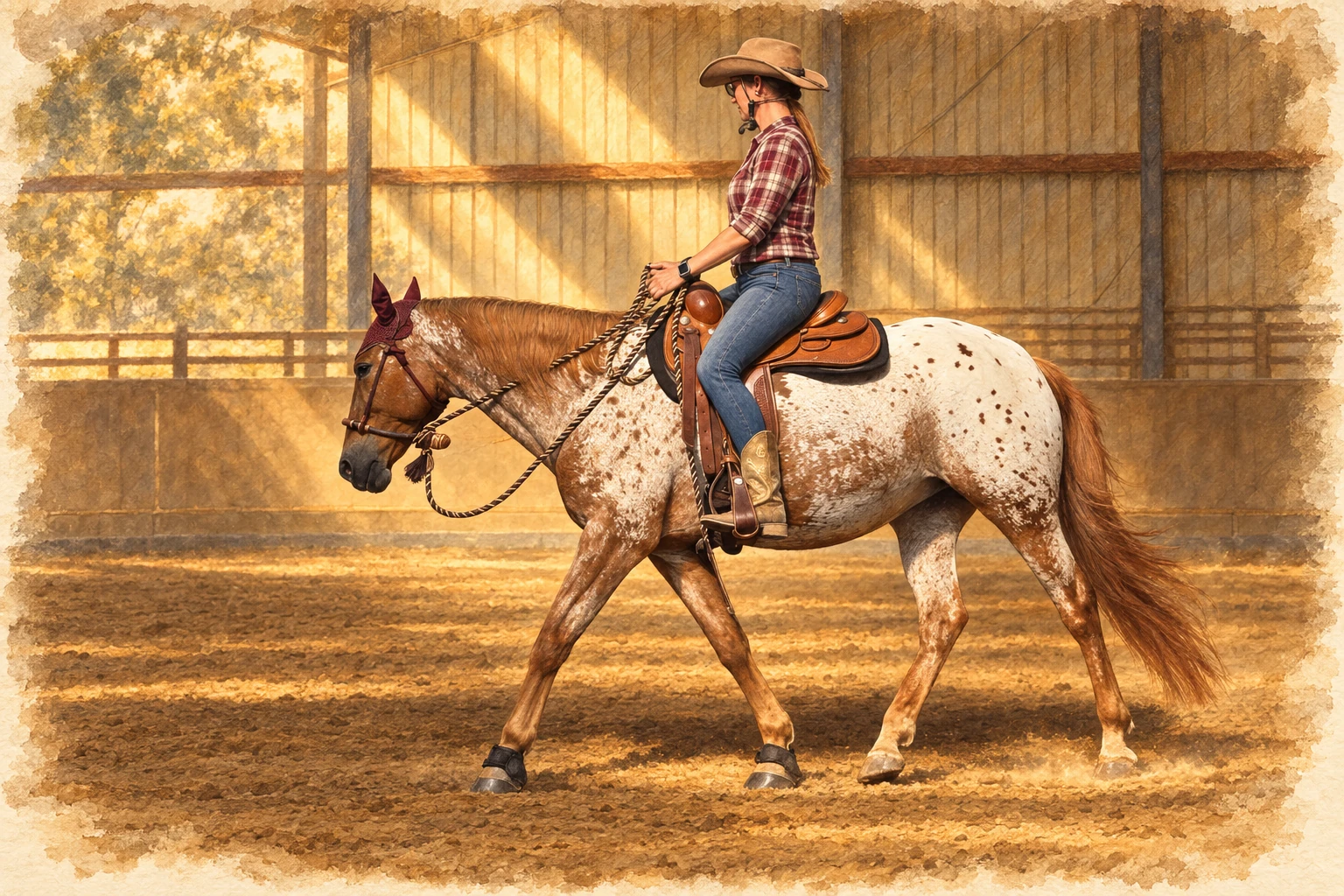
The painting-like motifs are AI-generated illustrations based on our personal photos. They show our everyday life with horses, not documented coaching participants.
To the detailed article from the Timmerherm Academy
https://t-akademie.de/wissen-impulse/fuehrungskraeftetraining-mit-pferden-coaching
An impulse for your cooperation
Clarity and trust begin in togetherness.
Would you like to talk to your team about leadership, communication and responsibility? A introductory talk (German) can address typical everyday situations and open up new questions about your own impact.
A lecture at your location will take place without horses. We arrange horse-assisted coaching and team building as our own formats through the Timmerherm Academy. We personally coordinate the topic, location and scope.
What would you like to know about your own impact?
Are you interested in horse-assisted coaching, team building or a lecture on leadership and communication? Tell us briefly about your concern. Together with the Timmerherm Academy, we clarify which framework, location and support are suitable.
Contact: marc@probalance24.com · Write to us via our contact page.
If you would like to know which products we use, please take a look here in the ProBalance shop .
Would you like to find out more about the topic and also read the scientific evidence and studies on this article? Click here.