

When your dog struggles to keep up at the stable: Osteoarthritis, movement and omega-3
What you can observe in everyday life, what studies show about Omega-3 and why a suitable supply is more than a dash of oil in the bowl.
The last few posts have been a lot about our horses. About feeding, intestinal health and about noticing changes in a timely manner. Today I would like to look a little deeper. To the four-legged friend that many of us come to the stable with us as a matter of course.
The dog.
He waits next to the tack room, accompanies us to the paddock and is somehow always part of it. In addition to Spirit and Valea, Sandra and I also have Benny and Nala in the family. That's why dog health has its place on this page for me.
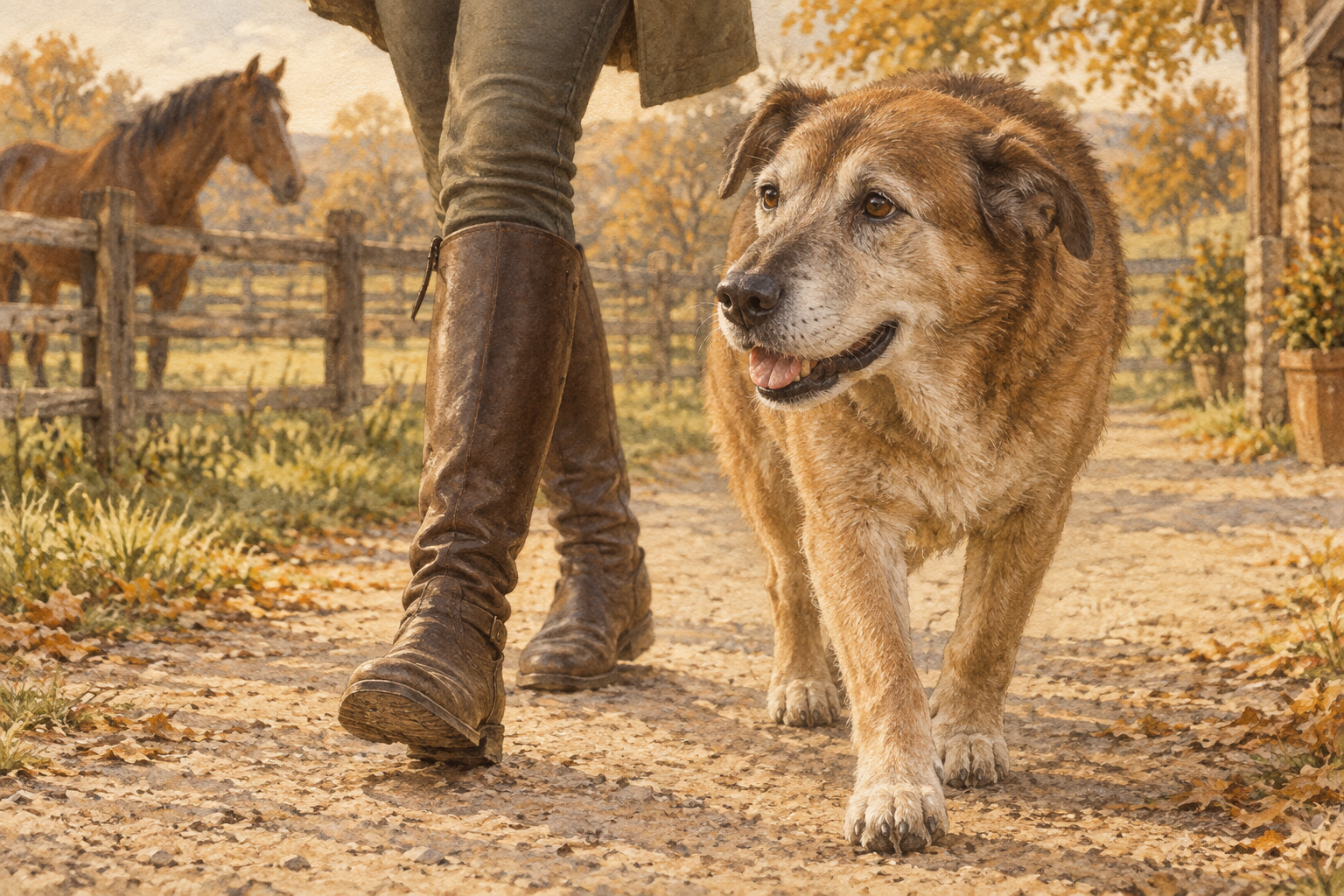
And maybe you know this situation: your dog used to be there straight away. Now he stays there a moment longer. Jumping into the car is canceled. On the way to the stable he walks behind you instead of next to you. You quickly think: he's just getting older. But what if it just hurts him?
Small changes deserve a second look
A dog doesn't have to yelp loudly for pain to change its everyday life. Sometimes it's more noticeable what he doesn't do anymore. He plays for shorter periods of time, gets up more hesitantly or looks for other places to lie down. Such observations are valuable, even if they alone do not provide a diagnosis. In addition to the examination, the veterinary pain assessment explicitly takes into account the experiences of the people who see the dog on a daily basis. [1]
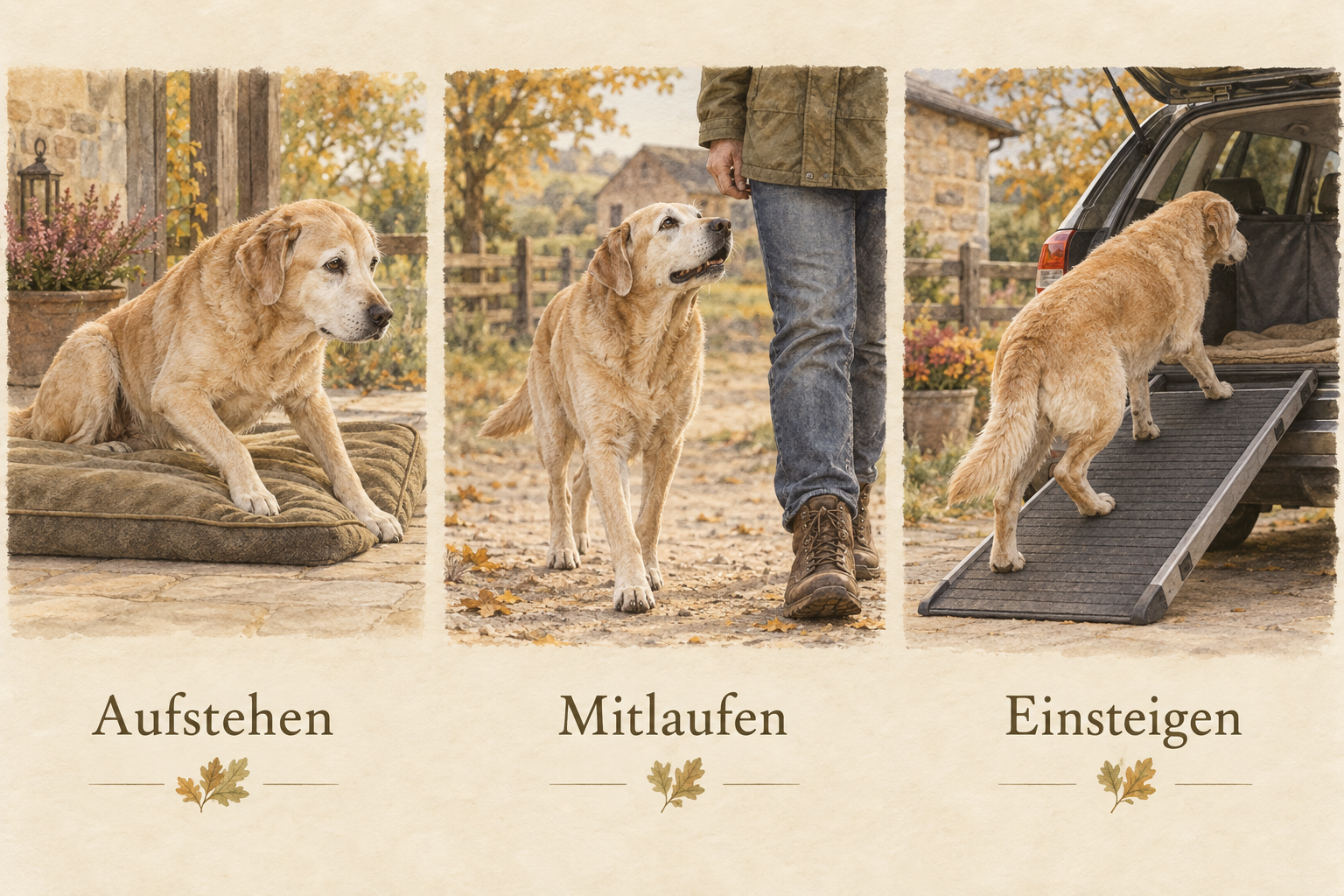
For everyday stable life, I would look at three things: How does your dog get back on its feet after a rest break? How does he keep up with a familiar round? And how does he manage to get into the car? A short video from a normal, everyday situation can be more helpful when speaking to the veterinary practice than “Somehow he is different”. [1]
Perhaps osteoarthritis has already been diagnosed. Perhaps it first needs to be clarified where the change comes from. Both are a good reason to take a closer look. If you suddenly experience severe lameness or significant pain, your dog needs veterinary help as soon as possible.
Getting older is a part of life. Simply accepting changes without taking a closer look does not have to be part of it.
The stable day can be beautiful – but still tiring
For us it's a normal afternoon: fetch the horse, clean it, ride it, bring it back. Our dog runs along from time to time, waits, gets up again and lies down somewhere else. If exercise causes discomfort, even this seemingly incidental part of the day deserves attention.
An easily accessible, protected place to lie down and safe ground can make everyday life easier. A suitable ramp can replace jumping into the car. In the case of osteoarthritis, appropriate body weight, appropriate exercise and treatment of the pain also come together. Veterinary guidelines consider these measures to be part of a joint accompaniment. [2]
This doesn't mean taking the dog out of everything. It means taking your options seriously. Which ways are good for him? When does he need a break? Which load corresponds to his findings? These questions can be clarified together with the treating practice and, if necessary, animal physiotherapy.
And then it's worth taking a look into the bowl.
Omega-3 for osteoarthritis: It's worth taking a look at the research here
There is a lot of talk about joint supplements. When it comes to omega-3, there are actually studies on dogs with osteoarthritis. I think this is important: we don't just have to transfer experiences from horse or human health to this context.
A 2022 systematic review evaluated studies on various supplements and fortified feeds. The authors found evidence of a pain-relieving effect in osteoarthritis for diets and supplements containing omega-3. However, the individual studies differed in quality, composition and implementation. The result is a basis for dealing with Omega-3 - no guarantee of success for every bottle and every dog. [3]
A randomized study with 131 dogs examined an omega-3-enriched diet in addition to existing pain treatment. In the corresponding group, the dosage of the painkiller was reduced more over time than in the comparison group. The treating veterinarians made this adjustment. A specific feed was examined, not our oil; A feed manufacturer was involved in the study. [4]
For me, the practical question is: Can a specifically tailored omega-3 supply meaningfully complement the support of this dog? It's worth having a conversation about. Medications are not reduced or discontinued on your own initiative.
Why “a little oil” is not yet a suitable supply
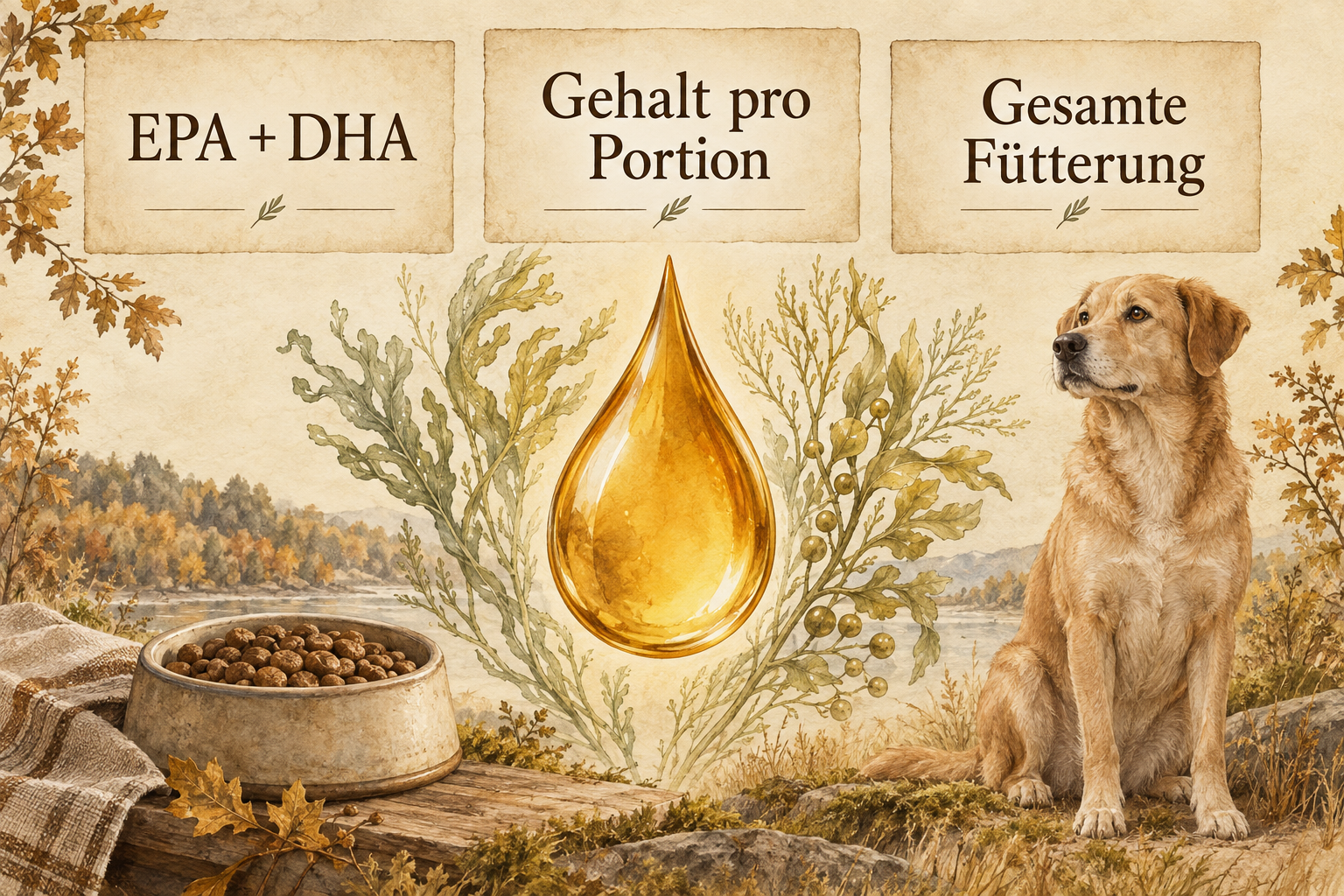
With Omega-3 you will encounter different fatty acids. When it comes to supporting dogs with osteoarthritis, EPA and DHA are particularly important. The decisive factor is what quantities of it are provided by the total daily feeding. Exactly these two fatty acids are also taken into account in the international COAST recommendations for the treatment of osteoarthritis in dogs. [5]
A teaspoon initially says something about the amount of oil. The composition reveals how much EPA and DHA it contains. And if the previous food is already enriched with it, this proportion is also included in the calculation.
When choosing, we don't just look at a nice label. We look at the content per serving, the complete recipe and what your dog is already getting. Other added nutrients and additional energy must also match the overall supply. A dosage specification for humans cannot simply be transferred to a dog.
If you are looking for a plant-based option, you can have a suitable EPA and DHA source from microalgae checked. The specific composition remains important here too. “Herbal” alone does not say anything about the appropriate amount or proven benefit for osteoarthritis. [6]
The crucial question is: What is your dog already getting - and which supplement really fits with it?
What the feedback from practice means to us
We always receive positive feedback from people who support their dog with osteoarthritis with the oil we provide. These experiences are an important reason for us to focus intensively on care and individual application.
I think such reports have their place. Behind every feedback there is a person who cares about their animal. At the same time, customer reports are not a controlled study of our product. When something changes, exercise, weight, medications, and other measures may also be involved. That's why we talk about experiences without making a promise for your dog.
For us, this means one thing above all: we want to accompany you in the selection and application. Which recipe is suitable? What amount is appropriate for current feeding and health situation? What should be agreed with the veterinary practice? For me, these are exactly the questions that are part of sensible advice.
Test, dose and keep an eye on the progress
You might also want to know what your dog's fatty acid supply looks like. We can then clarify together whether a suitable blood test makes sense for this specific question and how the result can be classified technically. You can find out more about the options, process and tailored support from us.
A fatty acid profile describes the fatty acids measured. It does not diagnose osteoarthritis or show how much pain a dog is in. For this, examination and everyday experience remain crucial. Human target values are also not a standard that should be transferred to dogs without checking.
I would therefore like to bring the two together: comprehensible care and an honest look at the process. For example, note how easily your dog gets up, how he manages a familiar lap and whether he likes to move. Also record when food, supplements or treatment were changed. This way, the next time we talk, we can discuss in more detail what has actually changed. [1]

Your dog is part of it. His health too.
We think a lot about the care of our horses. I think the dog next to the tack room deserves the same attentive look. He should be able to feel comfortable in his everyday life - on a walk as well as at our side in the stable.
If you would like to take a closer look at your dog's omega-3 supply, write to Sandra and me. Tell us what you notice, what has already been examined and what food and supplements your dog gets. Then we will clarify together which support, which individual dosage and, if necessary, which analysis is right for you.
You don't have to put this together solely from contradictory tips and different bottles. That's exactly what we're here for.
Sources and further literature
-
AAHA (2022): Chronic Pain Assessment in Dogs – observations in everyday life and veterinary pain assessment
-
AAHA (2022): Nonpharmacologic Modalities for Pain Management – Weight, Diet, Exercise and Environment
-
Barbeau-Grégoire et al. (2022): A 2022 Systematic Review and Meta-Analysis of Enriched Therapeutic Diets and Nutraceuticals in Canine and Feline Osteoarthritis
-
Fritsch et al. (2010): A multicenter study of the effect of dietary supplementation with fish oil omega-3 fatty acids on carprofen dosage in dogs with osteoarthritis
-
COAST Development Group (2023): International consensus guidelines for the treatment of canine osteoarthritis
-
Dahms et al. (2019): Safety of a novel feed ingredient, Algal Oil containing EPA and DHA, in a gestation-lactation-growth feeding study in Beagle dogs
This article provides general knowledge and does not replace a veterinary examination or treatment. The selection and dosage of a supplement are considered individually.
The sources examine specific feedings and supplements or provide expert recommendations. They are not proof of effectiveness for our specific oil. Customer reports describe personal experiences. The algae oil study examines tolerance and fatty acid intake, not the treatment of osteoarthritis.
All images are AI-generated illustrations. The last picture is based on photos by Marc, Sandra and Nala and shows a designed scene. The other dogs shown are not depictions of Benny or Nala. No documented treatment results are shown.
For stables, clubs and practices
Free introductory talk at your location (German)
Understanding equine health. Making a difference together.
Do you run a riding stable, are you involved in a riding club or work in a veterinary practice, in animal physiotherapy or animal osteopathy? And would you like to give your adjusters, members, customers or your team understandable health knowledge?
Then bring us to you for a free introductory talk (German). We talk about feeding, fiber, intestinal health, obesity and the role of exercise - with reference to everyday stable life and space for your questions. We will coordinate the topic, scope and date together.
Select “Free introductory talk (German) for stable, club or practice” in the form and write to us where you are and who you would like to reach.
What does your dog need right now?
Would you like to know which oil, which individual dosage or which test could be suitable for your dog's care? Write to Sandra and me what is bothering you and what your dog is already getting. Together we will clarify the next steps. You can also request a introductory talk (German) for your stable, club or practice team here.
Contact: marc@probalance24.com · Write to us via our contact page.
If you would like to know which products we use, please take a look here in the ProBalance shop .
Would you like to find out more about the topic and also read the scientific evidence and studies on this article? Click here.