


Lame again? When joints, muscles and inflammation keep causing problems
Do you know this moment? The therapist was there, the horse ran really well afterwards, the back was soft, the muscles were finally relaxed and you thought: Now we have it. Three days later, the horse is out of rhythm again, the hoof joint is having problems again or the back feels tight again. Maybe you'll even hear the sentence for the third time this year: "There's inflammation again." And at some point you rightly ask yourself the question: Why does this keep happening?
It's exactly this question that I find more exciting than the question of which remedy you could try now. Because inflammation is not fundamentally a bad thing. It is part of a normal repair process. The body reacts to injuries, overload or tissue damage, activates defense and repair mechanisms and tries to restore order. It only becomes a problem when this process does not come to a permanent halt, is repeatedly restarted or the body as a whole does not have the conditions to regenerate properly.
A diagnosis does not always explain why something returns
Inflammation of the hoof joint, spats, kissing spines, problems with the cervical spine, muscle and joint pain, imperfect timing or recurring lameness are very different topics and of course need to be properly clarified by a vet or therapist. If a horse is lame, it must first be clarified where this lameness comes from. Hooves, tendons, ligaments, joints, back, saddle, training load and other possible causes are on the table.
But then the second level of consideration begins for me: Why exactly does this horse always react so sensitively? Why does one treatment last for weeks on one horse, while the other heals after just a few days? Why does a joint flare up again and again, why does the muscle regenerate poorly or why does one horse remain significantly more vulnerable than another under comparable stress?
This is exactly where it gets interesting because you are no longer just looking at the painful area, but at the whole horse.
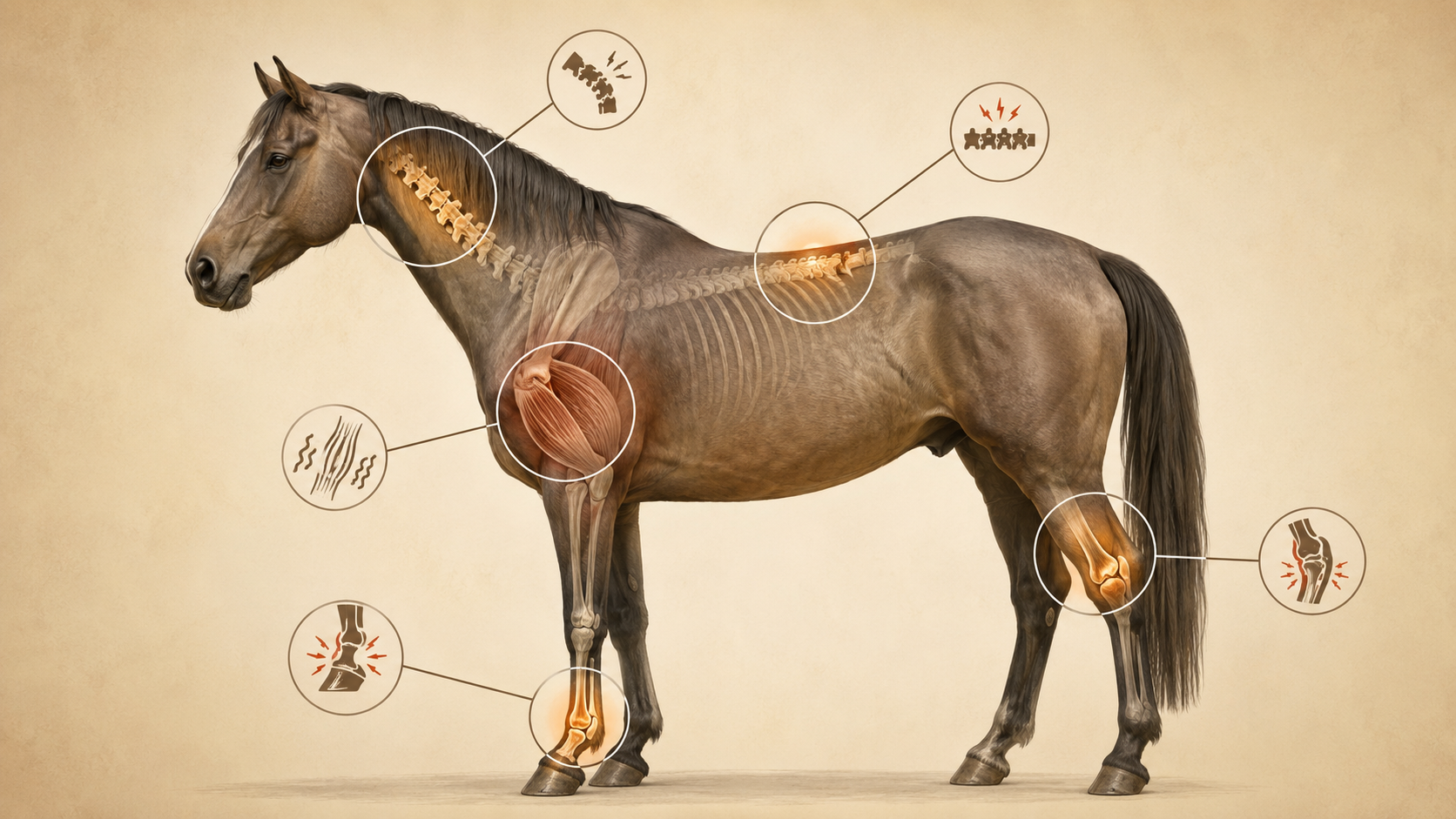
When treatment only helps for a short time
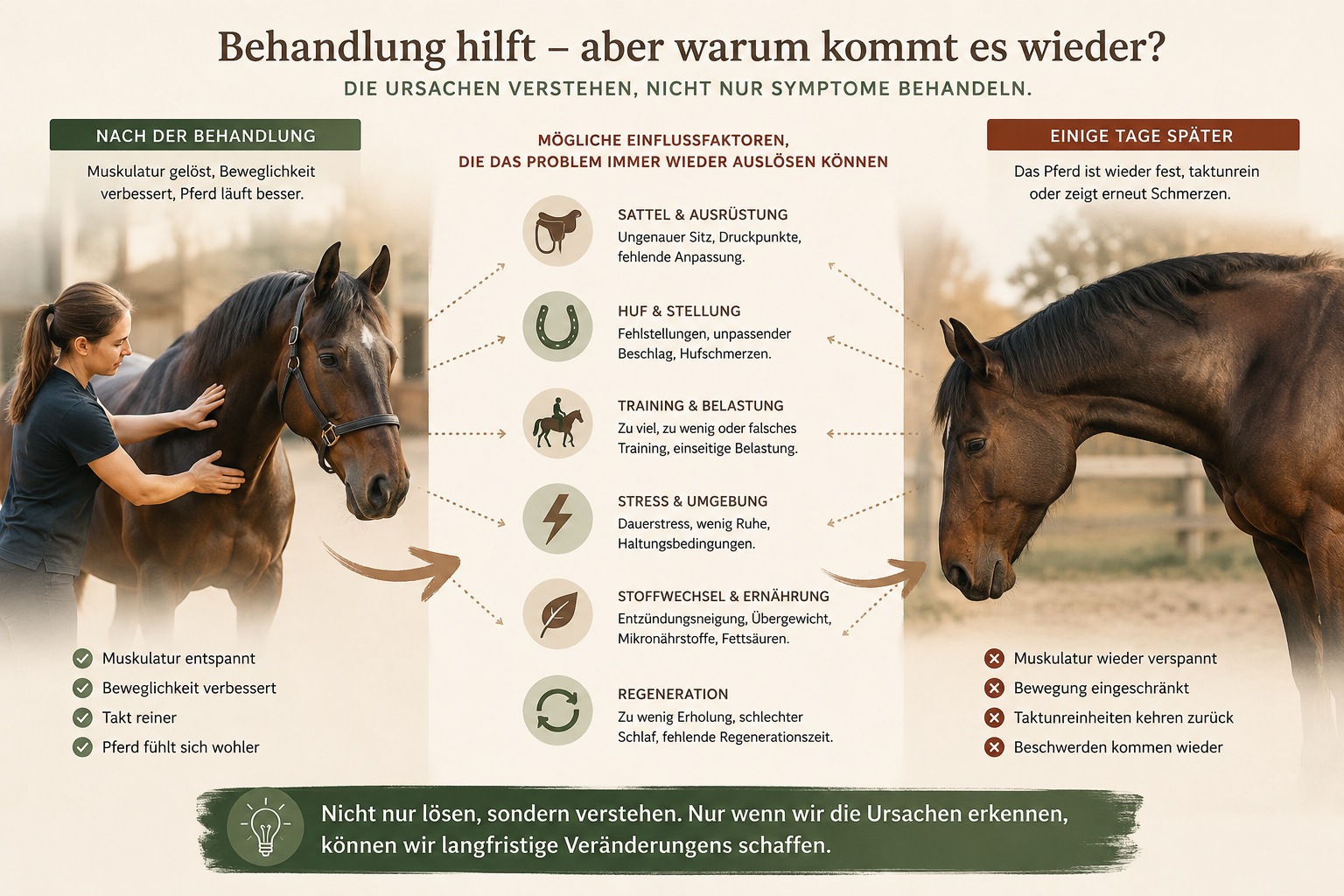
One thought from a specialist lecture that particularly stuck with me was exactly this typical image: a horse is being treated, the muscles let go, mobility improves and at first everything looks much better. A few days later the horse is stable again. Then you can of course treat again - but at some point you should ask yourself what factors keep pushing the body back into this old pattern.
This can be quite banal mechanical. An unsuitable saddle remains an unsuitable saddle, a problematic hoof condition does not go away with a massage and a training error can overwhelm the same structures again and again. But stress, lack of regeneration, metabolic stress or an insufficient supply of nutrients can also play a role. A muscle can only work properly if the conditions are right: it must be able to tense, but it is just as important that it can then let go again.
Muscles need more than just good treatment
Therapists can make an incredible difference, but no therapist can stand next to the horse every day. If a horse is constantly working under an incorrect load, is constantly under tension or has certain metabolic and supply problems, treatment can quickly fizzle out. To me, it's a bit like a tire that's constantly losing air: Of course you can re-inflate it every morning, but at some point you might want to look for the hole.
This is exactly how I see recurring muscle problems. If a horse runs better for a short time after each treatment and then becomes firm again, this does not automatically mean that the treatment had no effect. Rather, it may be an indication that the root cause, or at least an important part of it, is not yet fully understood.
And that's exactly why, for me, training is an essential part of this consideration. A horse with back problems not only needs treatment, but also exercise that suits his condition. A horse with recurring joint problems needs intelligent load control. A horse with weak or tense muscles doesn’t just need “more training,” but the right training. Incorrect exercise can increase symptoms, while targeted, adapted training can help the body become more stable, mobile and resilient.
Osteoarthritis, joints and lameness: the local problem remains important
With all this holistic consideration, one thing must not happen: that we explain away a specific orthopedic problem. Osteoarthritis is osteoarthritis. An inflamed joint structure must be taken seriously. A tendon injury requires appropriate diagnostics and rehabilitation. Kissing spines don't go away just by talking about Omega-3. And lameness should not be “covered up” with nutritional supplements.
But the crucial point is: The diagnosis does not automatically answer all questions about the course of the disease.
Particularly when it comes to chronic or recurring complaints, the question that becomes particularly interesting to me is what conditions we create in the rest of the body. How well does the horse recover? How are his muscles built? What is his weight? How does it move in everyday life? How high is the stress? What is the husbandry like? Does it have enough free movement? Does the herd fit? Are there enough rest periods? What does the supply look like?
Because a joint does not live separately from the rest of the horse.
Inflammation does not occur in a vacuum
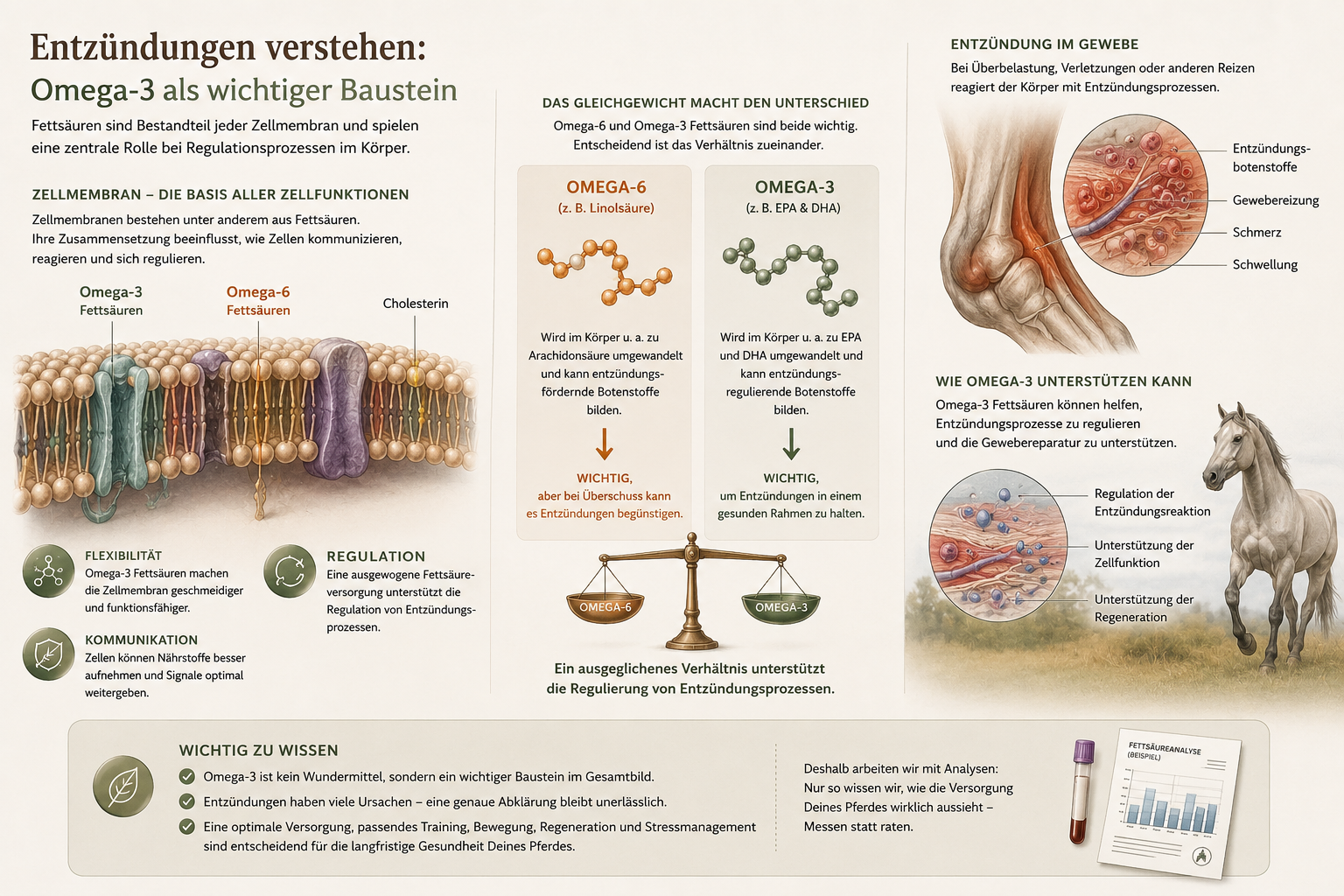
When tissue in the body is irritated or injured, complex inflammatory processes arise. This initially makes physiological sense, because without this reaction healing and repair processes could not proceed properly. At the same time, the organism must be able to shut down and regulate these processes.
That's exactly why I find it so exciting to not just ask when symptoms recur: Where is the inflammation? But also: What overall condition is this horse in?
What is the supply of important nutrients like? What is the fatty acid composition? Is there evidence that certain areas are significantly out of balance? What is the general metabolic situation like?
This does not mean that all lameness is caused by a nutrient deficiency. That would be far too simplistic. But it does mean that with a horse that has been developing the same problems over and over again for months, at some point you should know more than just: “Something is infected again.”
Omega-3: Not a miracle cure, but an exciting building block
Omega-3 fatty acids are part of cell membranes and play a role in various regulatory processes in the organism. EPA and DHA in particular are often considered in connection with the regulation of inflammatory processes. At the same time, omega-6 fatty acids are also indispensable - what is important is not to generally regard one side as good and the other as bad, but rather to classify the supply as a whole in a meaningful way.
And this is exactly where “measuring instead of guessing” becomes important for me.
Because just because a horse gets an oil, we don't know what his actual fatty acid supply is. Just because a feed bag says “Omega-3” does not automatically mean that the organism is optimally supplied. And just because a horse looks good on the outside doesn't say anything about how certain fatty acids present in the blood.
That's why we like to work with analyzes when it makes sense.
A fatty acid profile can show, among other things, how different fatty acids relate to each other and what certain markers derived from them look like. This is not a diagnosis of “inflammation in the joint” and does not replace an orthopedic examination. But it can be another piece of the puzzle if we want to understand how good or bad a horse's care situation currently looks.
Measure rather than guess
This sentence now applies to almost all areas of health management.
Of course, observation remains incredibly important. Nobody knows a horse as well as the person who sees it every day. But observation and measurement are not mutually exclusive – on the contrary. They complement each other.
If a horse keeps running stiffly, we can observe it. We can observe if things regularly get worse after stress. We can observe if the muscles constantly become tight or a joint is repeatedly abnormal. But at some point I would also like to know: What does the blood show? What does the supply look like? Which values are noticeable? Does this match what we see in the horse?
The more information we have, the less we have to guess.
And for me that is exactly the difference between “Let’s try something out” and structured health management.
Movement is not the problem – incorrect movement can be
Exercise is a huge issue, especially if you have osteoarthritis, back problems or recurring imbalances. And exercise is often either completely overestimated or completely underestimated.
Simply protecting a horse is not automatically the best solution. Likewise, it makes no sense to simply continue training as before if a horse is obviously having problems. What matters is which movement makes sense at the moment.
This can be free movement. It can be controlled step training. It can be groundwork. It can be targeted muscle building. It can mean re-developing certain movement patterns or setting training stimuli differently.
Especially when it comes to illnesses, good training is not just sport. It's management.
And it takes experience.
Why we work as a team
That's exactly why we try not to look at such cases from a single perspective.
In our network we work with veterinarians, physiotherapists, osteopaths and independent certified laboratories. At the same time, our team also includes trainers with a lot of practical experience in dealing with various health restrictions and more complex illnesses.
This is an important point for me, because sometimes the answer lies not only in the laboratory values and not only in the X-ray image. Sometimes you have to look at how a horse actually moves, how it is trained, how it is stressed, what happens in everyday life and where the same unfavorable patterns may arise again and again.
A good trainer is no substitute for a veterinarian. A laboratory does not replace a physiotherapist. And a nutritional concept does not replace correct training.
But when these areas talk to each other, something very meaningful can emerge.
What we would look at if there were recurring complaints
If someone contacts us with a horse that is repeatedly out of rhythm, constantly developing muscle problems or regularly showing inflammatory joint problems, our approach would not be: “Take this one product.”
We would rather ask: What has already been diagnosed? What was examined using imaging? What do the hooves and saddle look like? How is the horse kept? How much free movement does it have? How is it trained? What does the weight look like? What is being fed? What analyzes already exist? What does the fatty acid supply look like? And what do owners, trainers, therapists and veterinarians each observe?
Only when this information comes together does a picture emerge.
And sometimes this picture shows quite quickly that something should be started in a place that hardly anyone had thought of before.
An inflamed joint is never just “a joint”
Of course, in this specific case the inflammation may be in the hoof joint. Of course, a back problem can be caused by the spine. Of course, the cause of lameness can be in a tendon.
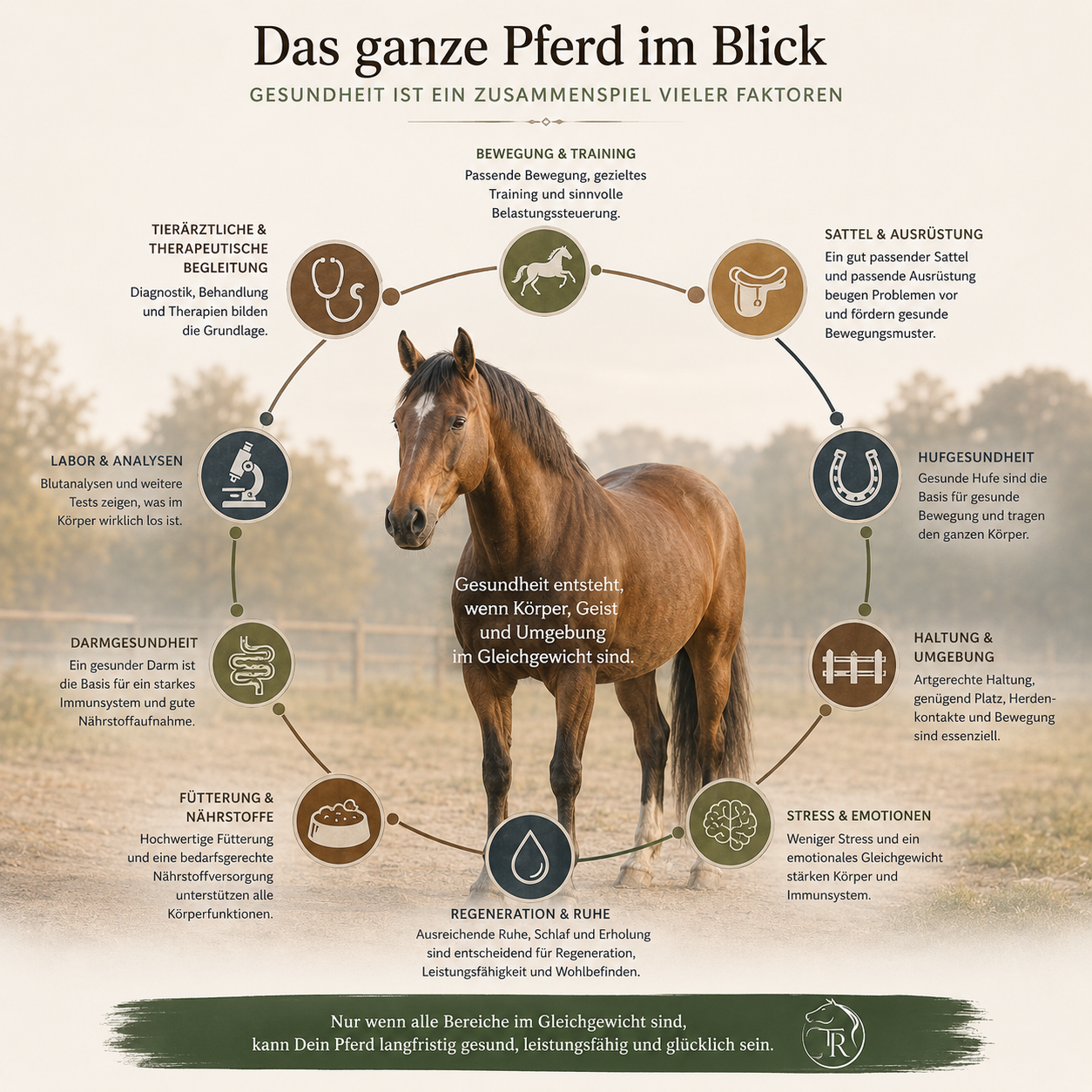
But the horse that has to supply, move and regenerate this structure does not just consist of this one joint, this muscle or this tendon. It consists of a whole organism.
That's why, for me, husbandry, training, exercise, stress, regeneration, feeding, intestinal health, nutrient supply, metabolism and cell function are always taken into consideration - not instead of a clean diagnosis, but in addition to it.
For me, that is exactly what holistic health management is.
If something keeps coming back, it's worth taking a second look
A single injury may simply be bad luck. Acute inflammation can resolve fully. But if a horse repeatedly falls back into the same pattern, I would eventually ask more than just, 'What can we treat this time?'
I would ask: Why is it coming back? What might still be missing from our overall picture? Which factors have we not yet considered? And what can we measure instead of continuing to guess?
Because sometimes the most exciting insight is not the next diagnosis, but the understanding of why the body keeps returning to the same point.
And that's exactly where real prevention begins for me.
If you are stuck with recurring lameness, joint problems, muscle tension or abnormal regeneration with your horse, please feel free to contact us. We don't look at such situations from just one perspective, but rather, together with the right experts, we try to find out which pieces of the puzzle fit together in a meaningful way - from diagnostics and laboratory, to husbandry and care, to training and exercise.
If you would like to know which products we use, please take a look here in the ProBalance shop .
Sources and further literature
Would you like to find out more about the topic and also read the scientific evidence and studies on this article? Click here.