


Does modern horse feeding have an omega-3 problem? How the natural diet differed
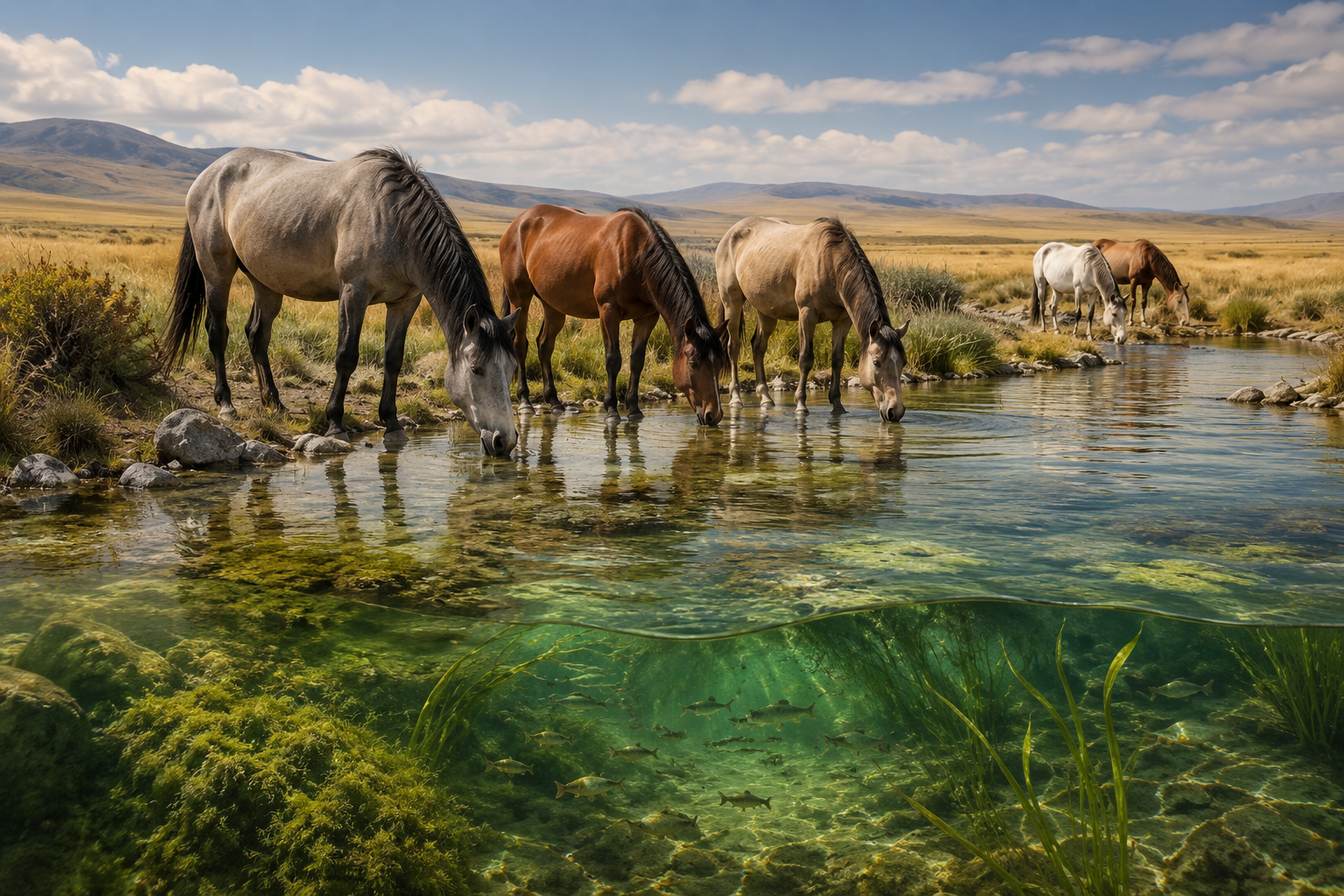
Wild horses had contact with significantly more diverse natural food and environmental sources than many of our domesticated horses today. They ate a variety of plants, absorbed water from natural bodies of water, and were exposed to much greater biological diversity. There has been little scientific research into whether relevant amounts of EPA and DHA were absorbed directly from microalgae or other aquatic sources. However, one thing is certain: in today's typical horse ration, direct sources of EPA and DHA are practically non-existent.
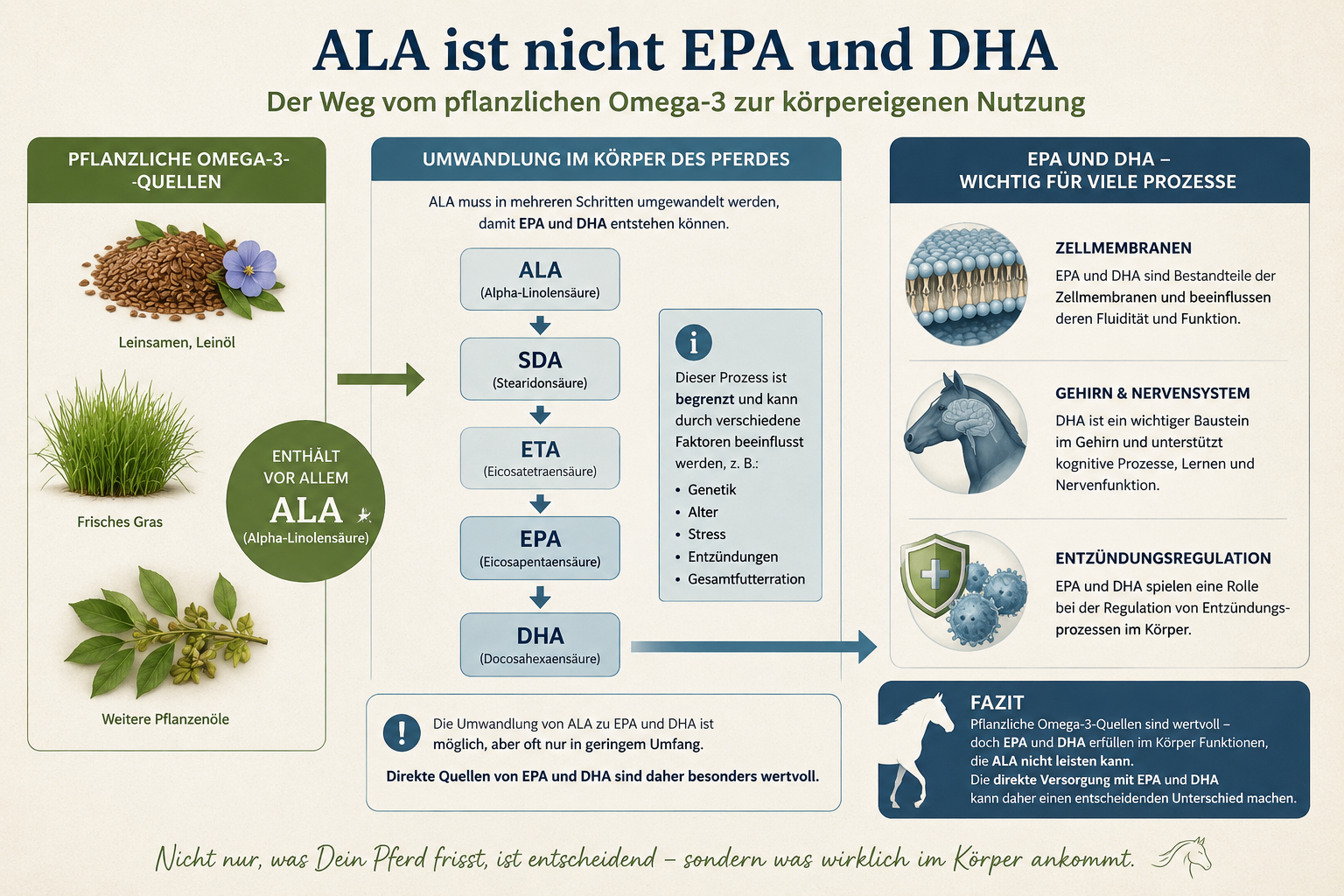
And that's exactly what I find exciting. Because today when we talk about Omega-3 in horses, we quickly talk about linseed oil, linseed or fresh grass. That's not wrong - these feeds primarily provide alpha-linolenic acid, or ALA for short, a plant-based omega-3 fatty acid. But ALA is not the same as EPA and DHA. The horse can produce longer-chain omega-3 fatty acids from ALA, but this requires several metabolic steps. Direct sources of EPA and DHA, on the other hand, are the exception in a classic ration made from hay, grass and common feed.
Why EPA and DHA are even interesting
EPA and DHA are long-chain omega-3 fatty acids and components or precursors of important structures and regulatory processes in the body. They are incorporated into cell membranes and play a role in, among other things, inflammation regulation, nervous system and brain function. In horses it can also be shown that EPA and DHA actually reach the blood and various tissues. For example, studies have shown an increase in plasma, red blood cells, muscles and even synovial fluid. PubMed
Of course, this doesn't mean that every horse with little EPA or DHA automatically becomes sick. Fortunately - or sometimes unfortunately - biology doesn't work that simply. An unfavorable fatty acid pattern is not a diagnosis. However, it can indicate that important regulatory processes in the body are not operating under optimal conditions.
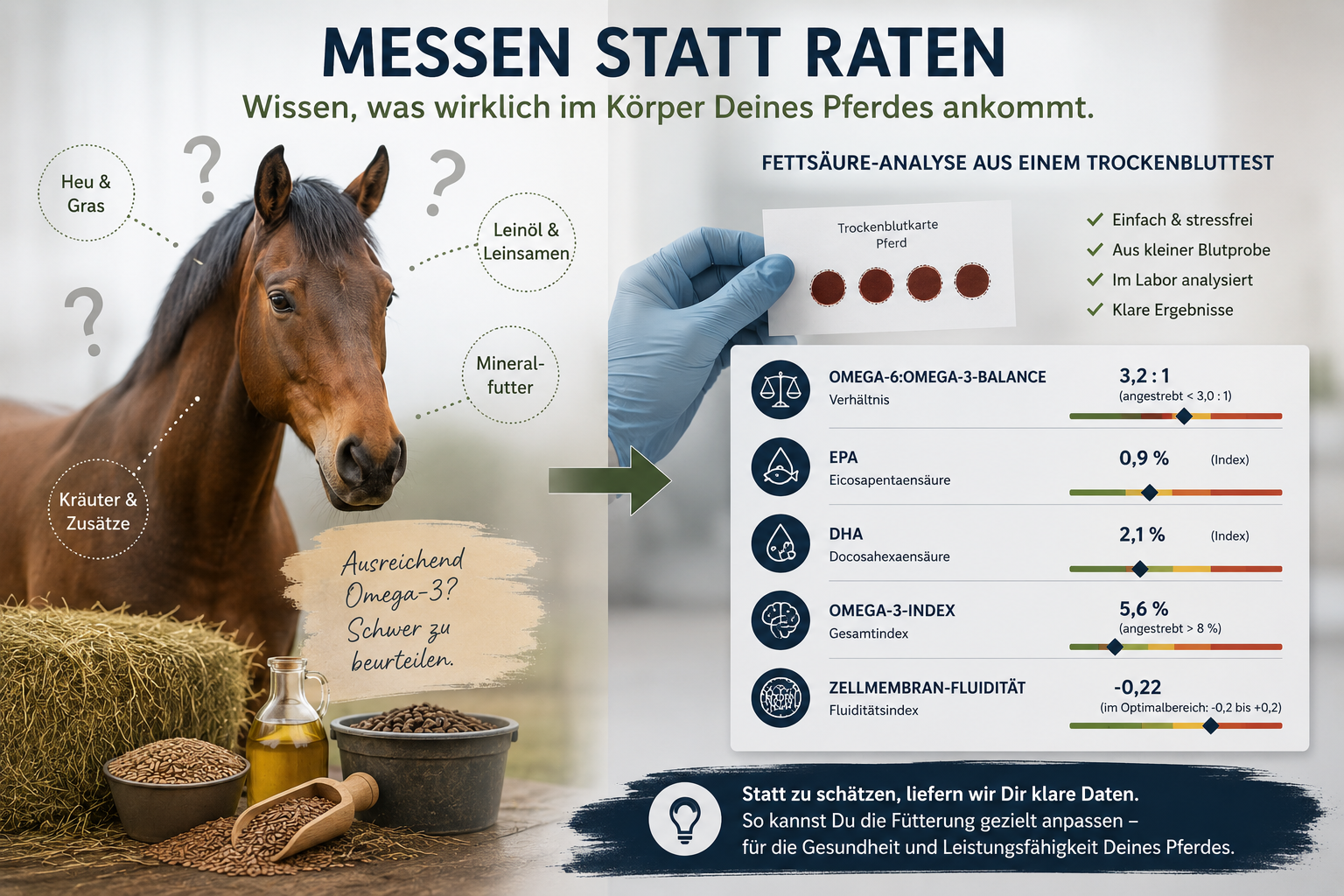
Among other things, fatty acids influence the properties of our cell membranes. This is exactly where a lot of things are decided: How flexible is a membrane? How well can substances be absorbed and released? How do signaling and regulatory processes work? In the fatty acid analyzes we use, in addition to the Omega-6:Omega-3 balance, the Omega-3 index and a marker for cell membrane fluidity are also taken into account.
A permanently unfavorable fatty acid pattern does not automatically mean illness. However, it can be a building block in a development that we continue to discuss today in connection with various typical diseases of civilization and chronic regulation problems. And that's exactly why I'm not only interested in what we feed into the horse's front, but also what actually ends up in the body.
And what was different before?
This is where things get a bit speculative, but also interesting. Horses did not evolve in a world where a clean bucket of tap water was set out every morning and the same preserved forage was available for months. Wild horses moved over large areas, ate a wide variety of plants and drank from natural waters. These waters contain microorganisms and microalgae and form their own complex ecosystems.
Based on current knowledge, we cannot reliably assert whether wild horses actually absorbed relevant amounts of EPA and DHA. There is simply no research for this. I still think the question is justified: Which nutrient sources have disappeared or at least become significantly rarer due to our current way of keeping and feeding them?
Because we know one thing: Direct sources of EPA and DHA are not exactly abundant in today's normal horse feed. At the same time, studies show that targeted intake of EPA and DHA can significantly change the fatty acid profile of horses. The concentrations in the blood increase dose-dependently when these fatty acids are actually consumed. PubMed
For me, this leads to a pretty simple consequence: I don't want to guess.
Measure rather than guess
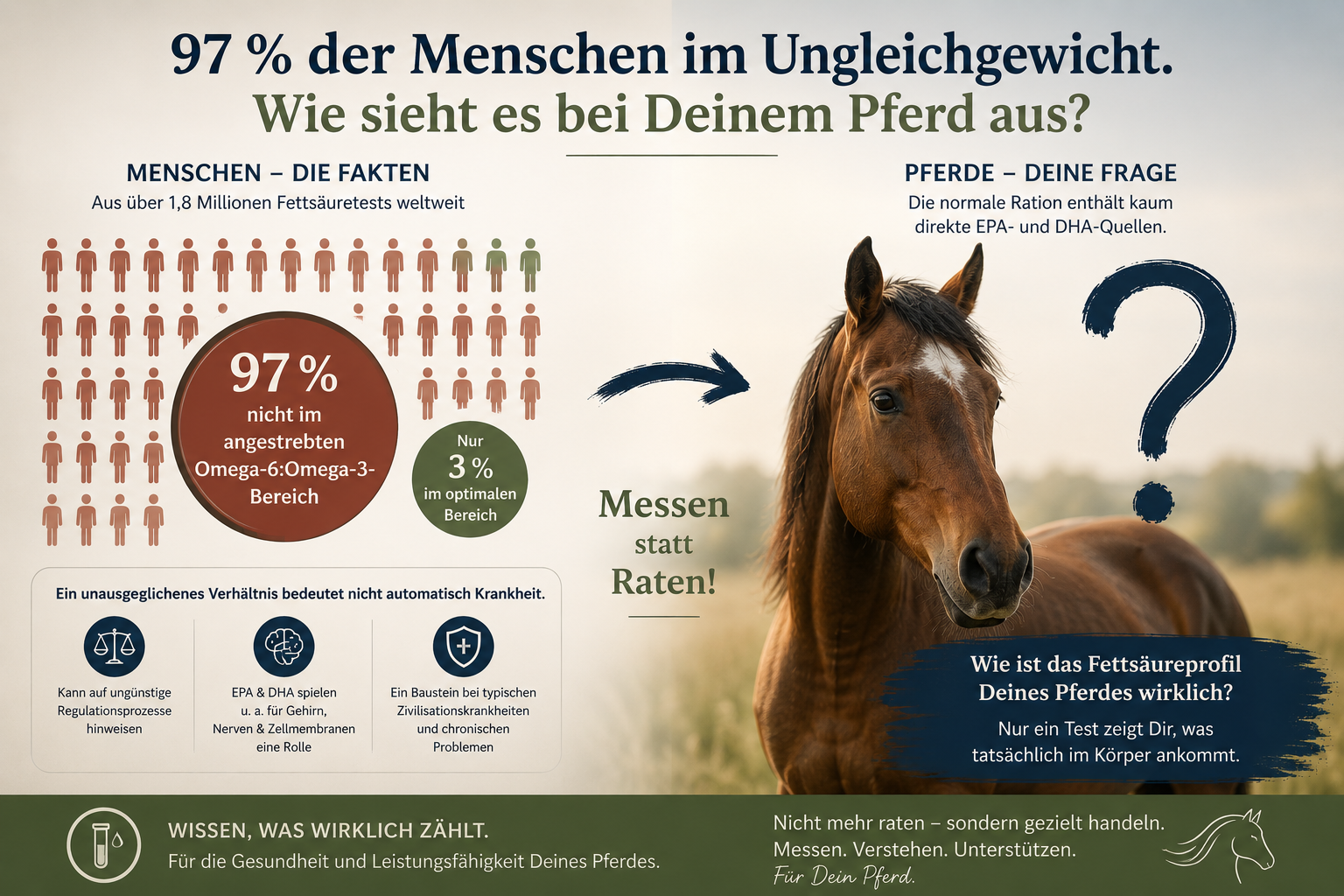
Just a look at us humans shows how difficult it can be to estimate the omega-3 supply based solely on what someone eats. With more than 1.8 million fatty acid tests evaluated worldwide, around 97 percent of the initial tests were not in the targeted Omega-6:Omega-3 range.
And I find that remarkable. Because a large proportion of these people are not vegan or vegetarian, but rather completely omnivorous. Many people eat fish, use various vegetable oils and would probably say that they get enough omega-3.
Nevertheless, the test does not initially show an optimal balance for the overwhelming majority.
Even in humans, an unbalanced ratio does not automatically mean that someone is sick. However, it may indicate that the conditions for certain regulatory processes are not optimal. EPA and DHA play a role in cell membranes and normal brain function, among other things; The fatty acid composition also influences the properties of the cell membrane. Sandra_3EY892698376BT_full (1).pdfPDF
The exciting thing about it is that you often don't notice such changes straight away.
And that's exactly why our principle is: measuring instead of guessing.
Because if even people who eat a varied diet and sometimes eat fish regularly do not lie in the desired Omega-6:Omega-3 range in 97 percent of the initial tests - what might it look like for your horse, whose normal ration contains practically no direct sources of EPA and DHA?
This is exactly the question I would ask myself before I just buy any new oil and pour it into the feed.
What does an omega-3 blood test show in horses?
A fatty acid test is not intended to determine whether a horse is “healthy” or “sick.” Rather, it provides a snapshot of how different fatty acids are actually represented in the blood.
The test we use analyzes an extensive fatty acid profile. From this, the Omega-6:Omega-3 balance, the proportion of EPA and DHA, the Omega-3 index and other markers calculated from this can be viewed. Comparable analyzes are also used in research to objectively detect changes in fatty acid supply in horses. Studies show, for example, that EPA and DHA increase measurably in the blood after targeted intake and are also incorporated into tissue. PubMed
And for me that is exactly the big difference between guessing and knowing.
A horse may indeed need support with its omega-3 intake. But its fatty acid profile may also look very different from what you expect. That is why I would personally start with a question rather than a product:
What does this horse actually look like right now?
Don't put more in it - just look more specifically
I think we've become very used to reacting to problems with another bucket, powder or oil when feeding horses. Sometimes the more interesting question is not: “What else can I add?”, but rather: “What does my horse actually need?”
Of course, a blood test does not replace sensible feeding, good husbandry, exercise, training or veterinary care. But it can provide another piece of the puzzle. And sometimes that one piece of the puzzle is what was missing before.
That's why I find the topic of Omega-3 in horses so exciting. Not because I believe that EPA and DHA are some kind of miracle cure. But because we now have the opportunity to measure things that we would have previously simply speculated about.
And if we can measure, why should we guess?
If you would like to know what your horse's fatty acid supply actually looks like, please feel free to contact us. We work with appropriate laboratory analyzes and do not look at the results in isolation, but together with feeding, husbandry, exercise, training and the horse's overall situation.
Because in the end it's not about getting as much omega-3 as possible into the horse.
It's about finding out what exactly this horse needs.
If you would like to know which products we use, please take a look here in the ProBalance shop .
Sources and further literature
Would you like to find out more about the topic and also read the scientific evidence and studies on this article? Click here.