


Equine asthma: Could DHA have a role in breathing?
A study makes you curious: What role can omega-3 play in coughing horses - and what does that mean for husbandry, feeding and the view of the blood?
If your horse coughs, you'll start to listen differently at some point. Was that just once? Does it come back when you trot? Why does it take so long today for breathing to calm down? Anyone who cares for a horse with respiratory problems is probably familiar with this constant monitoring. And the question of whether you have overlooked something, even though you have long been taking care of food, husbandry and treatment.
That's exactly why I got stuck on a post about DHA and asthma in horses. I'm interested in Omega-3 in connection with inflammation anyway. But breathing? I wanted to know more about what was behind it. So I looked at the original study. And I think: The topic deserves more than a large percentage in a picture.
Equine Asthma: Why “a little cough” deserves attention
Equine asthma describes inflammatory diseases of the lower respiratory tract with varying degrees of severity. In older publications you will often come across the terms IAD and RAO. Milder forms can be noticeable through occasional coughing or a decrease in motivation; In severe forms, breathing at rest can be significantly more difficult. However, a cough alone does not prove asthma. The cause needs to be clarified by a veterinarian, if necessary with an examination of the respiratory tract and its cells. If you experience acute shortness of breath, please call the vet immediately. [2]
For me, that's the starting point: we need to understand what's going on with this horse. Only then can it be meaningful to discuss what additional support is available. An interesting-sounding food additive does not answer the question of the cause.
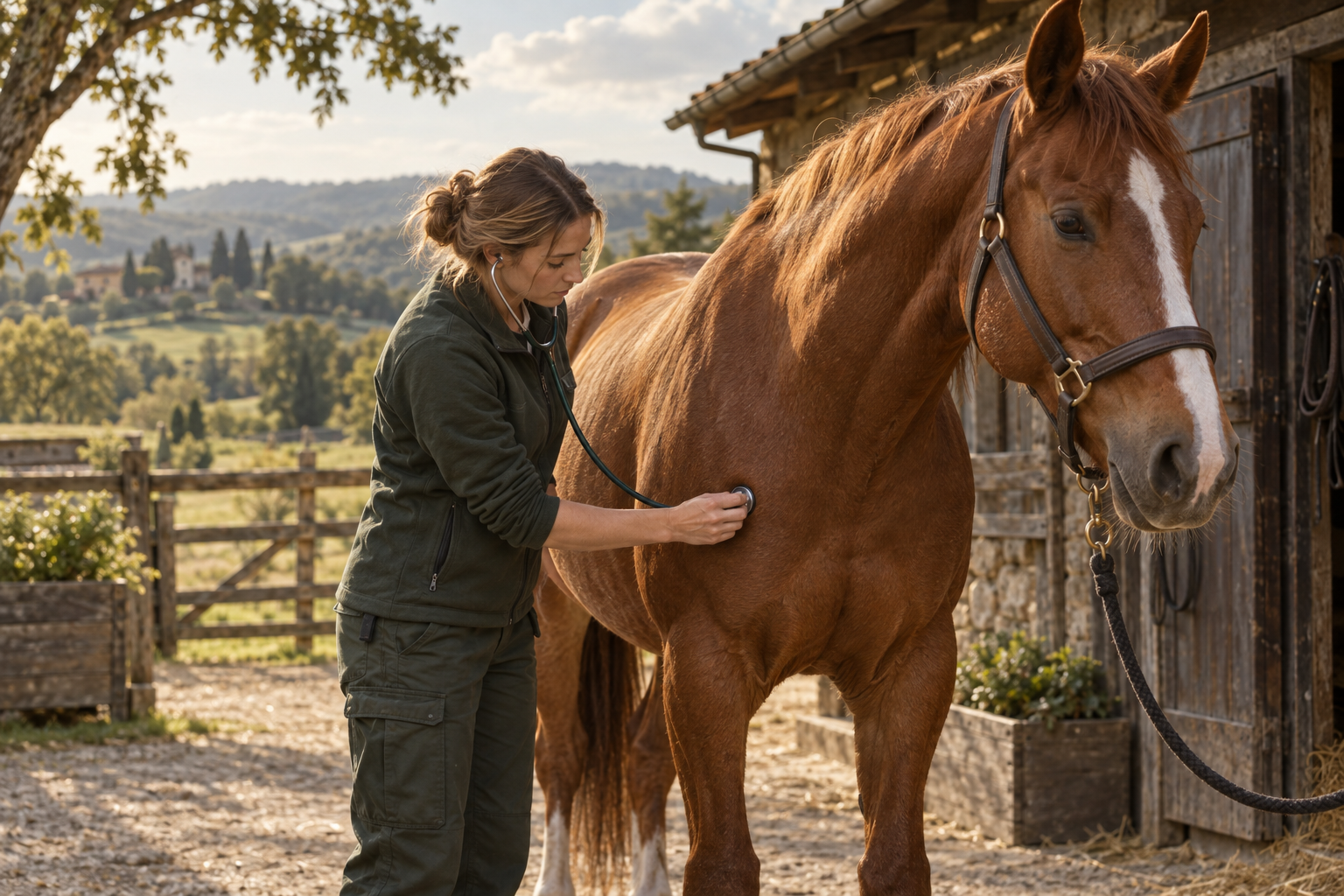
The DHA study: What was actually studied?
Nogradi and colleagues examined horses with chronic respiratory diseases in a randomized, double-blind study. 32 completed the attempt. Everyone received low-dust, pelleted complete feed without hay for eight weeks. There was also a placebo or a supplement with 1.5 or 3 grams of DHA daily. The two supplementary groups were combined for joint analysis. [1]
Results after eight weeks – both groups with low-dust feeding [1]
| Measured parameter | With supplement | With placebo |
|---|---|---|
| Improvement in cough score | 60 % | 33 % |
| Decrease in the measured work of breathing | 48 % | 27 % |
| Neutrophils in the airway lavage sample | 23 → 9 % | 11 → 17 % |
These are group values, not healing rates. An improved cough score does not mean 60 percent fewer coughs counted. Neutrophils are inflammatory cells; the flush sample comes from the deep respiratory tract, not from a blood test.
Important: The product also contained MSM and a mushroom complex, which were also missing in the placebo. The effect cannot therefore be attributed to DHA alone. The study was small and did not test a direct comparison between EPA and DHA.
How quickly did changes occur?
In the weekly owner assessments, changes with supplementation and food changes were already noticeable within the first two weeks. The greatest improvements were in coughing between weeks two and five, and in breathing effort between weeks five and six. The final examination took place after eight weeks. [1]
For your horse, this is not a calendar with a promised success date. The main thing I would take away from this is that anyone who changes something should monitor the process in a comprehensible manner. When does the horse cough, under what conditions, and how does its resilience develop? Notes like these are much more helpful when talking to the vet than the feeling that things have gotten “somehow a little better”.
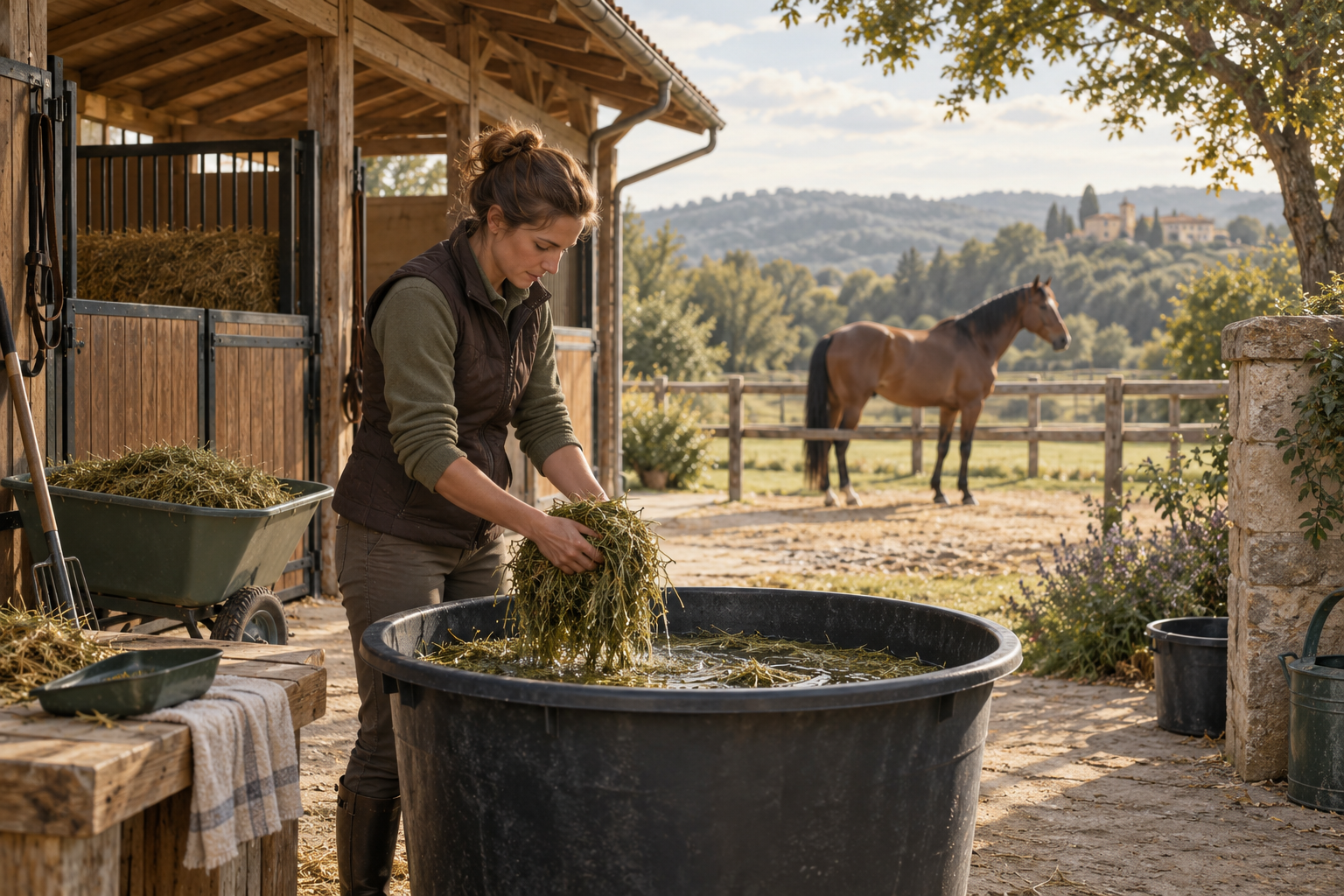
Low-dust management remains the basis
A good idea in the feeding trough is of little help if the respiratory tract is put under renewed strain every day. A current review therefore emphasizes the importance of the entire environment: roughage, bedding, ventilation and work such as sweeping or mucking influence the inhaled exposure. Even an open stable is not automatically low in dust, for example if your nose is stuck in dry hay for hours. Which roughage preparation and changes to husbandry are suitable must suit the horse and its triggers. Exclusive pellet feeding in the experiment is not a blanket feeding recommendation for at home. [3]
I find it helpful to get very practical: Where does my horse put his nose while eating? What happens around him while the stable is being made? What does the food really look like? These are not spectacular questions. But they lead to things that can be specifically checked in everyday life. Feeding and veterinary treatment should go together; Medications are not changed independently because of an article.
EPA or DHA – isn’t EPA more interesting when it comes to inflammation?
The question is legitimate. EPA is involved in metabolic pathways that produce inflammation-related messenger substances. DHA is also more than a building block for the brain and nervous system: both influence cell membranes and can be starting materials for mediators that help limit and resolve inflammation. Basic research provides plausible explanations for this. However, it does not yet prove a specific effect on an individual asthmatic horse. [4]
I would therefore not turn this discussion into a competition between two fatty acids. I'm interested in what question an examination really answers and what we can learn from it for the care of a horse. Anyone who has previously primarily thought of linseed oil or linseed when it comes to omega-3 will find the difference between plant-based ALA and EPA or DHA in more detail in our article about omega-3 in horse feeding.

What does the fatty acid profile reveal about your horse?
You take care of low-dust feed, have your horse receive veterinary care, perhaps inhale regularly and adapt exercise and training to his resilience. And yet the question remains: Can I provide even more targeted support through nutrition? This is exactly where I find a fatty acid profile interesting. It shows how EPA, DHA and other fatty acids are represented in your horse's blood. This gives us a concrete basis for talking about his care.
How high is the DHA content? What about EPA? What is the relationship between the measured omega-6 and omega-3 fatty acids? We look at these values together with the previous feeding. This way we can better assess whether an adjustment to the ration makes sense and what we should pay attention to. During a later check using a comparable measuring method, it is also possible to see how the blood values have developed after a change in feeding.
A study of 50 healthy horses shows that such changes can be measured: after targeted intake, the proportions of EPA and DHA in the whole blood increased. The measurements were taken after six and twelve weeks. [5] For me, this has a practical advantage: we don't have to estimate the effect of a change in feeding on the fatty acid profile based solely on the information on the feed bucket.
What does your horse’s EPA and DHA supply actually look like? A fatty acid profile gives you a look at his blood values - and gives us a basis for tailoring the diet more specifically to your horse. In addition to veterinary care, inhalation and adapted training, we can also consciously include the nutritional side of his support.
It is precisely this additional perspective that makes the asthma study so exciting for me: it provides an indication that feeding could make a contribution beyond dust management. A profile can help you understand your horse's initial situation and track changes in his fatty acid supply. It does not diagnose asthma and does not guarantee the improvements from the study; What was examined there was a supplementary feed together with low-dust feeding, not a treatment concept controlled by blood tests.
For me, classification is always part of it. We look at EPA, DHA and the other values in connection with the horse, its ration and the measurement method used. Human target areas are not simply transferred to horses. Additional calculated key figures in a laboratory report are additional guidance and not an independent diagnosis.
What I take away from this study
She makes me curious. Precisely because horse health can rarely be reduced to a single adjustment screw. Anyone who accompanies a coughing horse neither needs a new miracle cure nor the feeling that they have done everything wrong so far. He needs an understandable classification and a plan that can be implemented in everyday life.
For me, this includes having the respiratory tract checked by a vet, taking the environmental stresses seriously and taking a closer look at feeding. A fatty acid profile can supplement this view with specific EPA and DHA values. Our principle at ProBalance therefore remains: measuring instead of guessing. Understand the initial situation, discuss feeding specifically and understand what changes - so that you can also accompany your horse nutritionally consciously.
Note on illustrations: The images used in this article were created using AI. They serve to clearly present the relationships described and are based on the scientific and technical principles presented in the article. The horses, test situations and environments shown do not show any real individual cases or actual ProBalance horses.
Sources and further literature
The numbers in the study section come from the original publication [1]. The remaining sources supplement the classification of asthma, environmental management, inflammation regulation and fatty acid measurement. Basic research and measurement studies are not proof of effectiveness for asthma treatment. The original study was supported by the manufacturer of the supplementary food examined.
-
Nogradi, N.; Couetil, L. L.; Messick, J.; Stochelski, M. A.; Burgess, J. R. Omega-3 fatty acid supplementation provides an additional benefit to a low-dust diet in the management of horses with chronic lower airway inflammatory disease. Journal of Veterinary Internal Medicine, 2015; 29:299–306.
-
Couëtil, L. L. et al. Inflammatory Airway Disease of Horses—Revised Consensus Statement. Journal of Veterinary Internal Medicine, 2016; 30:503–515.
-
Diez de Castro, E.; Fernandez-Molina, J. M. Environmental Management of Equine Asthma. Animals, 2024; 14:446.
-
Calder, P. C. Omega-3 fatty acids and inflammatory processes. Biochemical Society Transactions, 2017.
-
Pearson, G. et al. Dose-Dependent Increase in Whole Blood Omega-3 Fatty Acid Concentration in Horses Receiving a Marine-Based Fatty Acid Supplement. Journal of Equine Veterinary Science, 2022.
What does your horse's omega-3 supply really look like?
Would you like to get to know your horse's EPA and DHA values and find out how you can support his supply more specifically? We accompany you from the fatty acid analysis process to the understandable discussion of the results. Together we look at the values and previous feeding and discuss possible next steps - in addition to veterinary care. The blood is taken by the veterinarian.
If you would like to know which products we use, please take a look here in the ProBalance shop .
Would you like to find out more about the topic and also read the scientific evidence and studies on this article? Click here.