


Migraine and omega-3: What fatty acids have to do with your head
Why EPA and DHA are a concern for research – and why taking a look at your own values can be exciting.
We've talked a lot about our horses here under Knowledge & Impulses. About gut health, inflammation, feeding and finally breathing. Today I would like to focus on us humans. Because ProBalance is about people and animals. And sometimes I have the impression that we look more closely at our animals than at ourselves.
When it comes to horses, we notice when they walk differently, eat less well or appear unusually tense. For us, on the other hand, we quickly say: Your head hurts again. Make another appointment, organize everyday life, carry on somehow. Anyone who regularly has headaches or migraines knows how much energy it can take.
That's exactly why I find it interesting to ask what role our diet could play in this. The omega-3 fatty acids EPA and DHA in particular have now appeared in several migraine studies. For me, this is a good reason to take a closer look: What was examined? What can you take away from this? And what does your own fatty acid supply actually look like?
When headaches dominate everyday life
Maybe you know this: The day is planned, then this throbbing begins. Light becomes unpleasant, noises become annoying, even small movements can be stressful. Migraines are often accompanied by nausea and a pronounced sensitivity to light or noise. An attack can last from several hours to three days. Other types of headaches feel different and have different contexts. That's why we're specifically looking at migraine research in this article. [1]
I'm also interested in the time between attacks. What conditions does our body face in everyday life? How regularly do we eat and sleep? Which fats do we consume? Nutrition is a possible complementary approach. Of course, this includes medical classification and treatment of recurring headaches.

Why Omega-3 is interesting for nerve cells
Fatty acids provide energy and are components of our cell membranes. These thin shells ensure that cells are separated and at the same time can communicate with their surroundings. DHA is particularly abundant in the brain. EPA and DHA are also starting materials for messenger substances that are involved in the regulation of inflammatory processes. It is precisely such connections that make them interesting for pain research. [2, 3]
Omega-3 for migraines: what do the studies show?
A larger study was published in the British Medical Journal in 2021. 182 adults with migraine were assigned to three dietary groups for 16 weeks. One group received more EPA and DHA, a second group also received less linoleic acid, an omega-6 fatty acid. The control group remained on a standard fatty acid intake for the USA. [3]
Compared to the control group, the group with more EPA and DHA had around two fewer headache days per month. If the linoleic acid intake was reduced at the same time, it was around four days less. The number of daily headache hours also decreased. However, the differences in everyday impairment recorded using a questionnaire were not statistically clear. A targeted change in diet was examined. [3]
For someone whose month always turns upside down, the question of possible additional starting points is anything but irrelevant.
More recent studies also arouse curiosity. In a 12-week study of 70 people with episodic migraine, the number of migraine days decreased more with an EPA-rich product than with placebo. Another, smaller study in chronic migraine also showed benefits in headache days, but no statistically clear difference on the primary disability questionnaire. [4, 5]
What I take away from this is that there are serious indications that make it interesting to take a closer look at fatty acid supply. How great the potential benefit is for the individual remains an open question. The studies differ in nutrition, product and participants; The results cannot be applied across the board to every oil or a specific advisory service.
For me, this leads to a very personal question: If EPA and DHA could play a role in this context, how are they represented in my own blood? It is precisely at this point that a research topic becomes something that can be looked at specifically.
Omega-3 is not the same as Omega-3: What matters when it comes to oil
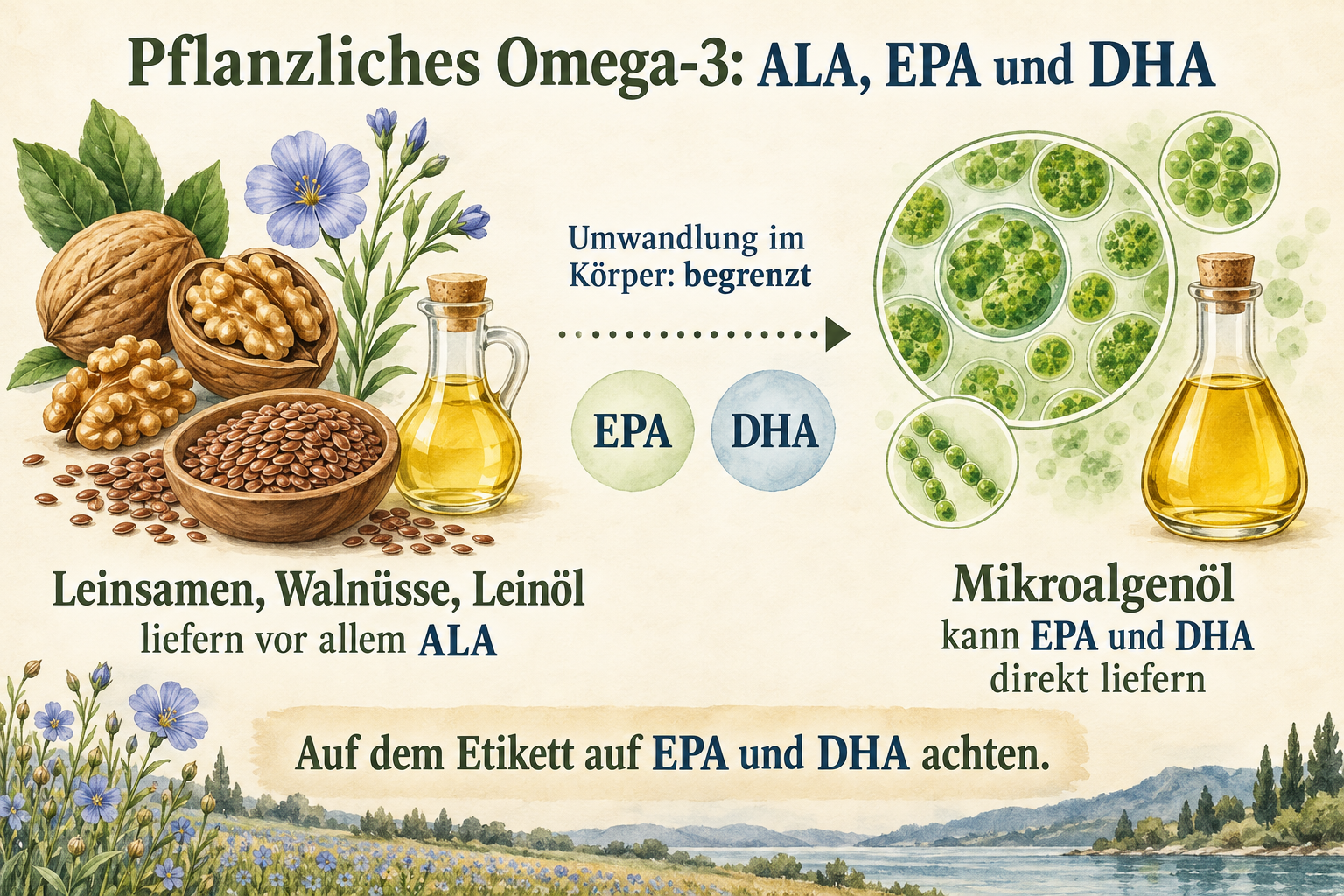
Maybe you're now thinking: I'll take a good oil. This is exactly where it's worth taking a second look. Flaxseed oil and walnuts primarily provide ALA. Our body can produce EPA and DHA from it, but only to a limited extent. For the targeted supply of these two fatty acids, such foods cannot be equated with a direct source of EPA and DHA. That doesn't make flaxseed oil bad - it just answers a different nutritional question. [2]
The amounts of omega-3 products also differ significantly. For example, saying “1,000 mg oil” is not the same as “1,000 mg EPA and DHA.” I would therefore look at the stated amounts of both fatty acids per daily serving. This also includes traceable quality information, shelf life and correct storage after opening. A large lettering on the bottle alone is of little help in making this decision. [2]
If you live a vegan lifestyle, you can absorb EPA and DHA through a suitable microalgae oil. Some algae oils mainly provide DHA, others also provide EPA - the specific composition also counts here. The question of appropriate nutrition affects us regardless of how we eat. [2]
Not every oil is suitable for every goal. A follow-up check can be used to check whether your EPA and DHA levels are developing as a result of a change in diet. Whether this makes headaches go away is a separate question: this cannot be determined from the label or from a single blood test.
What does an omega-3 test show in the blood?
A fatty acid profile shows what proportion different fatty acids make up the total amount measured. Eleven fatty acids are analyzed in the fatty acid test carried out by us. These include EPA and DHA, other omega-3 and omega-6 fatty acids as well as monounsaturated and saturated fats. These measured values create additional key figures. [6]
I am particularly interested in the individual EPA and DHA portions. The key figure referred to in the report as Omega-6:3 balance specifically describes the ratio of arachidonic acid, or AA for short, to EPA. The Omega-3 index shown there combines EPA and DHA. We look at the values with the target ranges and explanations of the method used. [6]
This is how to answer a nutritional question: What does my fatty acid profile look like and what is worth talking about? No migraine diagnosis can be derived from this. Terms such as “mental strength” in the report also refer to calculated ratios, not a test of your mental resilience. It's important to me that you really understand your results.

From a drop of blood to a personal conversation
For the dried blood test at home, a small blood sample from the fingertip is placed on a sample card using the included lancet and sent for analysis. An independent, GMP-certified laboratory carries out the chemical analysis. According to the laboratory information we have, it has already collaborated with the World Health Organization (WHO); The scientific partners listed include Harvard University and the University of Cambridge. This collaboration describes the laboratory's experience, not a recommendation of our offering by these institutions. You can access the results using your personal test ID. We will explain the process to you and then go through the report together. [6]
During the conversation, I'm interested in what your diet actually looks like and what can be implemented in your everyday life. Which Omega-3 sources do you already use? Are you already taking a supplement? What questions do you have about your values? This can result in a manageable next step. A later control test using the same procedure shows how the profile has developed. We will discuss a check-up after approximately 120 days. [6]
Which Omega-3 oil suits your diet?
We work with an experienced company that has been dealing with these issues for more than 15 years. There is also an interdisciplinary network with doctors, veterinarians and specialists in osteopathy and physiotherapy. If you have specific questions, we can call in suitable specialists after consultation. Sandra and I remain your personal contacts: We accompany you from the first conversation through the test to the classification of your results.
We will look at which supplement and how much is right for you based on your initial situation, your diet and your fatty acid profile. The aim is to support sensible care and avoid unnecessary additions. The blood test gives us information about the fatty acid supply; It does not determine your body's entire nutrient needs. We include existing medications; If you are taking blood thinners, you should consult your doctor. With a later check we can understand how your values change. This results in no promise of healing and no proof of an effect against migraines.

Maybe now is a good time to look at yourself
We often invest a surprising amount of attention in our animals. We observe, compare and want to understand what is good for them. I think we can give ourselves this perspective as well.
If the topic of migraines and omega-3 has made you curious, you can start with a specific question: What does my own EPA and DHA supply look like? A fatty acid test gives us measurements for this. In a personal conversation, we classify them and see which options suit you.
Measure instead of guessing. This is important to us for our animals. For us humans it can be just as obvious.
Would you like to get to know your values? Just write to me “I would like to have my omega-3 levels tested”. Sandra and I will explain to you how the test works and how we will accompany you during the evaluation. You don't have to know any technical terms or already know which product is suitable. The question about your own care is sufficient for the first contact.
Read more & explore further
Omega-3 in horse feeding: ALA, EPA and DHA
Read the ProBalance article
Health & personal support
Contact ProBalance
Sources and further literature
-
IQWiG: Migraine – symptoms and classification
https://www.gesundheitsinformation.de/migraene.html -
NIH Office of Dietary Supplements: Omega-3 Fatty Acids
https://ods.od.nih.gov/factsheets/Omega3FattyAcids-Consumer/ -
Ramsden et al. (2021): Dietary alteration of n-3 and n-6 fatty acids for headache reduction in adults with migraine. BMJ 374:n1448
https://www.bmj.com/content/374/bmj.n1448 -
Wang et al. (2024): A 12-week randomized double-blind clinical trial of eicosapentaenoic acid intervention in episodic migraine
https://pubmed.ncbi.nlm.nih.gov/38499208/ -
Mohammadnezhad et al. (2025; online 2024): Eicosapentaenoic acid versus placebo as adjunctive therapy in chronic migraine
https://pubmed.ncbi.nlm.nih.gov/39221580/ -
Test and laboratory information: German customer presentation, slides on the dried blood process and laboratory, as well as explanations of the complete fatty acid report. We will explain details of the test procedures and evaluation in a personal conversation.
Health note: This article provides information about nutrition and supplements medical care. A sudden, very severe or unusual headache, especially with neurological deficits, should be medically clarified immediately.
Transparency: We may receive compensation for tests and nutritional supplements arranged. We will discuss the selection personally based on your initial situation.
About the images: AI-generated illustrations. People and test situations are exemplary; the graphics show simplified relationships and no real findings.
What does your Omega-3 supply really look like?
Would you like to know your EPA and DHA values or have questions about the Omega-3 test? Write to us. Sandra and I will explain the process to you and accompany you in the understandable discussion of your results. Together we will see which next steps fit your diet and everyday life.
Contact: marc@probalance24.com · 0170 2424828
Write to us via our contact page.
If you would like to know which products we use, please take a look here in the ProBalance shop .
Would you like to find out more about the topic and also read the scientific evidence and studies on this article? Click here.