


Joint pain while riding: What your body tells your horse
Silent inflammation, osteoarthritis and omega-3: Why looking after your health is also important when riding.
In the last post we talked about migraines and fatty acid supply. Today I want to stay with us humans – and at the same time get back to our horses. Because sometimes the two can hardly be separated. For example, if your hip pulls when you get on, your knee hurts after riding, or your fingers just need to get going in the morning.
Maybe you know this: you want to sit loosely, move along smoothly and give your horse understandable riding aids. At the same time, you try to avoid uncomfortable movements. You may not even notice that you are positioning a leg differently or holding a hand tighter. Your horse will still notice this change.
For me, this is a good reason to turn the question around. We often think about what our horse needs so that it can move better. But what requirements do we bring with us? That's exactly what it's all about today: joint pain, osteoarthritis, inflammatory processes - and the question of where nutrition and a look at your own fatty acid levels can usefully complement it.
Your seat speaks, even if you don't want to say anything
When riding, our pelvis, legs, upper body and hands are part of our communication. If one hip allows less mobility, it may be more difficult to swing along. If you protect one knee, you may distribute the load differently. Tense shoulders can be noticeable right down to the reins. These are possible connections, not a diagnosis based on a crooked seat.
The fact that asymmetry in the rider can influence the horse's movement has also been experimentally investigated. In a small study with ten non-lame horses, a shortened stirrup on one side changed certain movement dimensions of the horse. This was an artificially created asymmetry, not a study of people with osteoarthritis. But the study shows: What happens at the top in the saddle can have a biomechanical effect at the bottom. [1]
I wouldn't blame anyone for that. A person in pain is not a bad horse person. I just think that we should take our own bodies just as seriously as saddle fit, hooves or training structure. Sometimes the next good step is a sitting analysis or physiotherapeutic support - and sometimes first an assessment of your own joint.

When pain captures attention
It's not just about the movement. If you constantly ignore a pulling sensation, you may sleep worse or need more energy for things that were previously taken for granted. A systematic review describes the connections between chronic pain and difficulties with, among other things, attention and processing speed. This doesn't affect every person in the same way. [2]
I take a practical consideration from this for everyday stable life: If part of my attention stays on my knee, I might notice a small change in my horse's expression later. Or I react more quickly with impatience, even though I actually wanted to take a closer look. This is a possible everyday situation, not scientific proof that people with joint pain have a harder time understanding horses.
And the same applies to horses: ears flattened, tail flapping or difficulties under the saddle have various possible reasons. Your own complaints do not automatically explain the horse's behavior. Abnormalities are related to health, equipment, training and the situation. Both sides deserve attention.
Osteoarthritis is more than a worn out joint
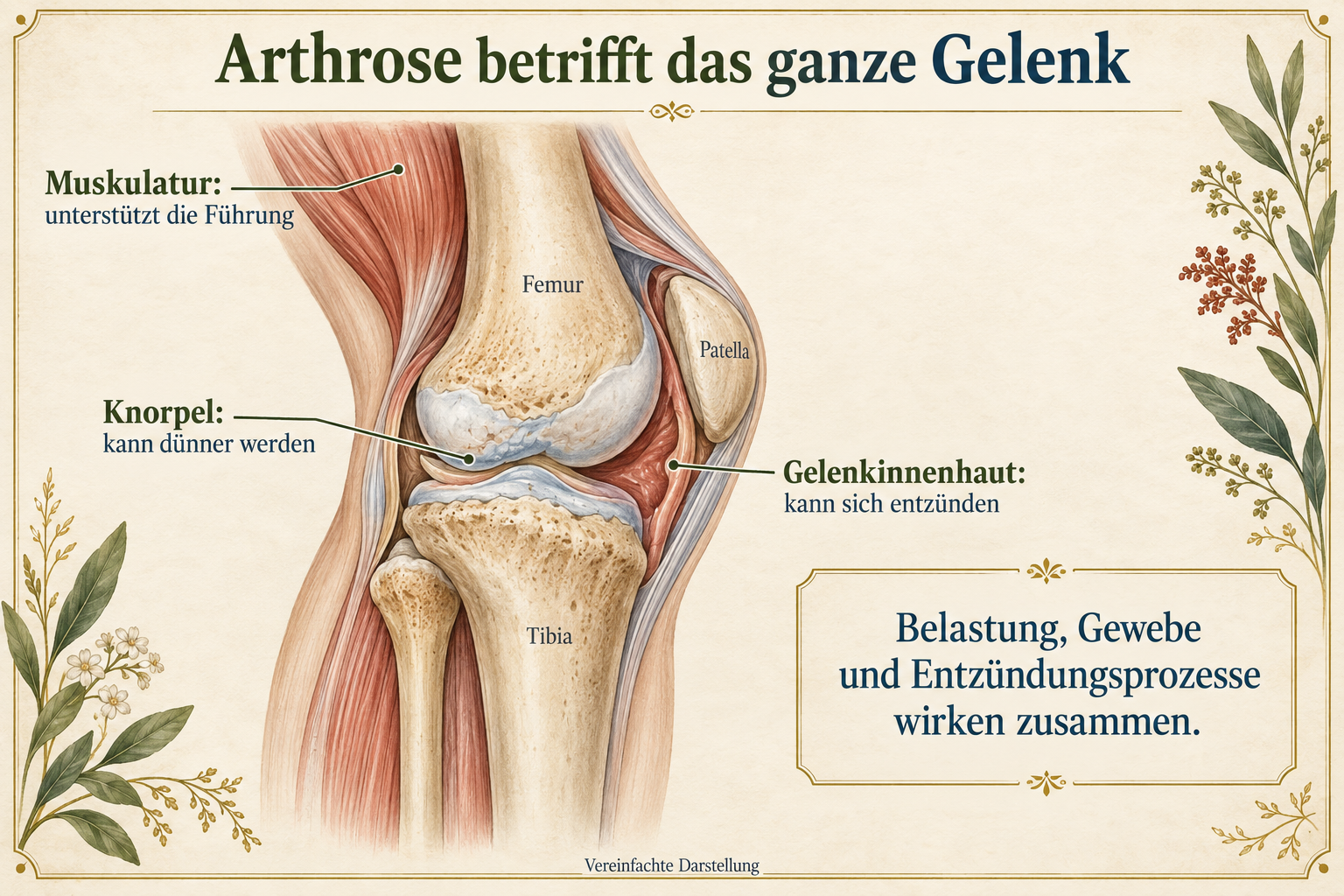
The word “wear and tear” sounds as if a joint is simply worn out at some point. However, with osteoarthritis, the entire joint changes: cartilage, bones, synovial lining and surrounding structures can be involved. Inflammatory processes also play a role. Stress, previous injuries, metabolism and the stabilizing muscles are part of the overall picture. [3]
“Silent inflammation” usually refers to longer-lasting, low-grade inflammatory processes. They are not the same as acute, significantly swollen joint inflammation. Research examines, among other things, connections with lack of exercise, metabolic stress and excess fatty tissue. However, the term alone does not explain a sore knee or fatigue. [4]
Osteoarthritis, an inflammatory rheumatic disease and complaints after overuse are different things. It is therefore worth making a clear classification before looking for a supplement. In particular, a suddenly hot, severely swollen joint, fever or a new significant restriction of movement should be checked by a doctor promptly.
What you can offer your body in everyday life
When it comes to osteoarthritis, appropriately dosed exercise is one of the most important building blocks. The guideline recommends individually tailored training, for example for muscle strengthening and general endurance. If you are overweight, supported weight loss can improve your symptoms. The goal is an everyday life in which stress and recovery fit together better again. [5]
For us horse people, this can be very specific: use a climbing aid, organize carrying routes in the stable more intelligently, mobilize carefully before riding and adapt exercises to your own abilities with a specialist. Your own training condition deserves a plan just as much as that of the horse. Riding through pain is not a prerequisite for taking good care of your horse.
Nutrition also belongs in this conversation. Regular, varied meals, sufficient protein and appropriate energy intake are a sensible starting point. When it comes to fats, it's worth taking a closer look: Which sources do I use and what does my supply of EPA and DHA actually look like?
Omega-3 for osteoarthritis: Interesting, but no promise of cartilage repair
EPA and DHA are components of cell membranes and precursors for messenger substances that are involved in the regulation of inflammation. This makes them interesting for research. However, a plausible mechanism does not yet answer how much a supplement changes a particular person's symptoms. [6]
An evaluation of nine randomized studies with a total of 2,070 people with osteoarthritis found small average benefits in pain and joint function from omega-3 supplements in 2023. However, the studies differed in product and results. [7]
A larger individual study from 2024 shows why the classification is important: in 262 people with knee osteoarthritis and inflammatory changes in the joint, the omega-3-containing krill oil examined did not provide any better pain relief than placebo over 24 weeks. [8]
That's why I think both are important: the information is an opportunity to look at your diet consciously. However, they neither justify the promise that an oil treats osteoarthritis nor the idea that cartilage can be rebuilt with it. The focus of our advice is on the comprehensible supply of fatty acids.
Not all oil is the same. Flaxseed oil and walnuts mainly provide ALA, which is only partially converted into EPA and DHA. A suitable microalgae oil can provide both directly and also enables a vegan supply. The decisive factors are the declared amounts of EPA and DHA, traceable quality and the appropriate application - not just the large number on the front. [9]

What a fatty acid test reveals
Maybe you're already taking a supplement and still wondering where you stand. A fatty acid profile can make this question more concrete. Eleven fatty acids are analyzed in the dried blood test we provide. Among other things, we look at the EPA and DHA proportions and the ratio of arachidonic acid to EPA. [10]
We use this to measure your fatty acid supply. The test does not diagnose osteoarthritis and does not detect “silent inflammation”. An unfavorable relationship is not automatically the cause of your pain.
The small blood sample is placed on a sample card at home and analyzed by an independent, GMP-certified laboratory. We will explain the process to you and then discuss the report. A follow-up test using the same procedure after approximately 120 days can show how fatty acid levels have developed after dietary adjustment. We consider changes in your symptoms separately and separately. [10]
Why the topic affects me personally
I have osteoarthritis in both shoulders. By the end of 2025, I couldn't even open a drawer without being in severe pain. It was hardly possible to stretch my arms far above my head. At times the pain was so severe that I cried out.
I also did a fatty acid test. My report showed a very unfavorable ratio of reported omega-6 and omega-3 values; My supply of EPA and DHA was also not balanced. I have been taking an omega-3 product for about three to four months. Today I would describe my change like this: My osteoarthritis pain feels like 99 percent has disappeared. Sometimes it still drags, but I can fully move my arms again. I can even get my saddle truck, which weighs around 15 kilograms, lifted over my head onto my military cabinet without feeling any pain.
This is my personal experience and my own assessment, not a measured treatment success. From this it is not possible to determine with certainty what contribution the omega-3 product played to the change. Nor does it mean that my arthritis is gone or that others will experience the same progression. But I would like to tell you that I feel so much better today. That's exactly why looking at your own care is so important to me.

A next step that suits you
Sandra and I will look at your diet, your previous supplements and your baseline values with you. The aim is to support sensible care and avoid unnecessary additions. Medications and existing treatments are included in the classification; In the case of blood thinners, we coordinate the intake with the medical care.
For special questions, we can call in specialists from our network upon consultation. We remain your contact persons. And if your knee primarily needs a physiotherapeutic or medical solution, that is also part of a sensible overall picture.
I like the idea that we also do something for our horses by paying attention to ourselves. Becoming more agile, perceiving more clearly, sitting more relaxed in the saddle: these are personal goals for which several building blocks can come together.
Your horse doesn't have to be the only one whose care you want to get to know in detail.
Would you like to know what your EPA and DHA supply looks like? Write to us using the contact form. We will explain the fatty acid test to you and see together whether it is a sensible next step for your nutritional questions. You don’t need any technical terms – your question is enough to get you started.
Read more & explore further
Migraine and omega-3: What fatty acids have to do with your head
Read the ProBalance article
Health & personal support
Contact ProBalance
Sources and further literature
-
MacKechnie-Guire et al. (2020): The Effect That Induced Rider Asymmetry Has on Equine Locomotion and the Range of Motion of the Thoracolumbar Spine When Ridden in Rising Trot
https://pubmed.ncbi.nlm.nih.gov/32303298/ -
Higgins et al. (2018): The Relationship Between Chronic Pain and Neurocognitive Function – A Systematic Review
https://pubmed.ncbi.nlm.nih.gov/28719507/ -
IQWiG: Osteoarthritis – causes, symptoms and treatment
https://www.gesundheitsinformation.de/arthrose.html -
Furman et al. (2019): Chronic inflammation in the etiology of disease across the life span
https://www.nature.com/articles/s41591-019-0675-0 -
NICE NG226: Osteoarthritis in over 16s – exercise and weight management recommendations
https://www.nice.org.uk/guidance/ng226/chapter/Recommendations -
Calder (2017): Omega-3 fatty acids and inflammatory processes
https://pubmed.ncbi.nlm.nih.gov/28900017/ -
Deng et al. (2023): Effect of omega-3 polyunsaturated fatty acids supplementation for patients with osteoarthritis – a meta-analysis
https://pubmed.ncbi.nlm.nih.gov/37226250/ -
Laslett et al. (2024): Krill Oil for Knee Osteoarthritis – A Randomized Clinical Trial
https://pubmed.ncbi.nlm.nih.gov/38776073/ -
NIH Office of Dietary Supplements: Omega-3 Fatty Acids
https://ods.od.nih.gov/factsheets/Omega3FattyAcids-Consumer/ -
Testing and laboratory information: provided German customer presentation and explanations of the full fatty acid report. We will discuss details of the process, measurement procedures and evaluation personally.
Health note: This article provides information and supplements medical or veterinary care. It does not replace individual diagnosis or treatment.
Transparency: We may receive compensation for tests and nutritional supplements arranged. We will discuss the selection personally based on your initial situation.
About the images: AI-generated illustrations. People, horses and test situations are exemplary. Graphics show simplified relationships and no real findings.
What does your Omega-3 supply really look like?
Would you like to know your EPA and DHA values or have questions about the Omega-3 test? Write to us. Sandra and I will explain the process to you and accompany you in the understandable discussion of your results. Together we will see which next steps fit your diet and everyday life.
Contact: marc@probalance24.com · 0170 2424828
Write to us via our contact page.
If you would like to know which products we use, please take a look here in the ProBalance shop .
Would you like to find out more about the topic and also read the scientific evidence and studies on this article? Click here.