


Is your horse overweight? Why the gut, feeding and movement belong together
Taking excess weight in horses seriously: How fiber, a suitable ration and regular exercise work together - and what questions a test can answer.
“He’s just easy to eat.” “It’s still from the grass.” “A little round looks good on him.” Maybe you've heard sentences like this before. And maybe you've already said them yourself. This happens quickly, especially when we see our horse every day. The change comes gradually, and at some point the figure appears completely normal.
My aim here is not to make anyone feel guilty. We feed our horses because we want to take good care of them. That's exactly why we should pay attention when what is well cared for gradually becomes too much. Because being overweight affects much more than the question of whether the saddle girth still fits.
I know this challenge all too well myself. My spirit is light and gains weight incredibly quickly. I always have to take a second look. At the same time, he stands in a paddock box with my wife Sandra's horse - and that tends to be too thin. So one needs more food, the other less. It is precisely these different needs that we have to reconcile in our everyday lives. For me, intestinal health and fat metabolism are just as important to consider as the question of which horse actually eats how much. Our goal is that both can stand together and still receive appropriate care. Spirit is still a little too round even now. That's why his weight remains an issue we pay attention to; A well-functioning intestine alone does not indicate a low risk of laminitis. If you are faced with a similar situation, I can understand your thoughts very well. These questions concern me just as much with my own horse.
We have already talked about the intestines here. Today I would like to continue this thought: What happens when a horse gets too fat? Why doesn’t “just less” work as a complete plan? And what role do appropriate fiber, exercise and a closer look at metabolism play?
Too fat – or just a round stomach?
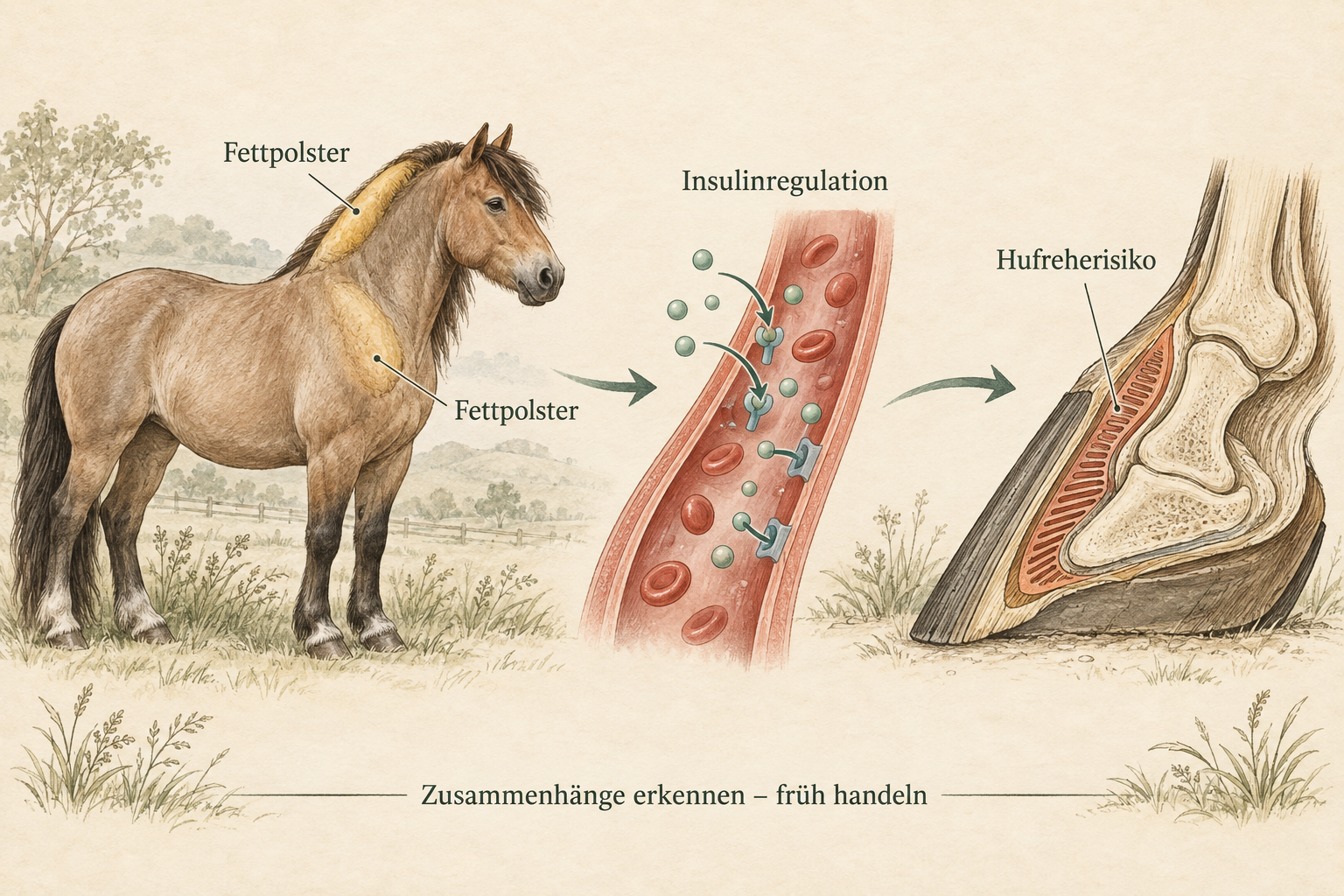
A large belly alone does not indicate how much body fat a horse carries. To do this, we have to look more closely and also feel with our hands: on the ribs, on the neck, behind the shoulder and around the base of the tail. A pronounced fat pad on the mane crest also deserves attention. Body type, muscles and fat are different things. [1]
A regular assessment of the body's condition, often called a body condition score, is helpful. There are also comparable photos and a weight check. A horse scale is particularly useful for this; a weight measuring tape can at least show changes under the same conditions. The number alone does not replace looking and feeling. [1]
I find one question very helpful: Would I notice the same figure if I saw this horse for the first time today? Sometimes you need that little step back. And sometimes a second person who looks at it in a friendly but honest way.
Your horse doesn't need you to make him feel guilty. He needs a plan that suits him and that you can implement in everyday life.
Why being overweight can be dangerous for your horse
Fat tissue is involved in metabolism. In horses at risk, the regulation of the hormone insulin may be disrupted. The Equine Metabolic Syndrome, or EMS for short, describes a constellation of risk factors in which insulin dysregulation is the focus. Obesity is common, but not every horse affected is present. Conversely, not every fat horse automatically has EMS. [2]
The connection with laminitis is particularly serious. In hormonal laminitis, excessive insulin exposure can contribute to damage to the delicate connection between the hoof wall and the coffin bone. This is very painful and can cause permanent damage. [2, 3]
And yes, such consequences can cost a horse's life. In severe laminitis, pain and damage can be so severe that a horse must be euthanized. This does not mean that every overweight horse will follow this course. But it does explain why “a little too round” isn’t a trivial beauty issue. [3]
Additional kilos also have to be carried with every movement. If exercise becomes more strenuous, the horse is less active and feeding remains unchanged, it will not be easier to get the weight back in the right direction in everyday life. That's why I want to start early, before a change in the scale becomes a serious problem.
If your horse suddenly runs sensitively, is reluctant to move or shows pain when turning, it should be checked by a vet immediately. If laminitis is suspected, please do not exercise or force exercise. [3]
Less energy, while still meeting nutritional needs
The obvious thought is: Then there will be less food. We have to differentiate. Less excess energy is different than chewing as little as possible. Horses need roughage-based feeding, sufficient activity with eating and a supply that takes their needs into account even during weight loss. [4]
That's why a sensible look at the ration starts with the whole day: What actually ends up in the horse? Hay, grass, concentrated feed, mash, treats, reward food and supplements belong together. A small shovel can be deceiving. Weighing creates clarity, and a hay analysis helps to assess the basic feed. Even “just hay” can provide more energy than this horse currently needs. [4]
Please no radical starvation diet. Instead, you need a gradually adjusted ration, suitable eating options and regular monitoring. A common agreement helps, especially in stables with several people involved: Who feeds what? What counts as a reward? How do we prevent well-intentioned extras from changing the plan unnoticed?
Fiber: The horse's intestines work properly
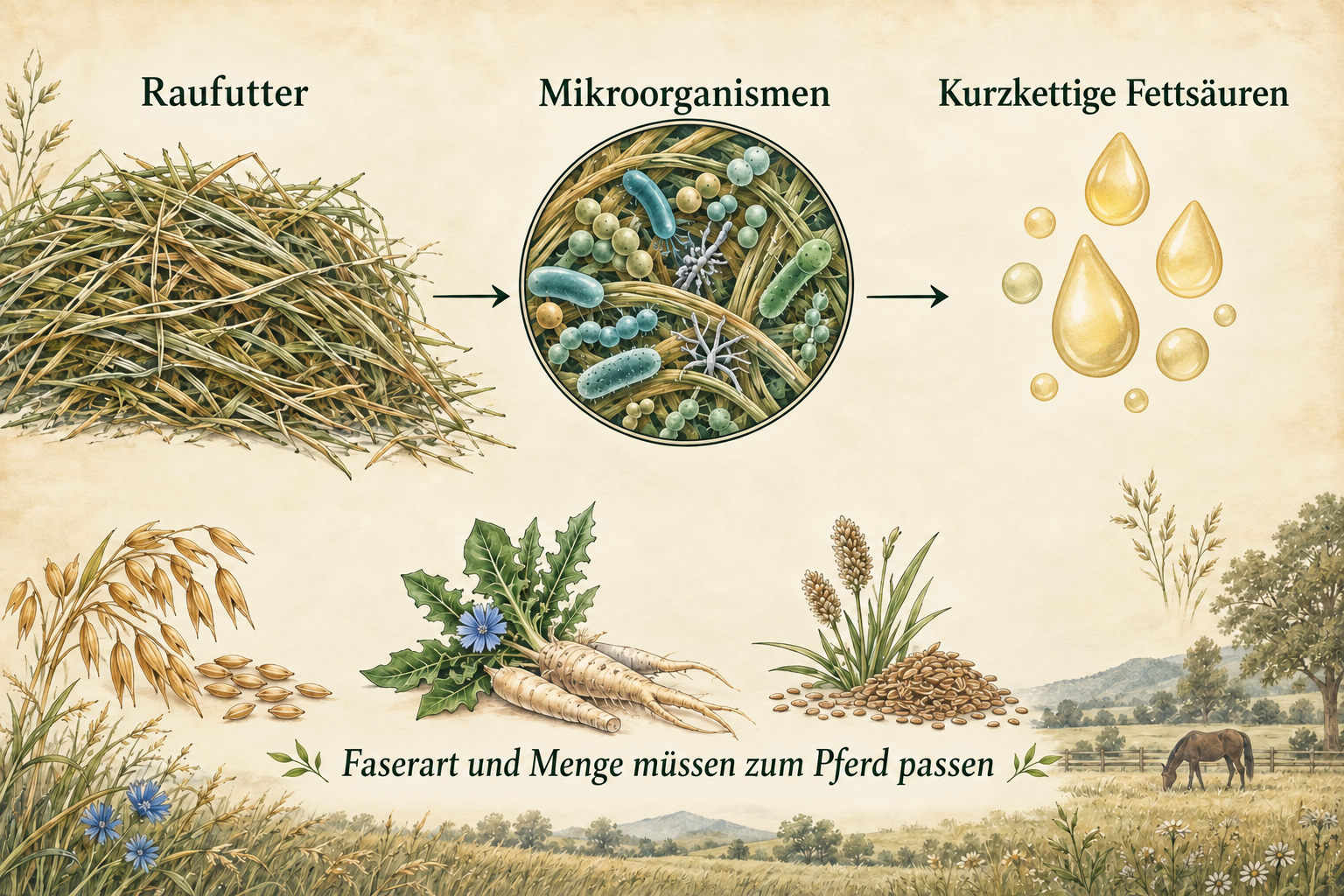
When it comes to weight, I would like to specifically think about the intestines. Horses use plant fibers with the help of microorganisms, especially in the appendix and large intestine. This fermentation produces, among other things, short-chain fatty acids that the body can use as an energy source. This collaboration is part of the horse's normal digestion. [5]
That's why "fiber" is not another word for worthless filling material. Fibers differ in how they bind water and how quickly or where they are converted by microorganisms. Long-fiber roughage has tasks that a spoonful of powder cannot take on: it has to be chewed and keeps the horse busy while eating. [4, 5]
For me, this is an important difference in advice. We look at both the basis of the feeding and the question of whether a targeted supplement actually has a meaningful place in it. Simply adding something more doesn't automatically make a ration more suitable.
What makes a diverse fiber mix interesting
Mixtures of different plant fiber sources play a role in our concern with intestinal health. These include, for example, psyllium husks, oat beta-glucans, partially hydrolyzed guar gum as well as inulin and fructooligosaccharides from chicory root. Resistant starch from corn, potatoes or green bananas is also used in such concepts. Different fibers have different properties.
The idea behind it is understandable: one mixture can provide several types of substrates for microorganisms. But when it comes to horses, we have to take a closer look. A mixture developed for humans and the amount taken are not a ready-made feeding recommendation for a horse. Especially with a sensitive metabolism, the specific composition, tolerance and the entire ration count.
It is interesting that research is looking here. A small study of 15 horses with or suspected of EMS evaluated a specific oligosaccharide supplement. Certain insulin levels fell in the geldings, but this effect was not evident in the mares. This is an avenue for further research, not evidence that any fiber blend will treat EMS or make a horse lose weight. [6]
Other studies also show that inulin and fructooligosaccharides are partially broken down microbially in the horse's stomach. The path through the digestive tract is more complex than a simple advertising graphic suggests. [7]
For me, good support begins with the question: What does this horse need in its current situation? This then determines whether and which addition makes sense.
That's exactly what we can talk about: the current food, the goal and what information is still missing. For a horse with a metabolic disorder or a horse at risk of laminitis, we coordinate supplements with the treating veterinary practice. This turns an interesting product idea into a decision that has to fit the individual horse.
Movement helps – when it matches the horse's capacity
Weight regulation also includes exercise. This does not mean suddenly putting an untrained, heavy horse through a demanding program. For a lame-free, appropriately cleared horse, regular, initially manageable sessions can be a starting point. Duration and intensity are structured appropriately.
In a twelve-week study with 24 overweight horses and ponies, adapted feeding with and without additional exercise was compared. Both groups lost weight. The additional exercise also improved insulin sensitivity. So the scale doesn't tell the whole story. [8]
In everyday life it is therefore worth asking the honest question: How much does my horse really move? Exercising creates opportunities, but does not automatically mean many active minutes. A feasible weekly rhythm, suitable paths and a sensible increase are more likely to help than a single, particularly strenuous day. And when pain limits movement, we must first understand where it comes from.

What a blood test can clarify – and where Omega-3 fits in
If your weight is noticeable or your metabolism raises questions, targeted examinations can help. If insulin dysregulation is suspected, the veterinary practice will select appropriate tests. An unremarkable general blood count does not automatically answer this question. [2]
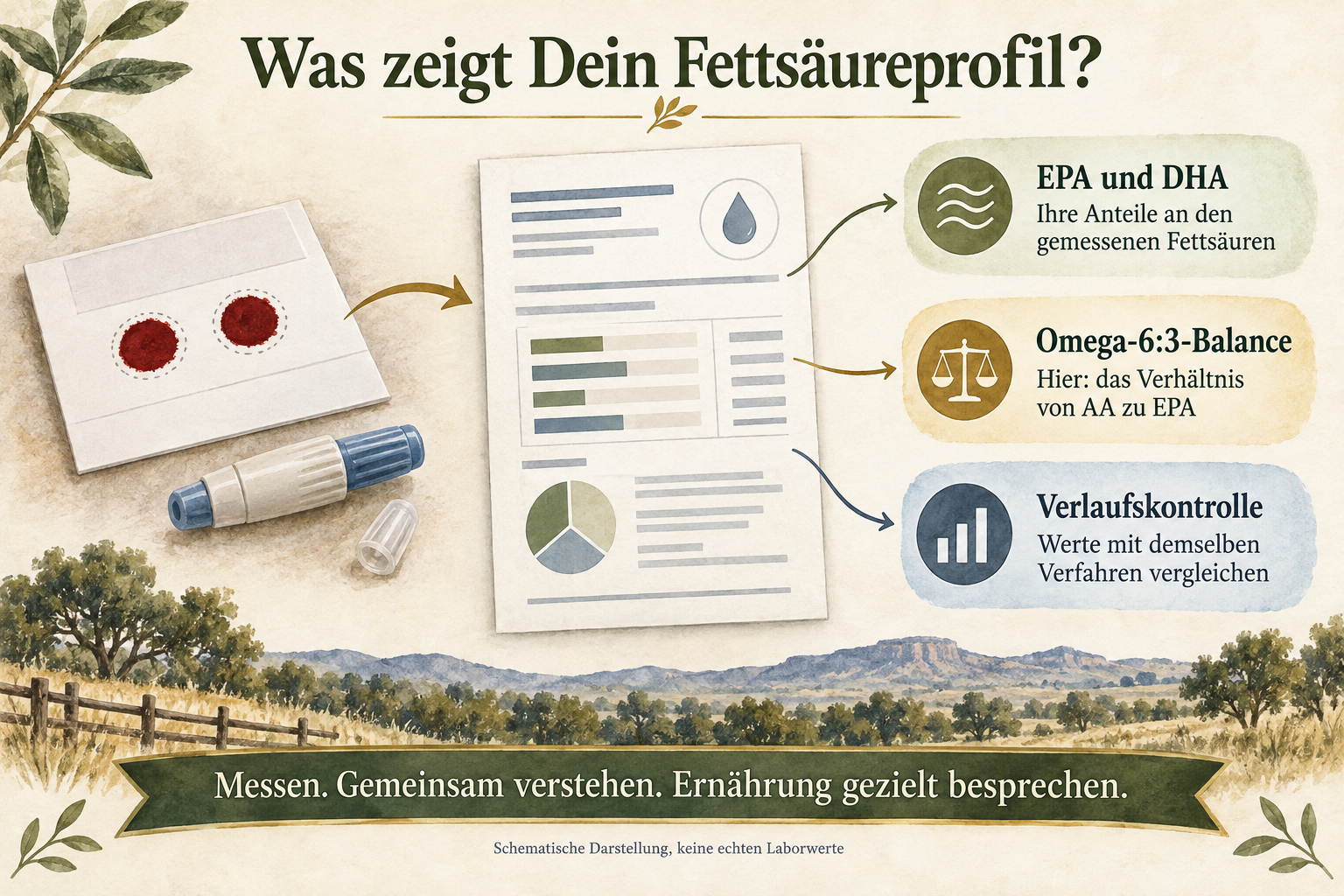
A fatty acid profile answers a different question: It shows the measured distribution of various fatty acids, including EPA and DHA. It does not replace an EMS test and does not diagnose laminitis. It can provide additional information for a targeted examination of fatty acid supply. We will discuss in advance which analysis is suitable for your specific question.
Omega-3 therefore remains a possible supplementary building block. A small pilot study on ten horses with EMS examined DHA-rich microalgae and found, among other things, changes in fatty acid levels and lower triglyceride levels. A proven treatment for EMS or laminitis cannot be derived from this. [9]
Especially for overweight horses, any addition of oil should be included in the energy calculation. I would therefore not recommend additional oil across the board while we want to save energy elsewhere. First understand the initial situation, then choose the supplement: This applies to fatty acids as well as fiber.
The first step doesn't have to be complicated
You don't have to reorganize the entire stable tomorrow after reading this article. Start by recording the current state and writing down the feeding completely. This inventory alone can make a conversation much more concrete. What has changed? What has already been tried? What can be implemented reliably in everyday life?
If you would like support with this, write to Sandra and me. We'll look at feeding, fiber, possible analyzes and the next steps with you. My wish is that you understand connections and can make decisions for your horse more consciously. Because in the end, good care means: suitable for this horse, for its health and for the life it leads with you.
Read more & explore further
Intestinal health in horses: understanding free fecal water and metabolism
Read the ProBalance article
Health & personal support
Contact ProBalance
Sources and further literature
-
World Horse Welfare: Horse nutrition essentials – body condition and needs-based feeding
https://int.worldhorsewelfare.org/advice/horse-nutrition-essentials -
Durham et al. (2019): ECEIM consensus statement on equine metabolic syndrome
https://onlinelibrary.wiley.com/doi/10.1111/jvim.15423 -
Royal Veterinary College: Laminitis - signs, treatment and possible consequences
https://www.rvc.ac.uk/equine-vet/information-and-advice/fact-files/laminitis -
World Horse Welfare: Weight management strategies for overweight horses
https://eu.worldhorsewelfare.org/index.php/advice/weight-management-strategies-for-overweight-horses -
Glatter et al. (2019): Modification of the equine gastrointestinal microbiota by Jerusalem artichoke meal supplementation
https://pmc.ncbi.nlm.nih.gov/articles/PMC6687111/ -
von Münchow et al. (2023): Oligosaccharide feed supplementation reduces plasma insulin in geldings with Equine Metabolic Syndrome
https://www.frontiersin.org/journals/microbiomes/articles/10.3389/frmbi.2023.1194705/full -
Bachmann et al. (2021): Degradation of Monosaccharides, Disaccharides, and Fructans in the Stomach of Horses Adapted to a Prebiotic Dose of Fructooligosaccharides and Inulin
https://pubmed.ncbi.nlm.nih.gov/34607684/ -
Bamford et al. (2019): Influence of dietary restriction and low-intensity exercise on weight loss and insulin sensitivity in obese equids
https://pubmed.ncbi.nlm.nih.gov/30520164/ -
Elzinga et al. (2019): Effects of Docosahexaenoic Acid-Rich Microalgae Supplementation on Metabolic and Inflammatory Parameters in Horses With Equine Metabolic Syndrome
https://pubmed.ncbi.nlm.nih.gov/31791524/
This article provides general knowledge and does not replace an examination or individual veterinary treatment. There is no promise of reliable prevention or cure through nutritional supplements.
Studies on individual types of fibers or special mixtures do not automatically prove the effects of other products. Personal advice may also include paid analyzes and supplements.
All images are AI-generated illustrations. They illustrate connections and do not show documented treatment results.
Free introductory talk at your location (German)
Understanding equine health. Making a difference together.
Do you run a riding stable, are you involved in a riding club or work in a veterinary practice, in animal physiotherapy or animal osteopathy? And would you like to give your adjusters, members, customers or your team understandable health knowledge?
Then bring us to you for a free introductory talk (German). We talk about feeding, fiber, intestinal health, obesity and the role of exercise - with reference to everyday stable life and space for your questions. We will coordinate the topic, scope and date together.
Select “Free introductory talk (German) for stable, club or practice” in the form and write to us where you are and who you would like to reach.
What does your horse need right now?
Would you like to take a closer look at your horse's feeding? Do you have questions about fiber or a suitable analysis? Write to Sandra and me. Together we will clarify what information we need to provide meaningful advice. You can also request your presentation for a stable, club or practice team here.
Please do not send emergencies or sensitive findings using the form.
Contact: marc@probalance24.com · 0170 2424828
Write to us via our contact page.
If you would like to know which products we use, please take a look here in the ProBalance shop .
Would you like to find out more about the topic and also read the scientific evidence and studies on this article? Click here.