


Does your dog keep scratching? The link between skin, feeding and omega-3
What your dog shows you by scratching and licking his paws, what role his supply plays and when Omega-3 can be usefully supplemented.
You are grooming your horse and your dog is scratching itself again next to the tack room. Shortly afterwards he nibbles on his paws. Licking takes place on the way home and continues on the carpet in the evening. At some point you ask yourself: Is this still normal?
For many of us, our dogs are a natural part of everyday horse life. They wait at the paddock, accompany us across the yard and find their place between the cleaning box and the stable bag. Sandra and I include Benny and Nala. That's why I'd also like to look at their fellow dogs: dogs whose skin just can't calm down.
Because constant scratching quickly gets lost in everyday life. Until the first bald spot is noticed. Or until you notice how often the dog interrupts your sleep. Then suddenly there are various food bags, oils and care products in the cupboard. All well-intentioned. But which of these really fits together?
That's exactly what I want to talk about. About looking carefully, caring for the skin and what role Omega-3 can play in certain skin problems.
When scratching deserves a closer look
A quick scratch doesn't cause a skin problem. However, if your dog repeatedly works on the same areas, licks his paws extensively or scratches himself sore, it is worth taking a closer look. Itching can have different causes: for example parasites, allergic diseases or skin infections. The cause cannot be determined from scratching alone. [1]
Even “I don’t see any fleas” doesn’t fully answer the question. Nor does paw licking automatically mean that the food is to blame. The veterinary examination helps narrow down the possibilities step by step. If you have open, weeping or painful areas, you shouldn't wait. [1]
Your observation is valuable for the conversation. Since when has it been noticeable? Where does your dog scratch or lick itself? Is it different outside than at home? Has anything changed in terms of food, care or environment? Such information is more tangible than “He somehow scratches a lot”.
Your dog can't explain to you what itches him. But you can take his signals seriously and help ask the right questions.
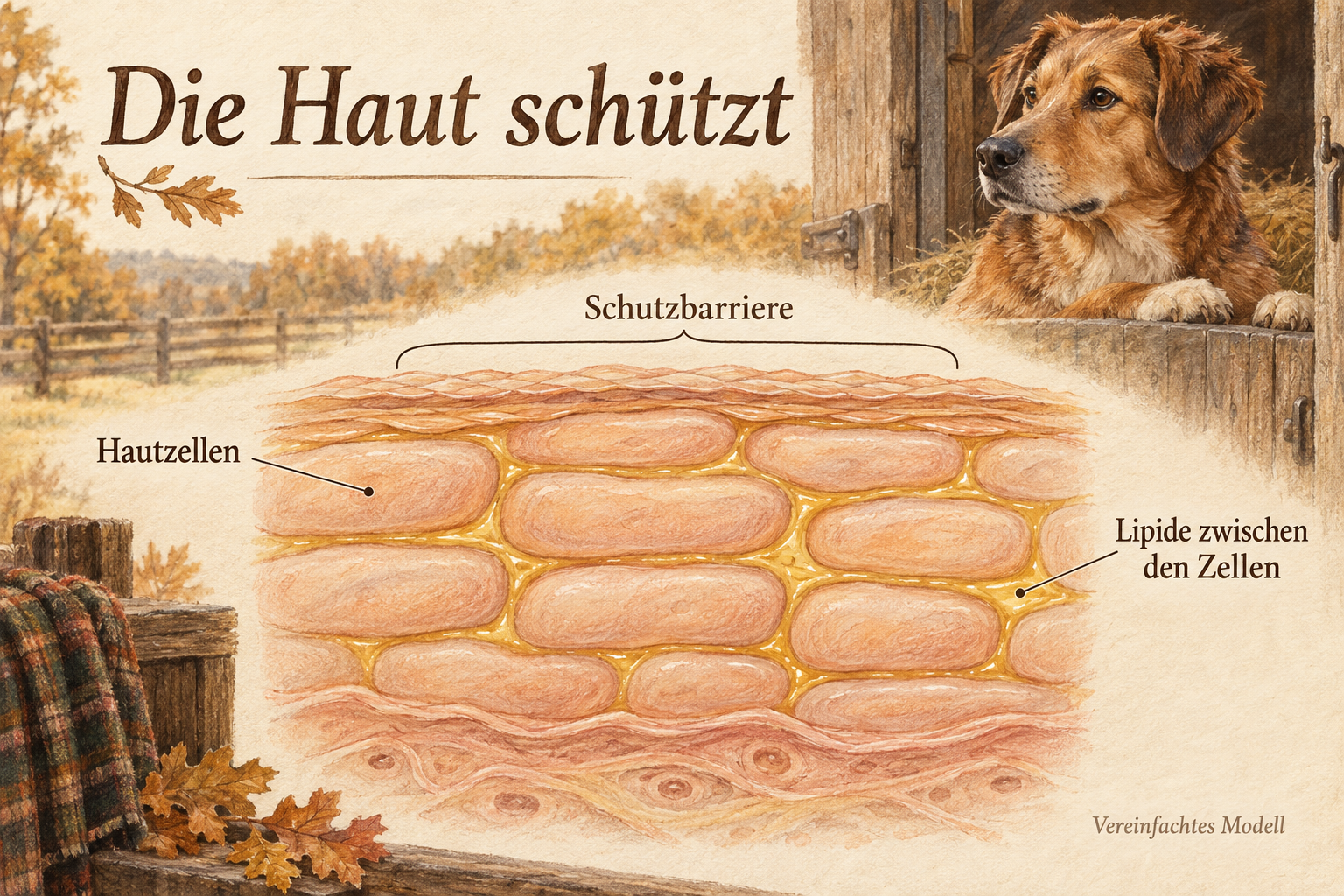
There is a protective layer under the fur
When we think of skin, we usually see fur, maybe some dandruff, or a reddened area. But the crucial work also happens where we cannot look directly.
In simple terms, the outer layer of skin can be compared to a wall: skin cells form the building blocks, with lipids, i.e. fat-like substances, lying between them. Together they help to retain water in the skin and ward off external influences. In dogs with atopic dermatitis, an inflammatory skin disease caused by allergies, this protective function may be disrupted. The interaction between the skin barrier, immune system and environment is complex. [2]
Nutrition therefore comes into the picture. The skin needs an adequate supply of nutrients. The important fatty acids also include linoleic acid from the Omega-6 family. Declaring Omega-6 to be an enemy across the board would fall short, especially when it comes to the skin. EPA and DHA from the Omega-3 family play a role in, among other things, inflammatory processes. Your tasks are not easily interchangeable. [2]
For me, this leads to a practical question: What does this dog already get, and what could be usefully supplemented in his specific situation? The answer lies neither in the shine of the fur nor in a particularly convincing label.
Omega-3 for itching: what has really been studied?
I'm interested to know if an idea has also been studied in dogs. After all, the fact that a fatty acid has a function somewhere in the body does not say how much a particular dog will benefit from an additional dose.
A 2024 study looked at 22 dogs diagnosed with atopic dermatitis. They were already given medication for itching. A specific oil containing EPA and DHA was also compared with a placebo over 16 weeks. The study was randomized and double-blind. [3]
In the supplement group, the amount of medication required decreased over time; In the end, the itching rated by the owners was also lower than in the comparison group. However, the veterinary evaluation of the skin changes did not reveal any corresponding difference. This is an interesting suggestion of complementary benefits, not evidence that oil treats all itchy skin. [3]
The study was small and was financed by the provider of the product being investigated. This specific product was examined in addition to an existing treatment - not our oil and not every dog that scratches itself. Medicines are therefore not reduced independently. [3]
Despite these limitations, I find the approach relevant. Because it's a question that concerns many owners: In addition to the necessary treatment, what else can I do to care for my dog?
A sensible addition has a comprehensible place in the overall plan: We know why we choose it, what we observe and when we discuss the process.

What's already in the bowl?
Maybe you feed a complete feed that already provides certain fatty acids. Your dog may also receive a skin product, an oil and various treats in between. I would like to look at these things together for advice.
This doesn’t have to be a complicated project. Photos of the complete labels and an honest list of daily quantities will help. What your dog gets at the stable is also included. Not as an accusation - but so that we are talking about the same actual feeding.
With an omega-3 oil, it is the amount of EPA and DHA per serving that counts. “One teaspoon” initially only describes the amount of oil. In addition, there is the complete recipe, possible additional nutrients added, the previous supply and the tolerability. We do not simply adopt a dosage for humans for a dog.
A suitable source of microalgae can also be taken into account when selecting the product. What remains crucial is what the specific recipe delivers and whether it suits the dog. The origin alone does not provide proof of effectiveness for itching.
Sandra and I would like to help at exactly this point: sort the information, check a suitable supplement and discuss the individual application with you. It's not about putting as many bottles next to each other as possible. It's about understanding why something goes into the bowl.
If a veterinary-supervised exclusion diet is currently in progress, oils, treats and other supplements must also be agreed upon in advance. Otherwise, an additional product can affect the effectiveness of the diet. [1]
And what can a fatty acid test contribute?
A fatty acid profile can answer the question about the fatty acids measured in the blood material examined. Whether an analysis makes sense and is suitable for your dog, which comparison values are used and what can be derived from it all belong in a personal conversation.
Such a profile is not an allergy test. It does not show whether your dog is reacting to a certain food or to environmental allergens, nor does it automatically explain his itching. Human target values are not a standard that we can transfer to dogs without checking.
If you would like to get to know his care in more detail, you can contact us. We will then clarify which question you want to answer and whether a suitable analysis will really help. The starting point remains your dog with its history, its feeding and what has already been examined.
Small notes can provide a lot of clarity
For everyday life, I would keep it simple: Make a quick note of where and how often your dog scratches itself, whether it rests at night and whether any areas of the skin change. Photos in similar lighting can help with later comparison. Also write down when food, care, supplements or medications were changed.
This gradually creates a comprehensible progression. When several things have been changed at the same time, an improvement cannot honestly be attributed to a single bottle. Nevertheless, it is valuable to see how your dog is doing overall and what next steps make sense.
I think it is precisely this attentive look that connects horse and dog people. We know our animals in everyday life. We notice when something is different. This knowledge can have its place in the conversation - together with a sensible examination and carefully considered care.

Your dog is part of it. His skin health too.
Maybe the cause is already known and you are looking for a suitable nutritional supplement. Maybe there are now three opened products at home and you would like to finally know which ones actually go together.
Then write to Sandra and me. Tell us what you notice, what has already been clarified and what food and supplements your dog gets. Together we will see whether and how a targeted supply of fatty acids can usefully complement your support.
You don't have to choose the right composition and quantity from contradictory tips. We can talk about exactly that. So that well-intentioned turns into an understandable next step tailored to your dog.
Sources and further literature
1. AAHA (2023/2025): Diagnosing allergic skin disease in the canine patient. Technical diagnosis and significance of the previous history; no diagnosis based on individual symptoms.
https://www.aaha.org/trends-magazine/publications/diagnosing-allergic-skin-disease-in-dogs/
2. Review (2024): Canine Atopic Dermatitis: Prevalence, Impact, and Management Strategies. Overview of the skin barrier, disease mechanisms and support; no study on our product.
https://doi.org/10.2147/VMRR.S412570
3. Schäfer & Thom (2024): A placebo-controlled, double-blind study evaluating the effect of orally administered polyunsaturated fatty acids on the oclacitinib dose for atopic dogs. 22 dogs, 16 weeks, specific supplement in addition to treatment; financed by the provider of the study drug.
https://doi.org/10.1111/vde.13246
4. AAHA (2023): Acute Flare and Long-term Management Therapies in Dogs. guideline overview; essential fatty acids as a possible long-term supplement, not for treating acute flare-ups.
5. Olivry et al., ICADA (2015): Treatment of canine atopic dermatitis: updated guidelines. Older consensus guidelines on the benefits and limitations of essential fatty acids; no general superiority of a particular mixture.
https://doi.org/10.1186/s12917-015-0514-6
This article provides general knowledge and does not replace a veterinary examination or treatment. If you have open, weeping or painful areas of skin, please seek veterinary help promptly.
The sources concern specific diseases, products and treatment situations. They do not prove any effect of our specific oil. A fatty acid profile is not an allergy test; Analysis and additions are checked individually.
All images are AI-generated illustrations. The dogs and people depicted are freely designed motifs, no images of Benny, Nala, Marc or Sandra and no documented treatment cases.
For stables, clubs and practices
Free introductory talk at your location (German)
Understanding animal health. Taking a closer look together.
Do you run a riding stable, are you involved in a riding club or work in a veterinary practice, in animal physiotherapy or animal osteopathy? And would you like to give your adjusters, members, customers or your team understandable health knowledge?
Then bring us to you for a free introductory talk (German). We talk about needs-based feeding, fatty acids and health support for horses and dogs - with reference to everyday stable life and space for your questions. We will coordinate the topic, scope and date together.
Select “Free introductory talk (German) for stable, club or practice” in the form and write to us where you are and who you would like to reach.
What does your dog need right now?
Would you like to take a closer look at your dog's feeding and know whether a suitable supply of fatty acids can complement his support? Write to Sandra and me what has already been clarified and what food and supplements your dog is getting. You can also request a introductory talk (German) for your stable, club or practice team here.
Contact: marc@probalance24.com · Write to us via our contact page.
If you would like to know which products we use, please take a look here in the ProBalance shop .
Would you like to find out more about the topic and also read the scientific evidence and studies on this article? Click here.