
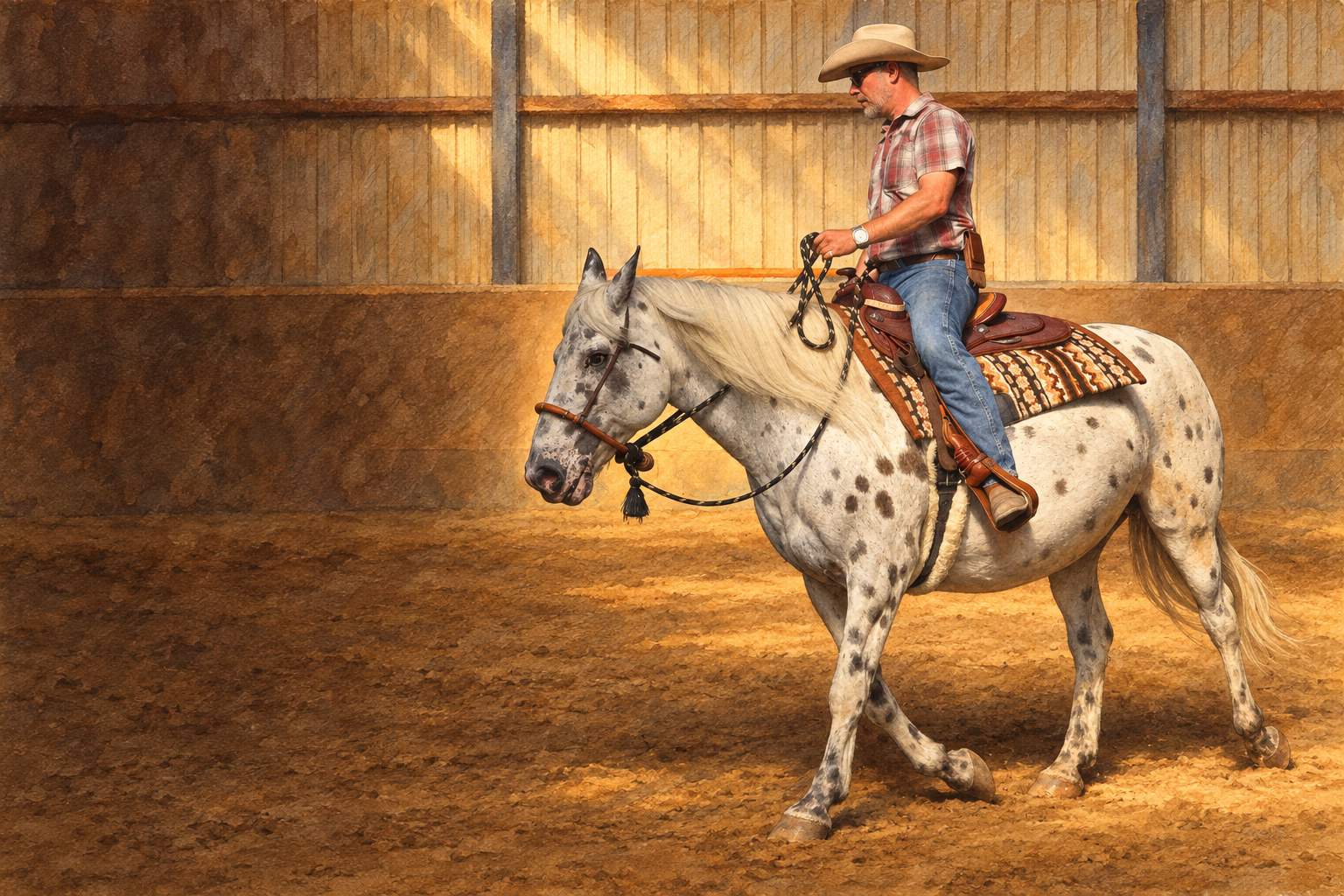
Understanding the bosal: What it does and how it works
Understanding equipment · Part 2 of 5: Origin, structure and the interaction of fine riding aids, balance and yield.
You stand next to your horse and hold a bosal in your hand. A braided nose piece, a narrow leather strap, a long rope. This looks pretty unspectacular at first. And with that you should be able to train a horse, do gymnastics and maybe even ride it one-handed at some point?
That's exactly what I find so exciting about this tool. Its possibilities are not revealed by looking at a sales photo. You need to understand how the parts work together – and what your horse can learn from it.
The first part of our equipment series was about looking at bridles more consciously. Now let's take a closer look at the bosal. You know by now: I really enjoy riding it. I am particularly excited about the moment when a little help becomes an understandable answer and my hand can become steady again.
From cattle work to a fine riding tradition
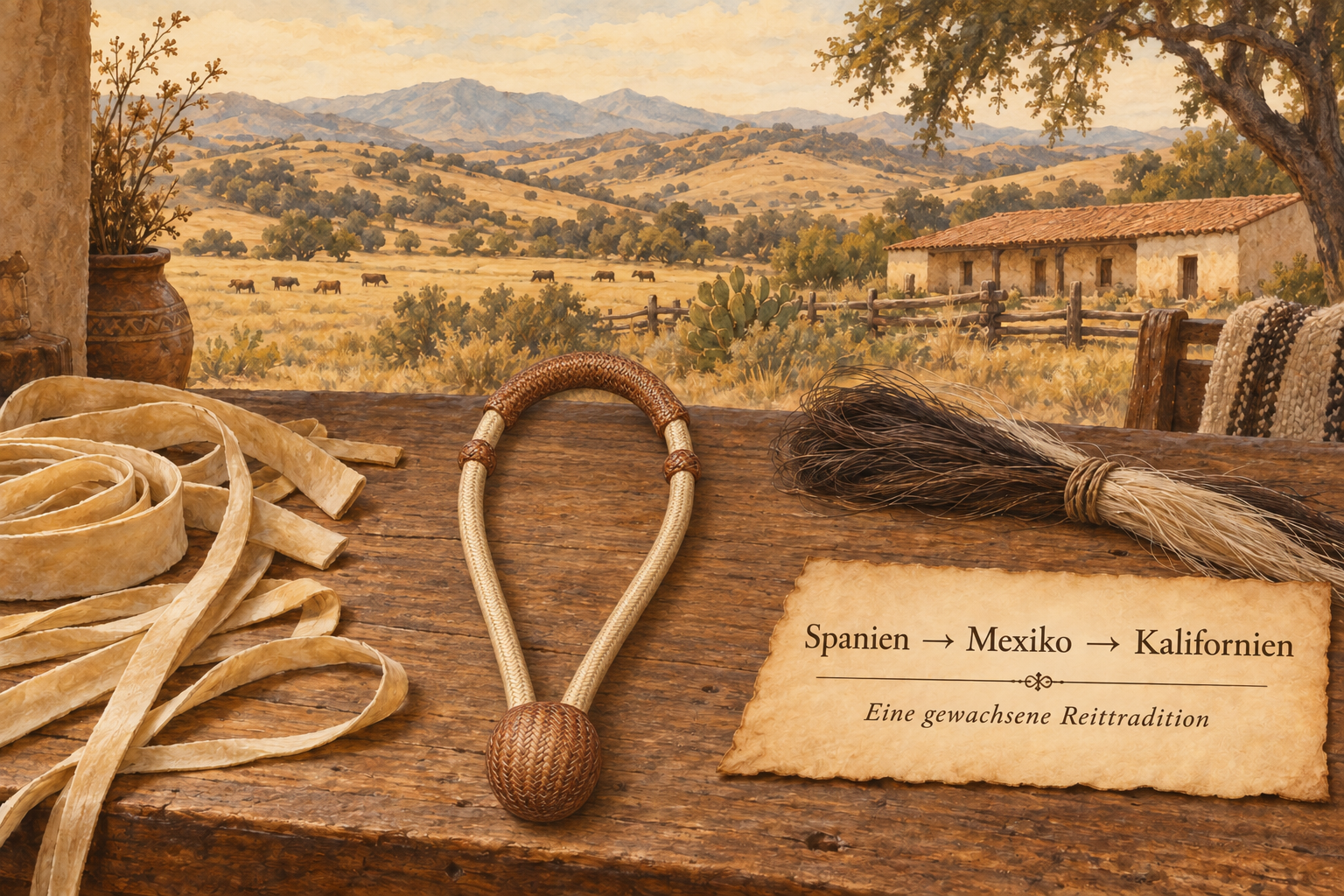
The story takes us via Spain and Mexico to California. Horses came to America with the Spanish colonization voyages; Columbus brought them to the Caribbean on his second voyage in 1493. However, today's Bosal did not suddenly emerge from this. Centuries of development lie between these early journeys and the later California equestrian tradition. [1]
With horses and cattle, knowledge of mounted livestock work also spread. On the ranchos, horses were needed to accompany herds, separate individual animals and quickly change directions. If one hand was busy with the rope, communication had to work even with little use of the reins.
This culture was shaped by Spanish, Mexican and indigenous communities. Indigenous horse people were themselves skilled riders and designers. But history also includes loss of land and colonial rule. Anyone who appreciates the art of horsemanship should let the people behind it be visible and not romanticize these conditions. [2, 3]
Rawhide, leather and horse hair were materials used in everyday work. A shape-retaining, yet somewhat flexible nose piece could be woven from rawhide. A rope made of horse hair could serve as a reins and lead. Craftsmanship, available materials and practical requirements shaped the equipment. [4]
Why rawhide? A question of available material
Imagine you need a usable bridle for daily work with your horses. What materials can you get and process locally? It is precisely this practical perspective that makes an explanation of the origin of the bosal particularly interesting for me.
The article “The Hackamore: A Tool of the Old West” connects the development of a Peruvian rawhide bridle with scarce metal. This idea sounds understandable to me: when metal is difficult to obtain, other materials become interesting. Rawhide offers special possibilities - it can be braided and shaped and can create a shape-retaining, yet limitedly flexible nose piece. [4, 10]
Personally, this explanation seems more plausible to me than the story of a metal ban that was also told. However, neither of the two explanations has been conclusively proven historically. It is an origin story that shows how closely craftsmanship, available materials and the demands of the work could be related.
Our manufacturer in Peru also traces the roots of his craft tradition back to the Spanish colonial period. For me, this gives the bosal an additional meaning: behind the braided nosepiece are people who pass on their knowledge about materials and processing.
An exact year of origin of today's bosal cannot be determined from this. The Hood Museum, for example, preserves a bitless hackamore from the late 19th to early 20th centuries. It is a tangible historical testimony; However, their age neither marks the beginning of the traditional tradition nor does it prove that no older evidence exists. [9]
For me, the main thing behind this story is the collaboration between people and horses. This work culture also gave rise to the Californian training tradition, in which Bosal still has a firm place today.
Five terms – and suddenly the whole thing becomes understandable
When we say “I ride in the bosal”, we usually mean the complete bridle. Strictly speaking, Bosal refers to the braided nose piece. Together with the headpiece and mecate it forms the traditional hackamore. Depending on the version, additional parts are added. This system cannot be equated with a mechanical hackamore with metal suits. [4, 5]
Nose button: the nose part
The more heavily braided section lies over the bridge of the nose. It should fit the shape of the nose and allow for even support. Its surface, shape and strength influence how movement feels for the horse.
Cheeks: the two side parts
The slimmer sides lead downwards from the nose part. Its shape determines how the bosal lies and how it moves in relation to the lateral and lower areas of the jaw when it is helped. They are not metal suits like a mechanical hackamore.
Heel Knot: the lower part
This is where the two sides meet. This braided finishing knot is different than the mecate tied over it. It provides the lower support and contributes to the balance of the entire bosal with its weight.
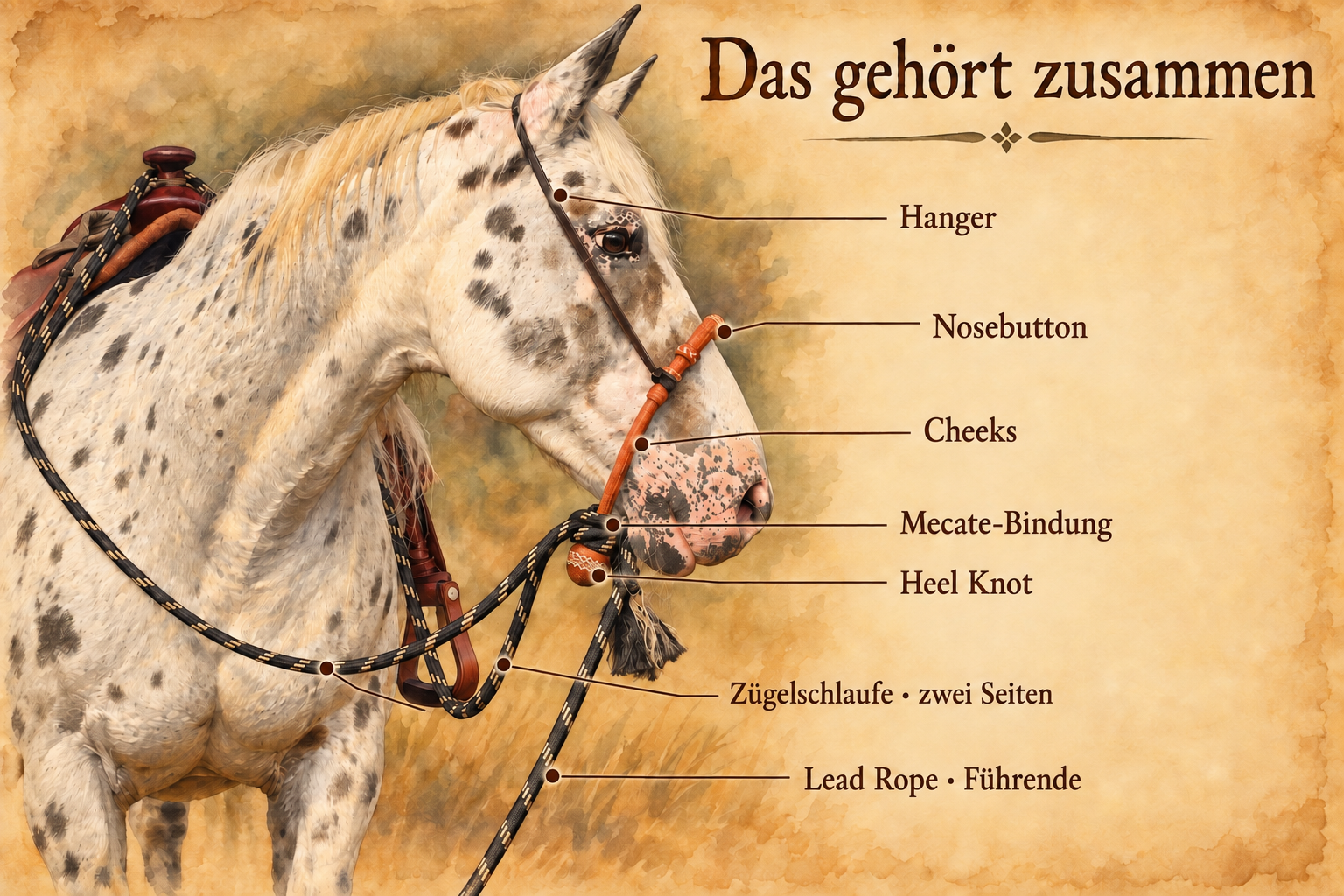
Hanger: the headpiece
The hanger carries the bosal on the horse's head. A suitably built, supple hanger gives him the mobility he needs. Its attachment, length and position are therefore part of the adjustment. It must neither get into the eyes nor rub there.
Mecate: reins and lead line made of a rope
The mecate is tied around the two side parts above the heel knot. Two tasks arise from a single long rope: a closed rein loop and a long leading rope, the so-called lead rope. The rein loop lies on the horse's neck with one side on the left and one on the right. The leader steps out of the binding at the front. There is no third in and not even the short tassel on the knot. [4]
This is where the origins of work equipment become particularly clear: when a vaquero dismounts, for example to work on cattle, he already has his lead rope with him. The free end is traditionally also tucked loosely under the belt. It is not tied to the body and must be able to come loose when pulled. This means that the connection to the horse remains available in everyday work without having to put on another rope. [8]
Traditionally, horse hair is often used; today there are also other materials. What's important is the right properties and correct binding - not that a rope pinches your neck as much as possible. [4]
What happens when you pick up the Mecate?
First imagine the bosal in its calm starting position. The horse carries it, the reins hang without constant pulling. If you pick up the mecate, you change the position and load on the lower bosal area.
Depending on the direction of the help, this area lifts or shifts. The bosal tilts and rotates slightly relative to the horse's head. The support changes on the nose part; the side sections can also come closer to the lower jaw. Your horse feels this change. [5]
In practical language we often talk about a rolling movement. What is meant is this small change in position of the shaped bosal. The nose part is not a freely rotating roller. It shouldn't rub back and forth across the nose either.
How much movement occurs and where contact occurs depends on the fit, head shape, material, binding and direction of the reins. That's why a properly tuned bosal can feel significantly different than one that only roughly fits over the nose.
Laterally and vertically: What answers can come from this?
“Lateral” initially means sideways. With one-sided help, the load on both sides changes differently. A suitably trained horse can understand this as a request to stand or change direction. The seat and thighs remain part of the communication.
“Vertical” describes the other level: A horse can learn to give way in the poll and change its head and neck position in response to coordinated help. The bosal offers tactile signals for this. But it doesn't teach the horse their meaning on its own.
It's important to me that we don't just look at the nose. A horse can hold its head close and still run on its forehand. Carrying capacity, uprightness and gathering arise from the training of the whole horse. The bosal can be a tool; it does not automatically raise the shoulder.
I want to be able to explain something clearly with my hand. Then my horse should find the answer with less and less support. For me, this is exactly what makes this bridle so attractive.
A bosal transmits an aid. Your horse will learn with you what this help means.
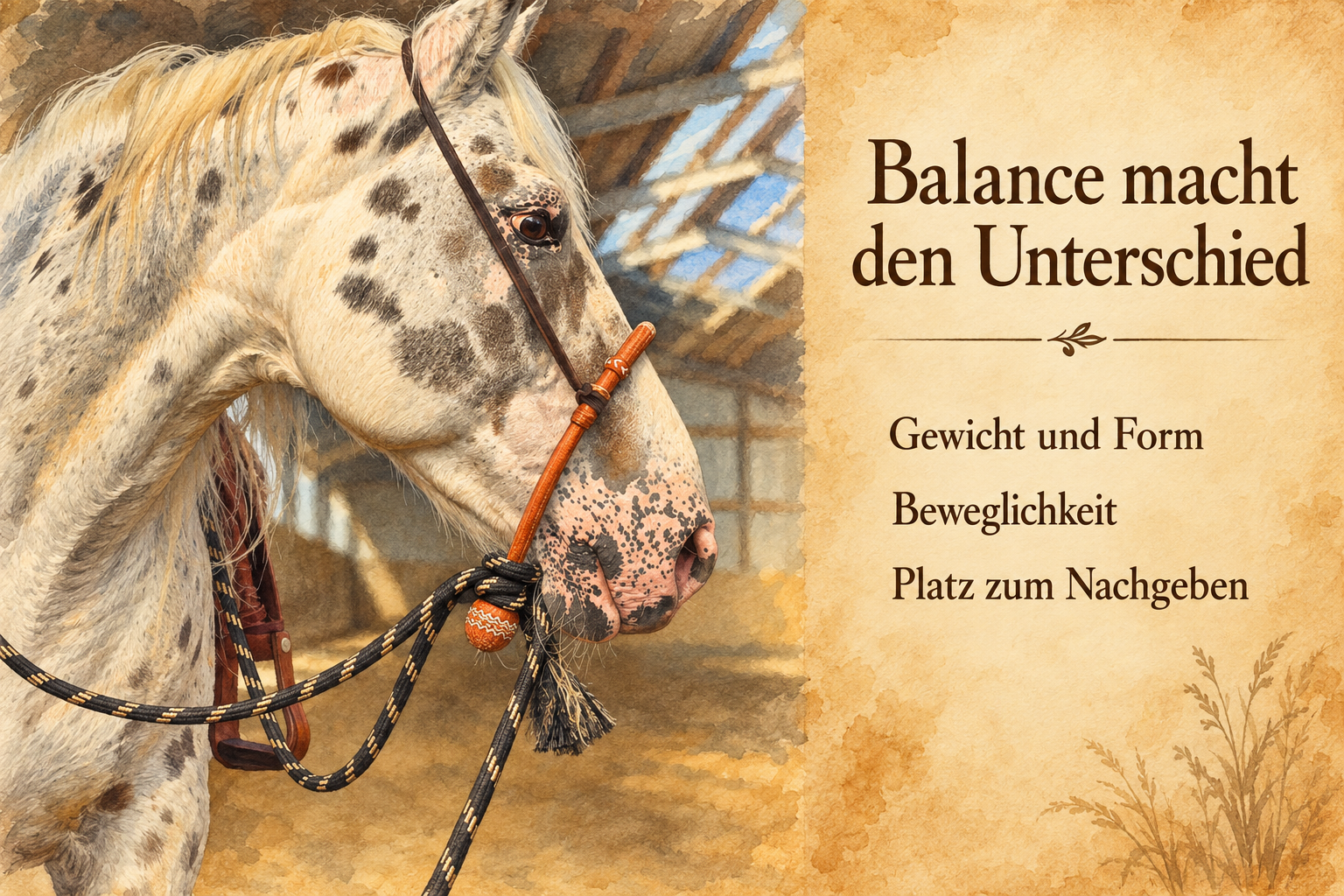
Balance and Release: The answer has to be worth it
Maybe you know this from a completely different everyday situation: someone puts a hand on your shoulder to get your attention. You turn to him - but the hand just keeps squeezing. At some point you no longer know what to do anymore.
With the horse, the decisive moment is similar: it tries to find an appropriate response, and the additional stress has to subside. We call this yielding release. The training principles of the International Society for Equitation Science emphasize understandable signals, small learning steps and the timely release of pressure. Constantly asking questions with your hand makes communication difficult. [6]
With Bosal, Release also has a craftsman side. If you give in, the bridle must be able to find its way back to its unloaded starting position. Weight at the bottom, appropriate shape and sufficient room for movement contribute to this. If the bosal is stuck or is hindered by its fastening, your relief may not be the way you intended. [5]
Balance therefore does not mean “as difficult as possible”. More Mecate wraps change both the width and the weight distribution. Bosal, Hanger and Mecate must fit together. The horse should be able to perceive a little help - and just as clearly notice when it is over.
For me, the most important question is not just: How will my help be received? But also: How well can I let them go again?
Why does it feel different than a sidepull?
With sidepull, the rein attachments are located on the side of the nose section. Help will be initiated there. With the Bosal, the attachment points of the mecate are at the bottom of the tied area above the heel knot. Together with the shape of the nose piece, this creates a different sequence of movements and contact. [5, 7]
Even with a sidepull, a horse can learn to yield laterally and in the poll. Both bridles can convey such answers - via differently structured signals, the meaning of which the horse first has to learn.
Why do I have to accept the more complex adjustment for the Bosal?
The question is legitimate. If a sidepull is structured more clearly, why am I so concerned with Bosal, Hanger and Mecate?
For me, the appeal lies in the small change in position of the nose piece that my hand can trigger and the subsequent giving way. If I release the Mecate, the appropriately balanced Bosal should be able to relieve the load immediately. Its weight distribution helps reduce the pressure under the chin. [5]
My goal is for my horse to notice a subtle change, respond to it and immediately feel: Yes, that was what was meant. I like to take my time when selecting and adjusting. A bosal that gets stuck or doesn't find its way back to its original position would make this interaction more difficult for me.
With the Bosal I have experienced horses that seemed happier, were less upset and responded more sensitively to my riding aids. These personal experiences are the reason why I enjoy working on it so much. For me, this signaling fits particularly well with the riding style that I want to develop.
Whether a horse responds to lighter riding aids also depends on his training and my hand. A fundamentally faster release than with sidepull is not proven. My preference is based on what I have experienced with properly tuned Bosals; another rider may be just as happy with a suitable sidepull.
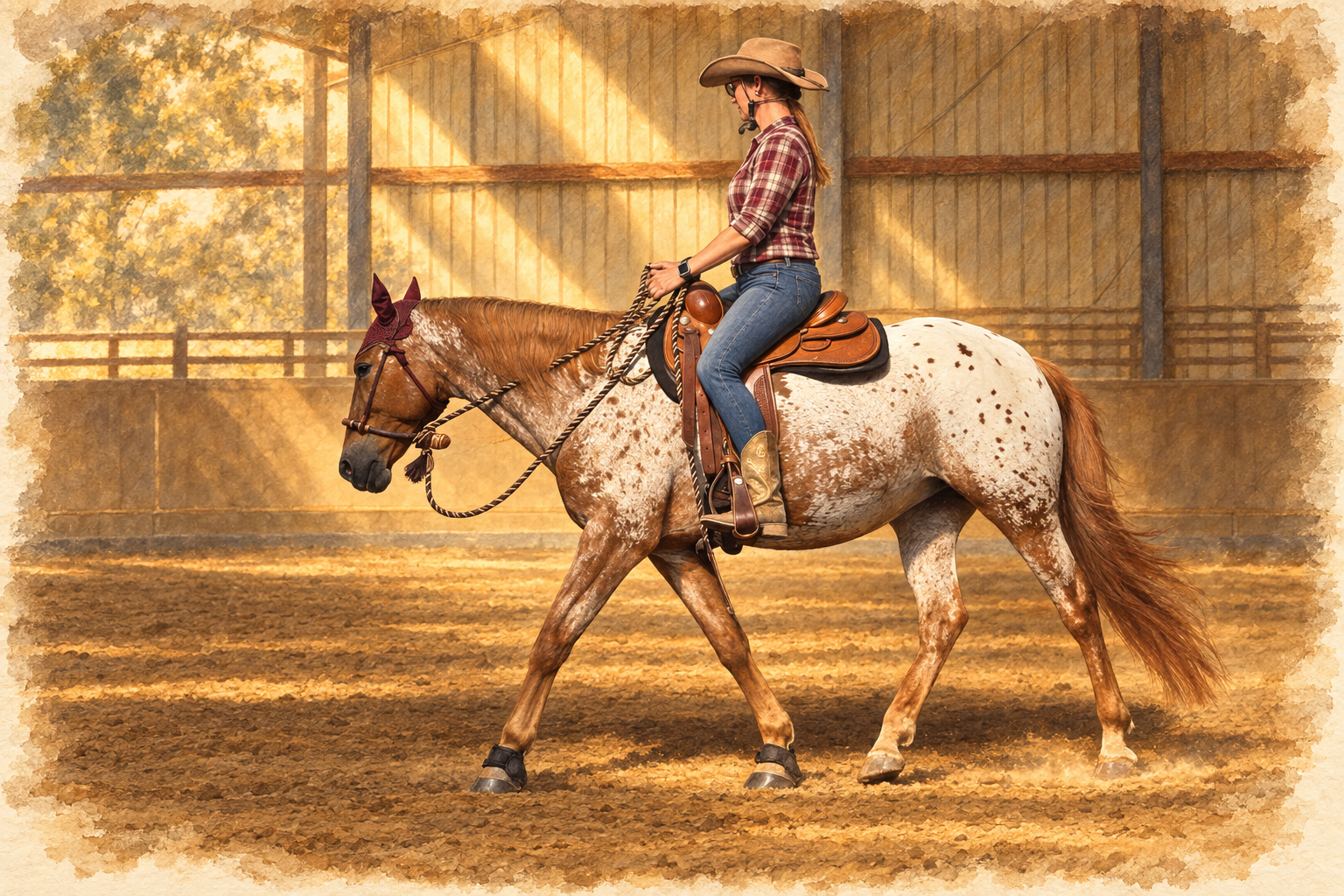
And what is the difference to the mechanical hackamore?
A mechanical hackamore has side suits. When you pick up the reins they rotate; Nose piece, chin strap or curb chain and head piece form a lever system. Length, arrangement and fastening influence the power transmission. [7]
The traditional bosal does not have this combination of metal suits and chin chain or chin strap. It works via its shaped nose piece and its movement. However, no general formula such as “always exactly one to one on the hand and on the nose” can be derived from this. Here too, angles and contact surfaces determine what reaches the horse.
Both systems should therefore be explained separately. The common name “Hackamore” does not make them the same tool.
The fine help starts with the fit
When it comes to the saddle, you probably wouldn't say: "It's about right, it's enough for the first few weeks." The Bosal is worth the same careful look.
The nose part belongs to the load-bearing area of the bridge of the nose. The shape and inner width must fit the horse's head and the eyes must remain free. The system needs room to move at the bottom without slipping uncontrollably. A certain number of wraps or fingers does not replace the assessment of the respective horse.
Strength and surface also count. The customs information describes a material thickness, not automatically the right size for your horse's head. And “thinner” or “softer” alone cannot reliably be used to derive “softer”. Pressure, friction and unpleasant effects are also possible with a Bosal. After all, the nose is also sensitive.
For me, selection, adaptation and first use belong together. A beautiful braided pattern can inspire me. What remains crucial is how the entire system sits and works on the horse.
That's exactly where we'll continue in the next article in our equipment series: We'll take a closer look at the fit, show you how to find a suitable bosal and measure your horse's head correctly to determine the size you need. So that you know what to pay attention to when making your selection.
Where can this path lead you?
Whatever you develop from this may suit you and your horse. The Bosal opens up a path of training without committing you to a specific end goal.
You can continue training your horse in a bosal with two hands and later ride one-handed once the horse understands the aids. The traditional Californian path can lead through the two-rein phase, using a thin bosal together with a bit, to a fully trained bridle horse. [4] This is an option, not a requirement. A well-trained bosal horse does not have to move on to a curb bit to be considered 'finished'.
If you would like to find out whether the Bosal suits you, write to me. Tell me about your horse, your previous bridle and what you want from riding. Then we can talk about a suitable bosal and an understandable introduction.
For me, the fascination lies precisely in this: a tool that appears simple at first glance can make a lot possible if we take the time to really understand it.
Sources and further literature
-
Smithsonian, National Museum of the American Indian: After a Long Absence – The Horse Returns. Historical classification of the return of horses to America.
https://americanindian.si.edu/exhibitions/horsenation/return.html
-
Smithsonian, Native Knowledge 360°: California Native American Survival and Resilience During the Mission Period. Historical sources and indigenous perspectives on the colonial mission period.
-
National Park Service: Rancho de las Cabras. Indigenous vaqueros and colonial ranching; regional example from Texas.
-
Gail Hought: Tying the Mecate. Technical source on the structure, binding and terms of traditional hackamore.
-
University of Missouri Extension: Pre-Bit Hackamore Training. Older textbook on construction and signal transmission; no blanket instructions for adapting or adopting all training methods.
-
International Society for Equitation Science: Ten Training Principles. Understandable signals, small learning steps and timely giving in.
-
Oklahoma State University Extension: 4-H Horse Quiz Bowl Manual, Glossary. Definitions of sidepull and mechanical hackamore.
-
Buckaroo Leather: Mecate, Bosal, Hackamore Vaquero Tack. Practical description from the manufacturer on the use of rein loops and leaders.
https://buckarooleather.com/blogs/buckaroo-johns-blog/mecate-bosal-hackamore-vaquero-tack
-
Hood Museum of Art, Dartmouth: Horse Bitless Bridle (Hackamore), late 19th to early 20th century. Historical collector's item; no evidence of the date of origin of today's bosal.
-
Part-Time Cowpoke: The Hackamore: A Tool of the Old West (2022). Origin story from the equestrian scene about metal shortages and rawhide; no primary historical evidence.
https://parttimecowpoke.com/2022/07/30/the-hackamore-a-tool-of-the-old-west/
The sources complement the explanation of history, crafts and training. They are not proof that a bridle is superior for every horse.
My personal experiences can be recognized as such in the text. Adaptation and application must suit the respective horse and rider.
The AI-generated illustrations illustrate the structure and connections. They do not replace adjustments to the horse or practical instructions for tying the mecate.
For stables, clubs and practices
Free introductory talk at your location (German)
understand bridles. Communicate more finely with each other.
Do you run a riding stable, are you involved in a riding club or work in a veterinary practice, in animal physiotherapy or animal osteopathy? And would you like to give your adjusters, members, customers or your team understandable knowledge about horse-friendly equipment?
Then bring us to you for a free introductory talk (German). We talk about bridles, how they work, the importance of a light hand and the possibilities of the bosal - with reference to everyday stable life and space for your questions. We will coordinate the topic, scope and date together.
Select “Free introductory talk (German) for stable, club or practice” in the form and write to us where you are and who you would like to reach.
Which bridle is right for you?
Would you like to understand your bridle better or are you interested in a suitable bosal? Tell me about your horse, your previous equipment and your questions. Together we will clarify the next step. You can also request a introductory talk (German) for your stable or club here.
Contact: marc@probalance24.com · Write to us via our contact page.
If you would like to know which products we use, please take a look here in the ProBalance shop .
Would you like to find out more about the topic and also read the scientific evidence and studies on this article? Click here.