

Good blood results. A well-nourished horse?
What the blood count, feeding and fatty acid profile tell us - with a personal look at our experiences with Valea.
“The blood work is fine.” First of all, a sentence that makes you happy. After all, you want your horse to be well. And yet you might be standing in the feed room the next day, looking at the hay, mineral feed and the various supplements and asking yourself: Does it all actually fit together? Is my horse really getting what it needs?
I think this question is absolutely legitimate. Sandra and I know this from our own horses. You care, read, ask questions and don't want to overlook anything. At some point you will have some information together - but not necessarily a comprehensible overview. That's exactly what I want to give you with this post.
Because “blood examined” does not automatically mean “the entire supply is checked”. If we understand what question an investigation answers, we can do something with its results in a much more targeted manner.
A lab note answers the questions we ask it
In the stable, we quickly say “blood count” and by that we mean everything that appears on the report after a blood sample. From a medical point of view, this is a little more precise: A blood count primarily examines the blood cells - for example red and white blood cells and platelets. Other examinations can provide additional information about organs or individual nutrients, for example. What was actually checked is stated in the respective report. [1, 2]
Imagine the following everyday situation: You are having a blood test done on your horse. The treating veterinarian will discuss the unremarkable results with you. A few days later, someone at the stable tells me about a fatty acid test. “I don’t need it,” you think. “The blood has just been tested.” That can be a completely sensible decision. But what is crucial first is: Were fatty acids even part of the study?
If EPA and DHA have not been determined, the existing findings do not provide any results. That doesn't make the first examination any less valuable. She simply answered other questions. Just as checking the teeth is important, but says nothing about whether the saddle fits.
Before we order another test, we should know: What question is actually still open?
The second half of the story is in the feeding trough
If you want to know whether the feeding is appropriate, the actual ration should be brought to the table. Hay and pasture, mineral feed, concentrated feed and all supplements count together. The need also depends on which horse is in front of us and what it has to do. A hay analysis and a suitable ration calculation can help to classify the offer more precisely. [3]
A simple, imagined example: A horse is fed mineral feed. There is also a supplement for the hooves and later something for the coat change. Every decision was well-intentioned. It's only when you look at the labels together that you notice that several products provide the same nutrients. Then the helpful question is: How much does this horse get in total - and does that fit in with the rest of his feeding?
Likewise, a small portion of a fortified food may provide less than expected based on the description on the bag. Nobody has to have been fed poorly for this to happen. There is simply a calculation between “contains minerals” and “meets my horse’s needs in this quantity”. [3]
So you don't need a perfect folder to get started. A list of feed and actual daily amounts, photos of the labels and information about the hay are helpful. With a single weighing, “a shovelful of it” becomes a lot that you can actually work with.
Valea: Why we wanted to take a closer look ourselves
At Valea, Sandra and I also had questions that we couldn't solve by just looking at the feeding trough. We wanted to better understand their care. In April 2026 we therefore had a bioresonance hair analysis carried out with an assessment of the feeding at the time. The report addressed, among other things, nutrient intake, trace elements and amino acids.
I can well understand why people hope to get guidance from such an evaluation. If you are concerned with your own horse, you want to recognize connections and find the next step. For us, this report is part of our personal story with Valea.
So that you can classify the terms: This bioresonance evaluation is not a chemical measurement of the nutrient content in the hair and does not contain a measured fatty acid profile. It therefore does not prove any corresponding defect. Even with chemical hair mineral analysis, horse studies show limitations and differences between laboratories. For a targeted supplement, we therefore also need an appropriate assessment of the feeding and, if necessary, appropriate veterinary examinations. [4, 5]
What I take away from this is a very practical question: Does the information in question help us make a sensible decision for Valea? A report, our observations on the horse and the actual feeding are discussed together. A colored marking alone does not explain what belongs in the trough.
When a targeted blood test can help
An example is vitamin E. If there is a specific question about its supply, the content in serum or plasma can be determined. This is a targeted examination of a specific substance. Which measurement makes sense and how the result suits your horse will be discussed with the treating practice. [6]
This turns a general “We should test everything” into an understandable question. You will know afterwards why the value was collected and what decision depends on it. I find that much more helpful than a long list where you only end up looking at green and red fields.

And what does a fatty acid profile show?
Fatty acid analysis involves a different section: Which fatty acids are represented in the blood sample? The profile we use includes eleven fatty acids. These include EPA and DHA from the Omega-3 group. Ratios are also calculated from the results. This study answers a specific question about fatty acid supply, not all questions about vitamins, minerals and organs.
For me, this becomes interesting when someone is already feeding an oil and wants to know how the fatty acid supply develops underneath. The bottle states what the product contains. The examination shows which proportions are measured in the blood examined. Both together can create a more solid basis for discussions about further care.
A study on 50 healthy horses shows that such changes can be measured in horses: after a supplement containing EPA and DHA, the corresponding proportions in whole blood increased. Examinations were carried out after six and twelve weeks. The study shows a change in the fatty acid profile; This does not mean that there is any evidence that this will resolve a specific health problem. [7]
When it comes to classification, we stick to the horse: sample material, procedures and comparison standards must be correct. Target areas from a human report cannot be easily transferred. Even a calculated fatty acid ratio is not a diagnosis of inflammation. For a follow-up check, comparable examinations and information about what has been fed in the meantime are required.
A good test doesn't have to answer everything. He should help us with a concrete decision.
What difference can that make for your horse?
You may find that the existing feeding system is already well thought out. There may be overlaps between additions. Perhaps a specific question remains unanswered about fatty acid supply, which can be examined in more detail with a suitable analysis. Each of these answers can be helpful because you can then make more conscious decisions.
If an omega-3 supplement makes sense, we look at the fatty acids it actually contains, the overall composition, its suitability for the horse and the previous ration. It's about finding suitable support and accompanying your journey. It is only with this information that we can reasonably discuss which amount is appropriate.
And the horse remains visible: How does it eat? How does it move? Has anything changed in weight, digestion or behavior? In the case of new or persistent complaints, a veterinary assessment is necessary, even if a previous finding was normal. A laboratory value and the horse in front of you together tell more than either one alone.
You don't have to sort the numbers alone
It is important to me that after reading this article you don't think: Now I need three more examinations and five new products. I hope that you take away a good question: What do I already know about caring for my horse - and what do I really want to understand?
Sandra and I can accompany you on exactly this. Tell us what your horse is getting, what tests have already been done and where you are still unsure. Then we'll see together whether an overview of the feeding would help, whether a fatty acid analysis might make sense and which supplement, if any, would suit your horse.
You don't need a ready-made diagnosis or perfectly sorted documents for the first message. Write to us about what concerns you using the contact form. A lot of individual information can become an understandable next step.

Read more and deepen
Omega-3 in horses: EPA, DHA and feeding
Read the ProBalance article
Intestinal health and our experiences with Valea
Read the ProBalance article
Osteoarthritis in winter: exercise and care
Read the ProBalance article
Sources and further literature
-
Cornell University: Hematology – the components of a blood count.
-
UC Davis: Horse Tests – Blood Count, Clinical Chemistry and Targeted Examinations.
-
Merck Veterinary Manual: Nutritional Requirements of Horses and Other Equids - the horse's entire ration and requirements.
-
Wahl and Vervuert (2022): Commercial Hair Analysis in Horses: A Tool to Assess Mineral Intake? – Limitations of commercial hair mineral analysis.
-
Van der Merwe et al. (2022): Evaluation of hair analysis for determination of trace mineral status and exposure to toxic heavy metals in horses in the Netherlands - comparison of hair and liver samples.
-
UC Davis: Vitamin E in Horses – targeted measurement of alpha-tocopherol in serum or plasma.
https://nutrition.vetmed.ucdavis.edu/labs/finno-laboratory/vitamin-e-horses
-
Pearson et al. (2022): Dose-Dependent Increase in Whole Blood Omega-3 Fatty Acid Concentration in Horses – a study in 50 healthy horses.
The article serves as orientation and supplements the veterinary assessment. Which examination makes sense depends on the specific question and the horse.
Valea's report is a personal record and is not used as scientific proof of effectiveness. The following specialist sources deal with different analysis methods.
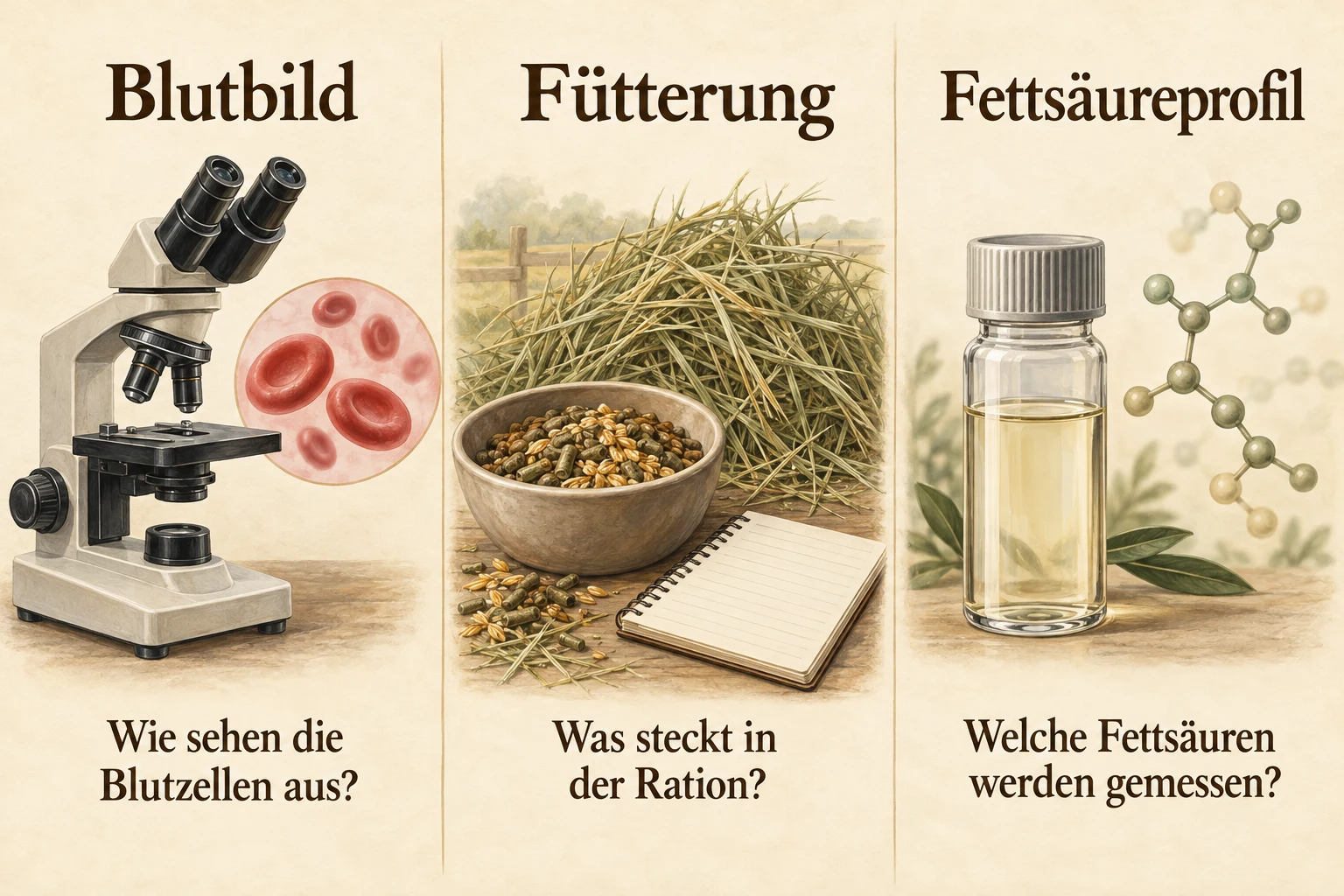
The painting-like images are AI-generated illustrations. Schematic representations do not show real laboratory findings.
For stables, clubs and practices
Free introductory talk at your location (German)
Understanding equine health. Making a difference together.
Do you run a riding stable, are you involved in a riding club or work in a veterinary practice, in animal physiotherapy or animal osteopathy? And would you like to give your adjusters, members, customers or your team understandable health knowledge?
Then bring us to you for a free introductory talk (German). We talk about feeding, fiber, intestinal health, obesity and the role of exercise - with reference to everyday stable life and space for your questions. We will coordinate the topic, scope and date together.
Select “Free introductory talk (German) for stable, club or practice” in the form and write to us where you are and who you would like to reach.
What would you like to think about with us?
Tell Sandra and me what you already know and what you would like support with. Together we will see whether advice on feeding or a fatty acid profile suits your situation.
Contact: marc@probalance24.com · Write to us via our contact page.
If you would like to know which products we use, please take a look here in the ProBalance shop .
Would you like to find out more about the topic and also read the scientific evidence and studies on this article? Click here.