
Oil for horses: What really belongs in the feed bucket
Horses don't have a gallbladder - can they still digest oil? What matters when it comes to selection, quantity and freshness.
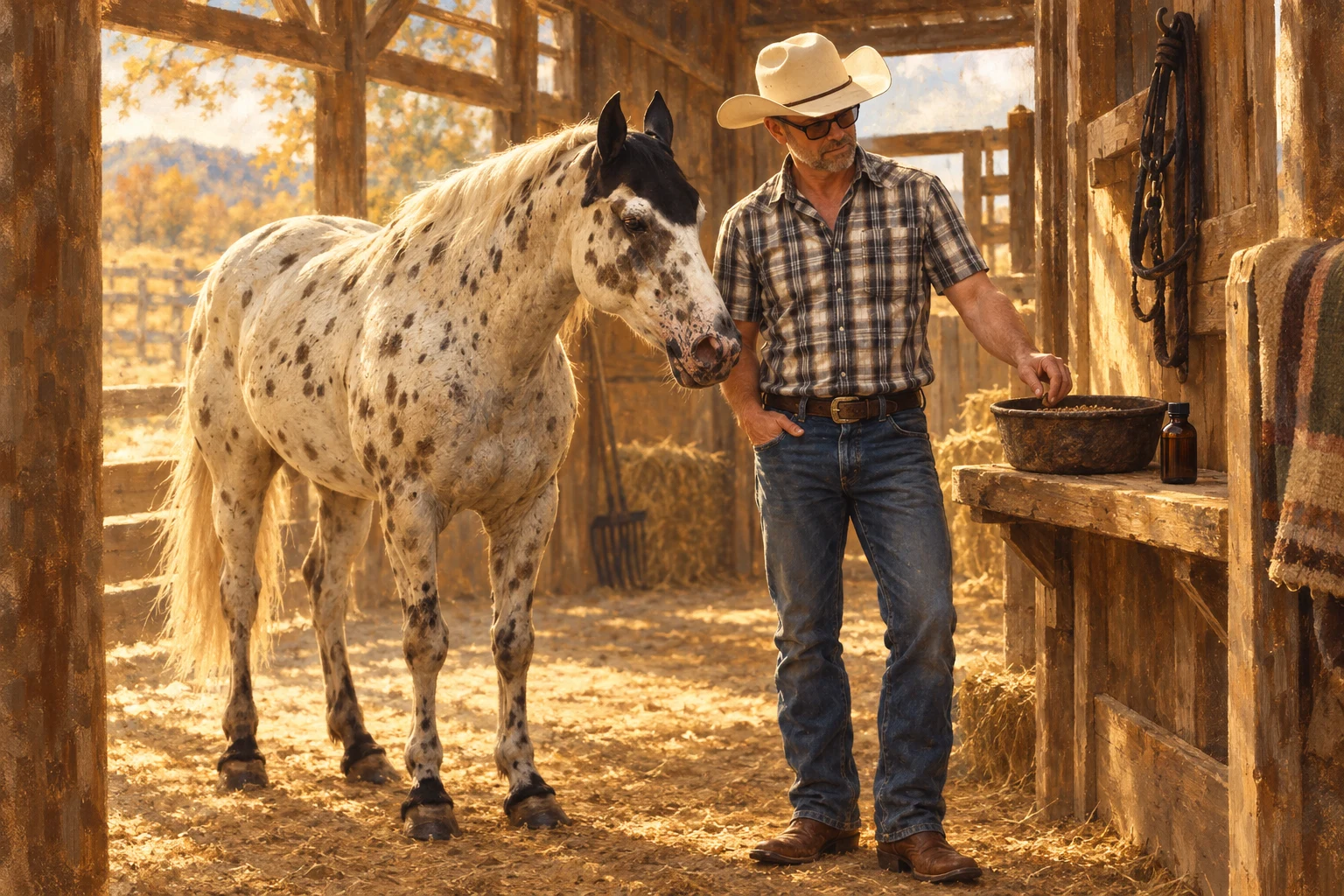
You are standing in the feed chamber, have the oil bottle in your hand and want to do something good for your horse. Maybe you're concerned about its fatty acid supply. Maybe it needs extra energy. And then this sentence comes out at the stable: "Horses don't have any bile. Are they even allowed to have oil?" You can start to think about it.
I think questions like these are important. Because buying a bottle is easy. Understanding why it suits your horse is the part that's really worth it. This includes digestion, contents and quantity - and, quite practically, where the opened bottle is placed.
No gallbladder doesn't mean no bile
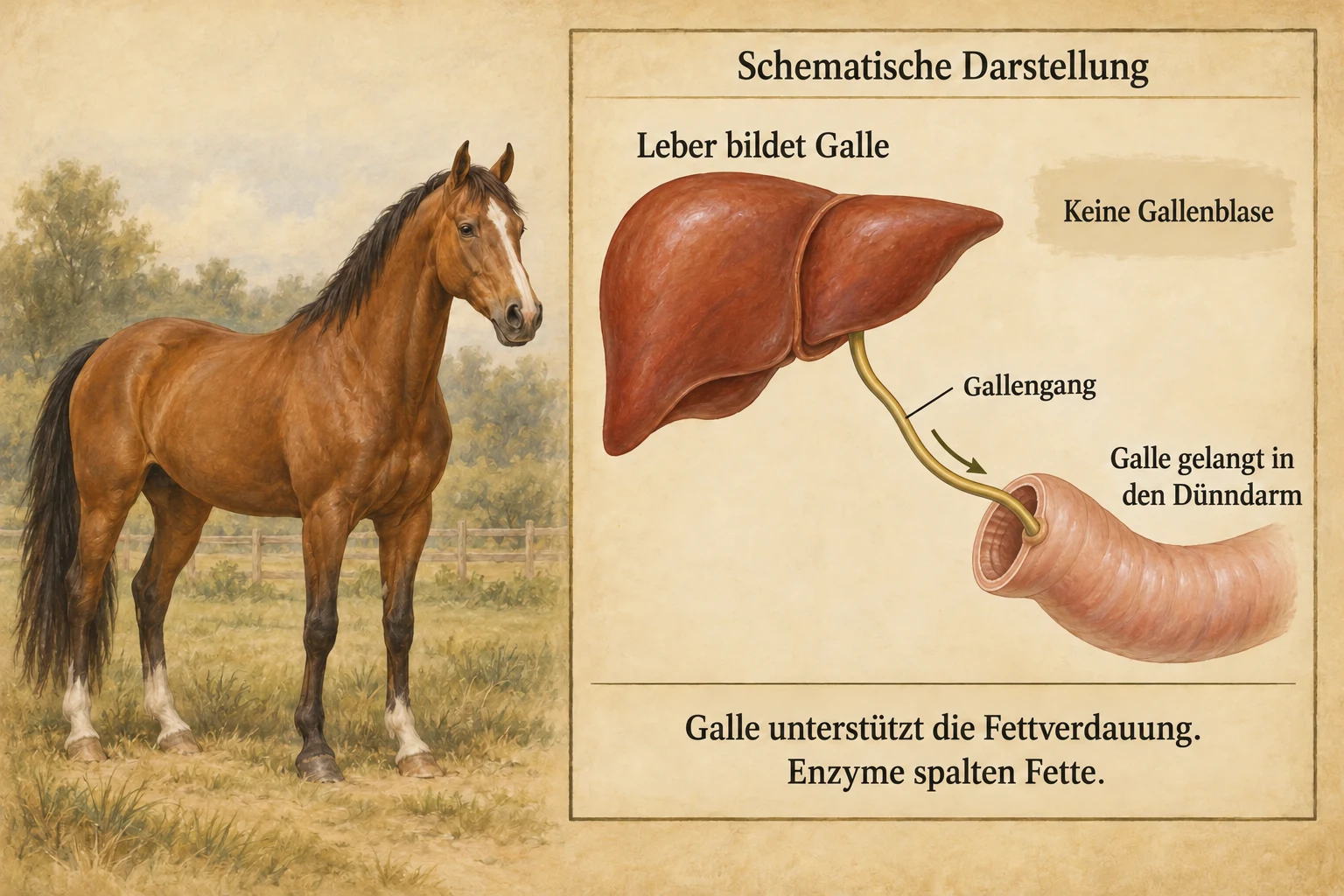
There's a little word here with a big difference: horses don't have a gallbladder. However, your liver does produce bile. This passes directly into the small intestine via the bile ducts. The gallbladder would be a reservoir for this fluid; it is not their place of production. [1, 2]
Bile helps to finely distribute fats in the intestinal contents and enables their digestion and absorption. The actual breakdown is carried out by digestive enzymes. In the horse, the small intestine is an important place for this. The lack of a gallbladder does not make a horse unable to digest oil. [1, 3]
For me, that is the decisive answer to the sentence from the feed room. Whether and how much additional oil makes sense is then decided by the overall feeding. A missing gallbladder is neither a fundamental prohibition nor an invitation to pour any amount into the food.
Horses don't have a gallbladder. They still have bile and fat digestion.
What do you want to achieve with the oil?
Before we talk about individual oils, I would like to clarify this question. Oil provides concentrated energy. For a horse that needs extra calories, this can be a useful part of the ration. If, on the other hand, the supply of certain fatty acids is to be specifically supplemented, the focus is on their content. These are different goals - even if in both cases there is an oil bottle in front of us at the end. [3]
We know the difference with our own horses: Spirit gains weight quickly, while Valea tends to have too little on her ribs. The two belong together, but their feeding cannot simply be equated. Especially with Spirit, I would always consider additional energy. A suitable supply of fatty acids remains interesting; the amount must suit the horse.
For you this means: Write down in one sentence why you feed or want to feed the oil. “Because everyone at the stable does it” is not an answer to what it should do for your horse. With a specific goal, the choice becomes much easier.
Omega-3 on the label is just the beginning
Flaxseed oil primarily provides the omega-3 fatty acid ALA. EPA and DHA also belong to the Omega-3 family, but are different fatty acids. There are also oils from microalgae that provide EPA and/or DHA; Which ones are included and in what quantity depends on the product. If you want to specifically supplement these fatty acids, you should therefore look at the specific information. [3]
This means that linseed oil does not become a bad oil. It simply does not automatically answer every question about fatty acid supply. I want you to understand what you are buying: which ingredient is included, how much of it does the planned portion provide and is the entire composition suitable for your horse?
Even “high quality” alone doesn’t help much. Comprehensible information about the contents, clear instructions for use and storage and quality information available upon request are more helpful than a big promise on the front. We explained the detailed basics of ALA, EPA and DHA in our Omega-3 article; Here we stick to the practical selection.
The quality doesn't end with the purchase
Now imagine the bottle back in the feeding chamber. She may be right by the window. The lid remains open after feeding. Nobody knows exactly when it was opened. That sounds unspectacular, but it can make a difference for a sensitive oil.
Oils can react with oxygen. This process is called oxidation and can change their quality. Light and heat can promote such changes. This is not a peculiarity of a particular brand: In a study of 30 cold-pressed linseed oils, quality characteristics deteriorated after storage under the influence of light. Another study compared different light and temperature conditions and also showed the importance of storage. [4, 5]
These studies explain why we should handle oil carefully. They do not provide a consistent number for how many days each feed oil goes bad. Initial quality, recipe, packaging and storage conditions differ. That's why the specific manufacturer's instructions are always included.
A good oil also needs a good place - and a bottle size that suits the consumption.
The large bottle is not always the better purchase
A small calculation example makes this tangible: assuming consumption of 10 milliliters daily, one liter is enough for 100 days. A half liter bottle is enough for 50 days. This is expressly not a feeding recommendation, but rather a range calculation. The appropriate daily amount must be determined in advance for the horse.
Now compare this range with the specified use after opening. Does that fit together? If not, a smaller bottle may be a more sensible choice. A cheap price per liter is of little help to you if a part has to be disposed of later. The University of Florida also points out this very practical connection in its feeding instructions. [3]
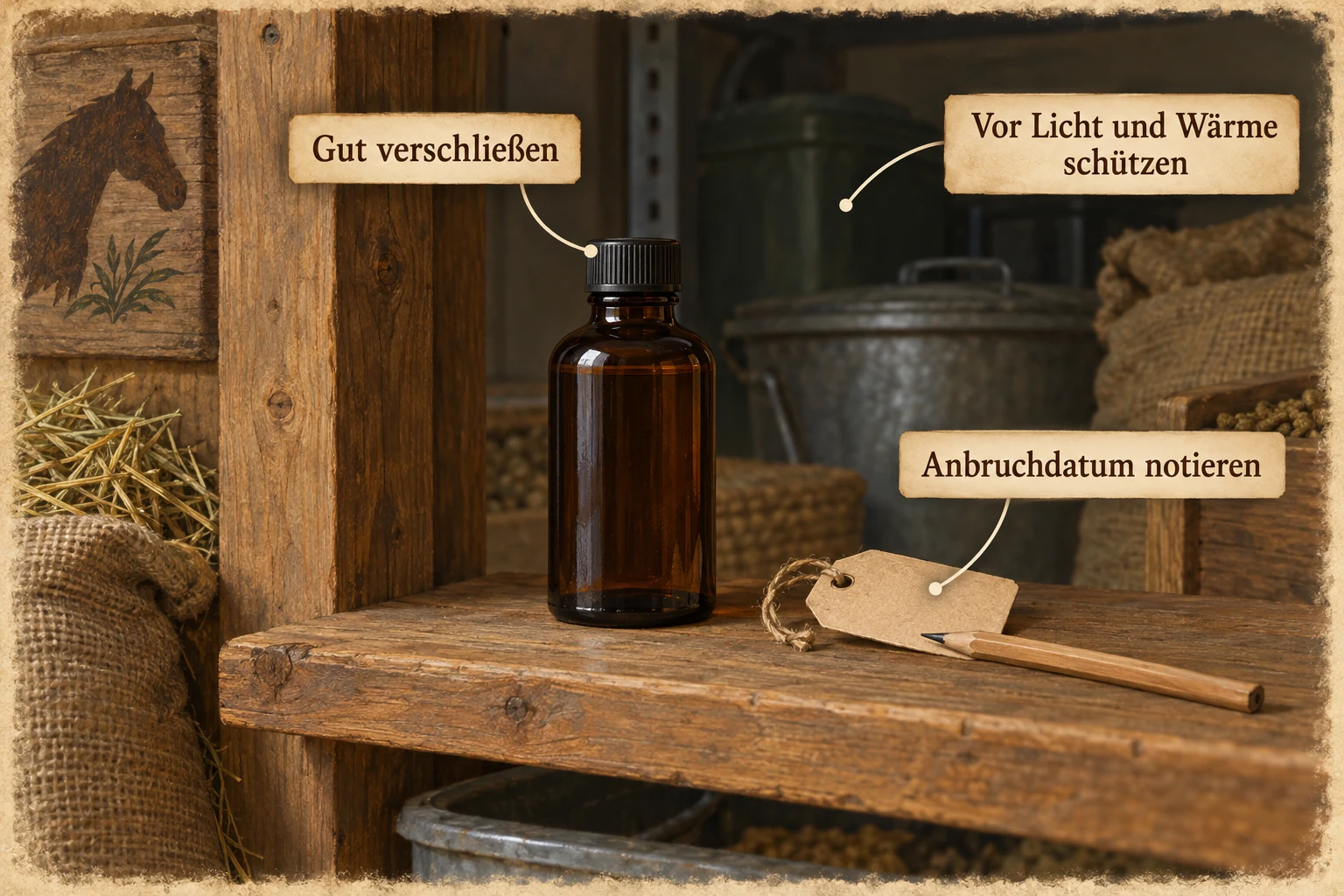
For everyday use, I would keep it simple: write the opening date on the bottle, close it well after use and protect it from light and heat. If cooling is intended for the product, it must be cooled accordingly. The bottle is best identified by its label so that information and the date are not lost.
If an oil smells clearly rancid or appears spoiled, it should not be added to the food. However, an inconspicuous smell does not replace reliable storage or quality testing. And the best-before date of the unopened package is not automatically the period of use after opening. The relevant information is crucial. [3, 6]
Change slowly and look at the horse
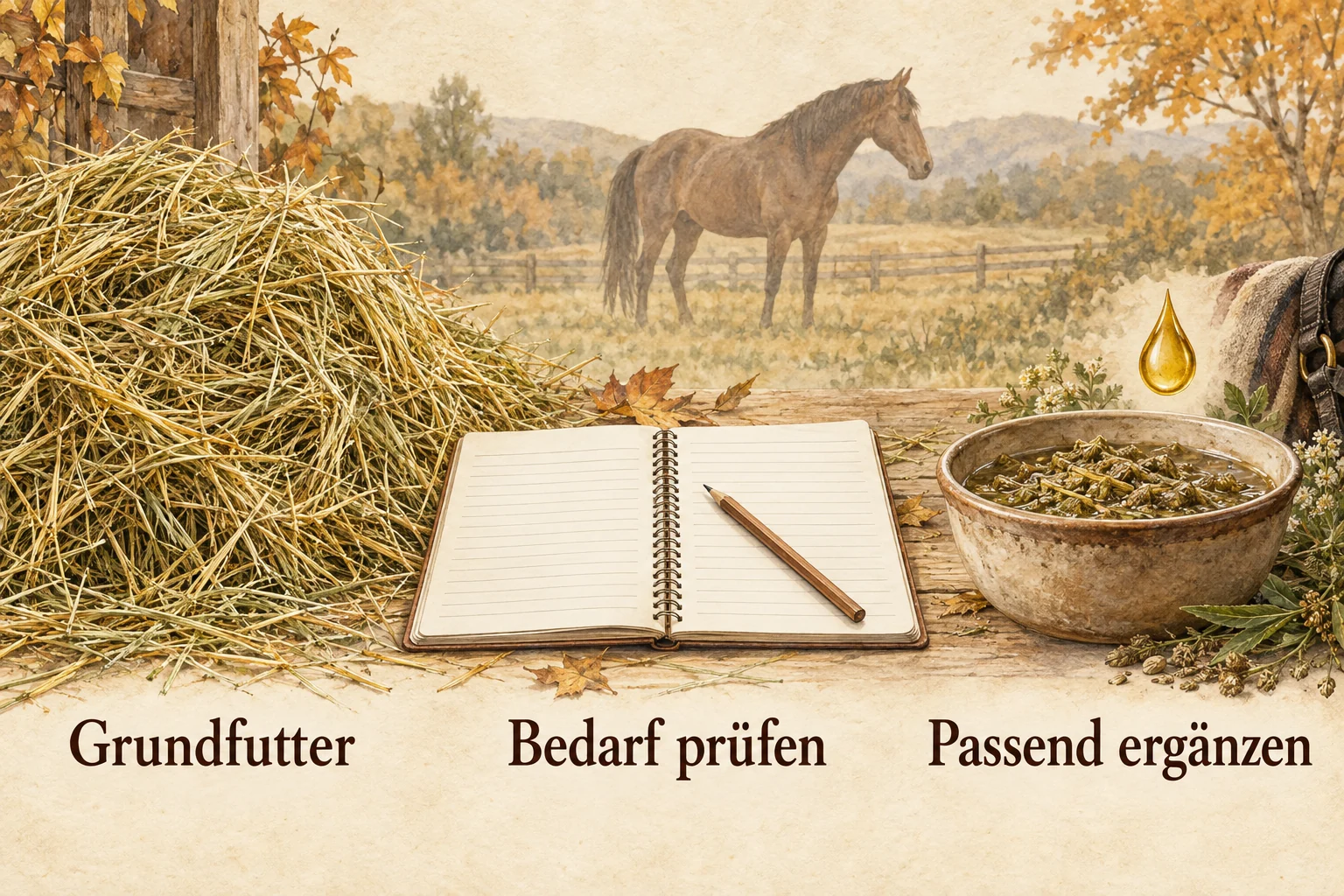
A new oil should be carefully incorporated into the existing ration. When fat intake is increased, digestion needs time to adapt. We therefore discuss the amount and change in accordance with the previous feeding. Larger changes in particular are made gradually. [3]
Observe appetite, stool and body condition. Not every change is caused by oil, but it is part of the conversation. If your horse has known illnesses or symptoms occur, feeding must be coordinated with the treating practice. The question is then bigger than the choice between two bottles.
And when does a fatty acid test help?
A fatty acid profile can show how certain fatty acids are represented in the blood examined and how these values develop under a changed supply. The fact that targeted EPA and DHA intake can change the blood profile in horses was also observed in a study on 50 healthy horses. [7]
This can be helpful for accompanying a suitable supplement. However, the analysis does not check whether the opened oil bottle is still fresh. Product quality and storage remain crucial. The measured values must also be classified using suitable standards for horses; they are not a diagnosis in themselves.
So what belongs in your feeding trough?
For me the answer starts with your horse. What is it already getting? What do you want to achieve with the supplement? Does the selected oil provide the right fatty acids, can the amount be incorporated sensibly and can you use the bottle under the recommended conditions?
This is exactly where Sandra and I can support you. To get started, send us the name or a photo of the label of your current oil, the amount fed and your question. Then we'll look together to see what information is still missing, what supplement might suit your situation and whether a fatty acid analysis offers useful additional insight.
You don't have to go through all the technical terms. It's enough if "I'll just give it a shot" becomes a conscious decision. For your horse, your feeding and everyday life in which good care also works in practice.
Read more and deepen
Omega-3 in horses: Understanding ALA, EPA and DHA
Read the ProBalance article
Good blood results. A well-nourished horse?
Read the ProBalance article
Easy-to-feed horses: think about supply and weight together
Read the ProBalance article
Sources and further literature
-
Iowa State University: Synopsis of the Digestive Anatomy and Physiology of the Horse – Bile and Fat Digestion.
https://www.extension.iastate.edu/equine/synopsis-digestive-anatomy-and-physiology-horse
-
University of Georgia: Understanding a horse’s digestive system – bile goes directly into the small intestine.
https://site.extension.uga.edu/forageteam/2018/09/understanding-a-horses-digestive-system/
-
University of Florida: Feeding Fat to Horses – Fat Sources, Feeding Goals, Transition and Storage.
-
NFS Journal (2022): Effect of initial quality and bioactive compounds content in cold-pressed flaxseed oils on oxidative stability and oxidation products formation during one-month storage with light exposure – an investigation of 30 flaxseed oils.
-
Brühl et al. (2022): Oxidation of Cyclo-Lino Peptides in Linseed Oils during Storage – Comparison of temperature and light conditions.
-
Mississippi State University Extension: Benefits of Fat Supplementation in Equine Diets - Notes on the Quality of Fat Sources.
https://extension.msstate.edu/sites/default/files/publications/P3734_web.pdf
-
Pearson et al. (2022): Dose-Dependent Increase in Whole Blood Omega-3 Fatty Acid Concentration in Horses – 50 healthy horses.
This article provides guidance on feeding and does not replace a veterinary diagnosis or individual ration assessment. Manufacturer instructions apply to the specific product.
The oil studies examine storage and chemical quality characteristics, not treatment success in horses. The horse study mentioned examines changes in the blood profile.
The images are AI-generated illustrations. The digestive graphic is a simplified functional diagram, not a scaled anatomical representation.
For stables, clubs and practices
Free introductory talk at your location (German)
Understanding equine health. Making a difference together.
Do you run a riding stable, are you involved in a riding club or work in a veterinary practice, in animal physiotherapy or animal osteopathy? And would you like to give your adjusters, members, customers or your team understandable health knowledge?
Then bring us to you for a free introductory talk (German). We talk about feeding, fiber, intestinal health, obesity and the role of exercise - with reference to everyday stable life and space for your questions. We will coordinate the topic, scope and date together.
Select “Free introductory talk (German) for stable, club or practice” in the form and write to us where you are and who you would like to reach.
What would you like to think about with us?
Tell Sandra and me what oil and how much you feed and what you want to achieve with it. Together we look at the composition, application and, if necessary, a useful fatty acid analysis.
Contact: marc@probalance24.com · Write to us via our contact page.
If you would like to know which products we use, please take a look here in the ProBalance shop .
Would you like to find out more about the topic and also read the scientific evidence and studies on this article? Click here.