

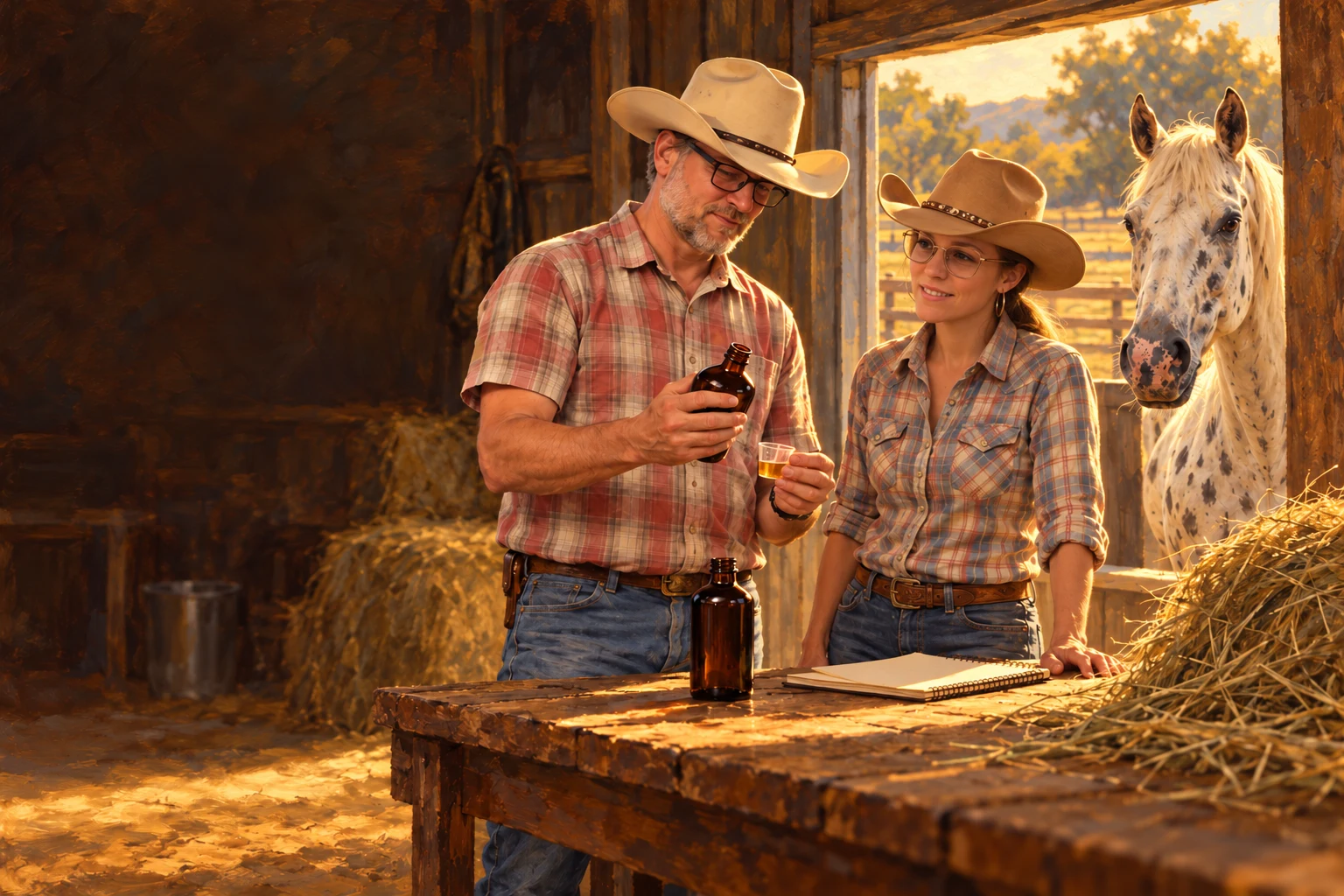
Feeding oil to your horse – have you considered vitamin E?
What oil and vitamin E have to do with each other - and why it makes sense to look at feeding together, especially when there is little fresh grass.
You stand at the feeding trough, add the measured portion of oil and think: Good, I've done something for my horse. Understandable. Especially when you're dealing with omega-3, you pay close attention to which oil you choose. But have you ever thought about vitamin E?
That sounds like the next topic on an already long feeding list. It's about something very practical: What does your horse get with his daily ration - and does the supplement fit in with it? It is important to Sandra and me that you understand these connections. You shouldn't end up with even more question marks in front of the trough.
Oil and vitamin E: two tasks that belong together
Oil can provide energy and certain fatty acids. Which one depends on the oil in question. Vitamin E has a different task: As an antioxidant, it supports the protection of cells from oxidative damage. Among other things, it is important for the normal function of muscles and nerves. The two therefore take on different tasks in providing care. [1, 3]
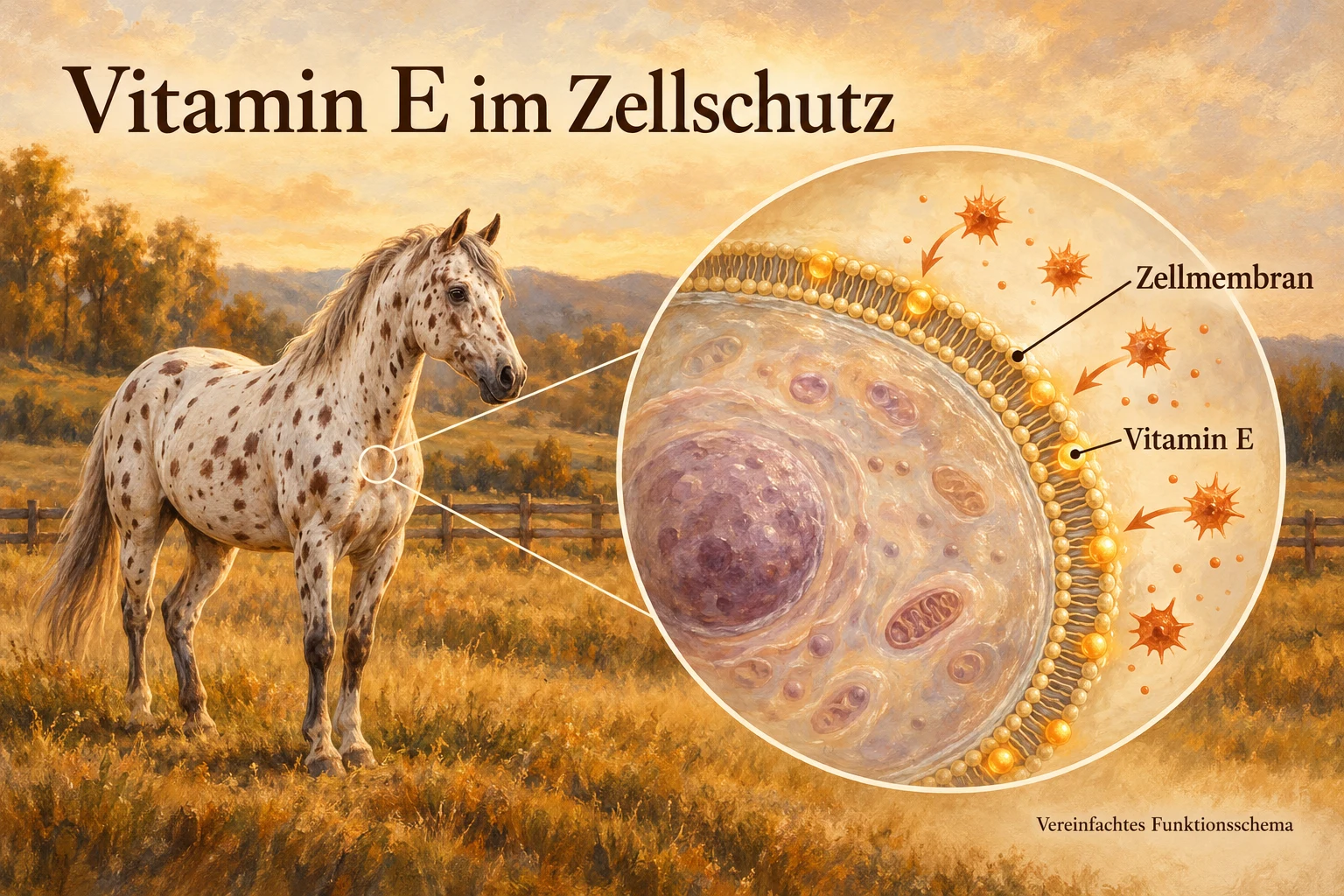
Imagine the cell membrane as a fine, living boundary of a cell. There are also fats in it. Vitamin E can help limit damaging oxidation reactions. The illustration shows this principle in simplified form - so that the word “cell protection” becomes something you can imagine. [2]
Vitamin E requirements may also increase with higher-fat rations. This is why oil and vitamin E often appear together in feeding recommendations. However, it does not follow that a small splash of oil automatically causes a deficiency. The overall ration and your horse’s situation are crucial. [2]
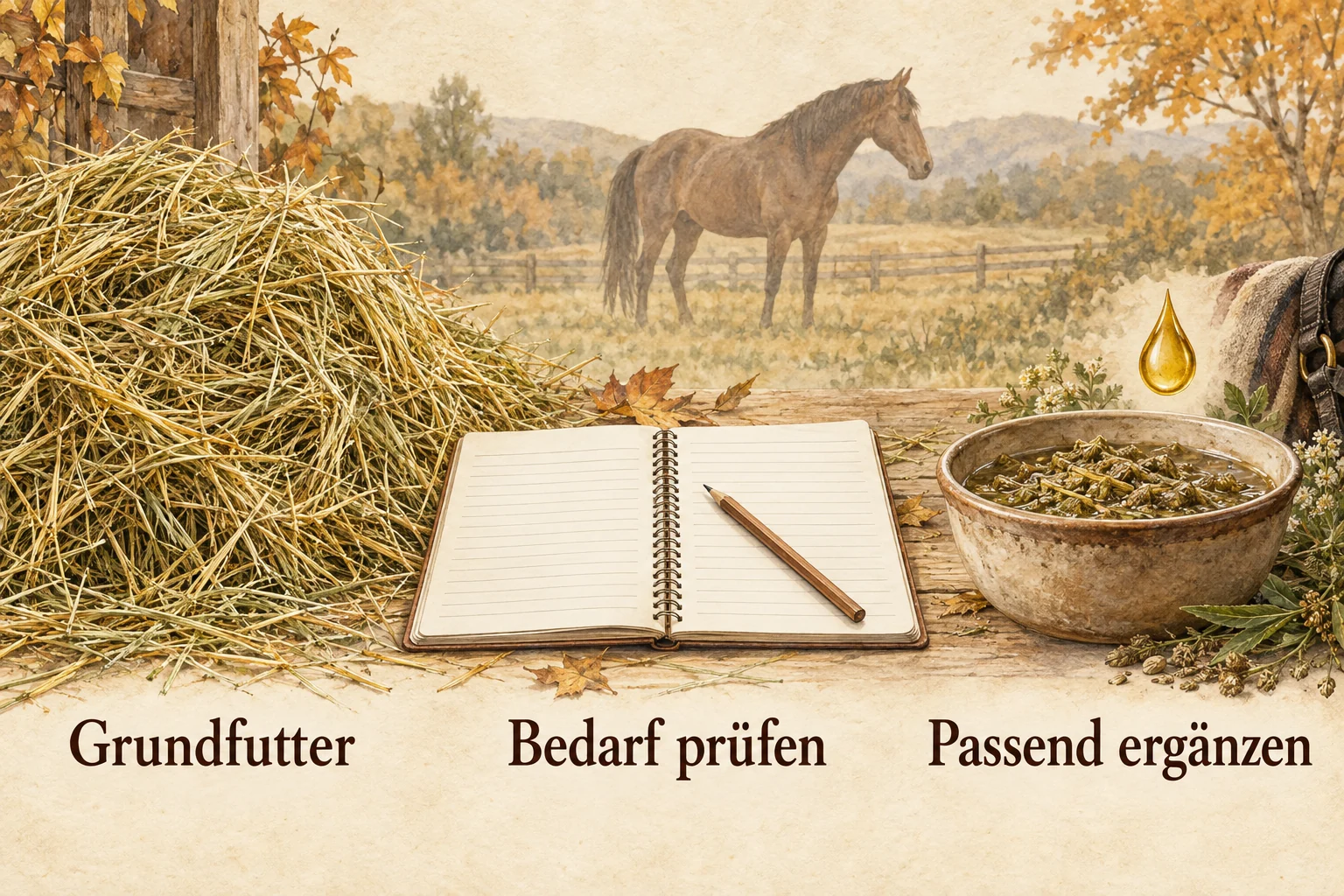
The sensible question is: What does my horse already get – and what does he actually still need?
What changes when the fresh grass is missing
Fresh, green pasture grass is an important natural source of vitamin E. A horse with plenty of good pasture grass therefore has different requirements than one that hardly has any fresh green available. Especially when grazing time declines, it is worth taking another look at the supply. [1]
A paddock with a few nibbled stalks is not the same as a productive green pasture. In everyday life, this means: Don’t just look at the calendar or the “Grazing” sign. Look at what your horse is actually eating there. And then what else you feed.
Maybe your feeding schedule hasn't changed much over the summer. Now the horse has less access to the grass, training continues and the oil remains in the ration. That would be a good reason for me to put everything next to each other. Not because you did anything wrong. But because the conditions have changed.
“Our oil already contains vitamin E!”
Yes – and that’s exactly what needs to be on the table. The oil we work with also contains tocopherols, i.e. compounds from the vitamin E group. These are also listed in the composition as antioxidants. We should of course take components that are already included into account when we talk about supplementing your horse.
We look closely: An indication of the vitamin E content of the olive oil used is not an indication of the quantity of the finished mixture. And the ingredient “tocopherols” alone cannot be used to calculate how much nutritional vitamin E the daily portion provides. For a reliable classification, we need the appropriate manufacturer information on the actual amount fed.
For me, that is an argument for a well-coordinated selection. If the oil already contains vitamin E and something is added from the rest of the food, both belong in the same consideration. It would be a shame to only look at a single bottle and miss the rest of the feeding.
A good oil can have more than just fatty acids. Whether the supply is appropriate depends on the daily ration.
An example straight from the feeding trough
Imagine two horses. Both get the same oil. The first eats a lot of fresh grass and receives appropriately dosed, enriched food. The second one mostly stands in the paddock and gets hay and a small amount of feed to mix in. Both feeding plans say “oil” – but there are still two completely different starting situations.
Would you now give both of them the same additional supplement just because they are getting the same oil? I would like to know beforehand what is already included in each case. It is precisely this second look that makes the advice useful: you don't take a single product as a starting point, but rather the horse and its actual everyday life.
With Spirit and Valea we have two horses in front of us every day that have different requirements. This reminds us again and again how unhelpful a solution based on the motto “everyone can get it now” would be. What works well for one horse needs to be looked at more closely for the other. Sandra and I like to take our time to look at each individual horse.
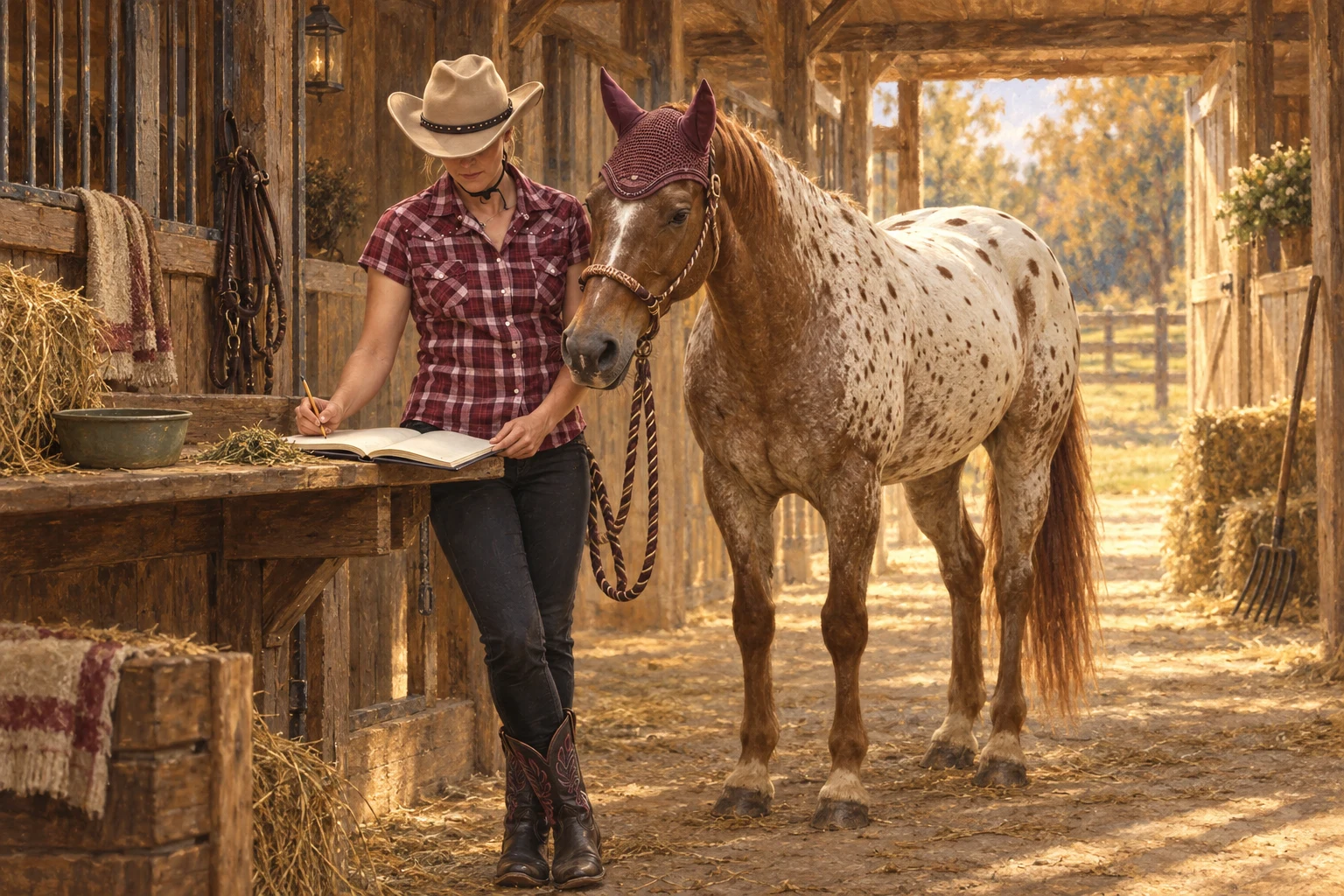
This will help you organize the information on the packages
You don't have to become a feeding expert to do this. Start simple: Take photos of the labels on everything your horse regularly eats. Next to it, write how much you actually feed per day. This also includes oil, mineral feed and other supplements. A product name alone does not tell us how much the horse gets.
The actual portion is important: a figure per kilogram of food does not automatically refer to your scoop. “Included” and “taken with the daily ration” are two different things. Once you put this information together neatly, many individual packages become a much more understandable picture.
There are also a few questions about the horse: How does it live? How much fresh grass does it get? What is being done with him? Why are you giving the oil at all – for extra energy, certain fatty acids, or some other reason? At this point, selection and quantity can be discussed much more specifically.
And what can a blood test say about it?
A fatty acid profile can help us take a closer look at fatty acid supply. This is an interesting addition if we want to assess where the horse is and how the care is developing. However, it does not automatically answer the question about vitamin E.
There is a targeted examination of alpha-tocopherol in the blood, which is arranged and classified by the veterinary practice if necessary. This is a different measurement than a fatty acid profile. Both can answer different questions and thus help you take a more targeted approach. [1]
For me, that's exactly the benefit: we don't have to choose between gut feeling and an unmanageable amount of supplements. We can first sort out the feeding and then consider what information would really be helpful for this horse.
Providing well means: complementing it appropriately
Maybe a lot of things are right for your horse. Perhaps when you look at the ration together, you will notice a gap. Both are a good result. Because you will know better afterwards why you are giving something and what place it has in the supply.
If you feed oil or are currently thinking about an omega-3 supplement, please contact us. Tell us about your horse, its everyday life and what it has been fed so far. Then we look together at how the individual building blocks fit together – including what is already contained in the oil.
You don't have to have everything figured out yourself before you get in touch. That's exactly what the conversation is for: so that "I want to do something good for my horse" becomes a decision that you understand and can support with a good feeling.
Read more and deepen
Oil for the horse: feeding, gallbladder and storage
Read the ProBalance article
What the blood count reveals about the care – and what it doesn’t
Read the ProBalance article
Sources and further literature
-
UC Davis, Finno Laboratory: Vitamin E In Horses - veterinary information on pasture grass, muscles and nerves as well as targeted alpha-tocopherol measurement.
https://www.vetmed.ucdavis.edu/labs/finno-laboratory/vitamin-e-horses
-
MSD Veterinary Manual (2026): Nutritional Requirements of Horses and Other Equids - expertly tested overview, in particular vitamin E function and possible additional requirements.
-
University of Florida, Lori K. Warren (2011): The Skinny on Feeding Fat to Horses - Basics of Fat Feeding; no evidence of the effectiveness of a specific product.
The sources explain vitamin E supply, cell protection and fat feeding in horses. The comparison of the two feeding situations is an illustrative example, not a documented advisory case.
Tocopherols contained are not a blanket guarantee of a complete vitamin E supply. Selection and quantity depend on horse and overall ration; A fatty acid profile does not replace targeted vitamin E measurement.
The painting-like motifs are AI-generated illustrations. The cell image shows a simplified functional diagram, not a scaled anatomy.
Free introductory talk at your location (German)
Understanding equine health. Making a difference together.
Do you run a riding stable, are you involved in a riding club or work in a veterinary practice, in animal physiotherapy or animal osteopathy? And would you like to give your adjusters, members, customers or your team understandable health knowledge?
Then bring us to you for a free introductory talk (German). We talk about feeding, fiber, intestinal health, obesity and the role of exercise - with reference to everyday stable life and space for your questions. We will coordinate the topic, scope and date together.
Select “Free introductory talk (German) for stable, club or practice” in the form and write to us where you are and who you would like to reach.
Is the oil suitable for your horse's care?
Tell Sandra and me what oil and feed your horse gets. Together we look at the ingredients it contains, the actual quantities and the question of which supplement or analysis suits your needs.
Contact: marc@probalance24.com · Write to us via our contact page.
If you would like to know which products we use, please take a look here in the ProBalance shop .
Would you like to find out more about the topic and also read the scientific evidence and studies on this article? Click here.