

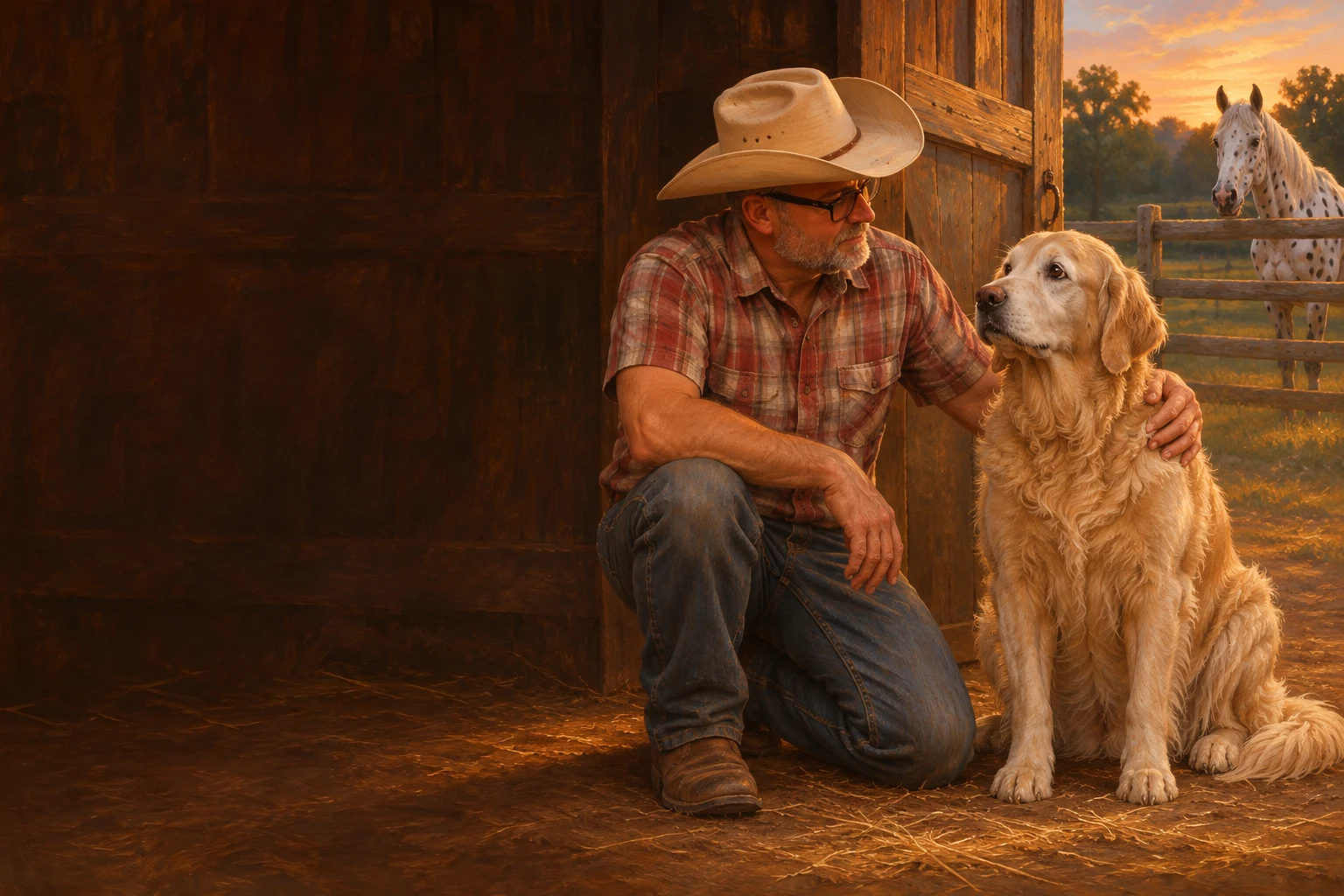
When your older dog cannot settle at night
What can be behind changed nights - and how familiar routines, appropriate nutrition and targeted care can support your older dog.
For years your dog was there as a matter of course. He knew the way to the tack room and knew exactly when to go home. Now he sometimes stops, seems unsteady and walks around the apartment at night. You hear his paws on the ground, look at the clock and ask yourself: What's wrong with him?
“He’s just getting old,” you quickly hear. That wouldn't be enough of an explanation for me. Of course, a dog changes over the years. Nevertheless, I would like to know what could make his everyday life easier. Even an old dog should feel safe, enjoy being around and be able to find peace. And yes: Nutrition can also play a role in this view.
When familiar things suddenly become more difficult
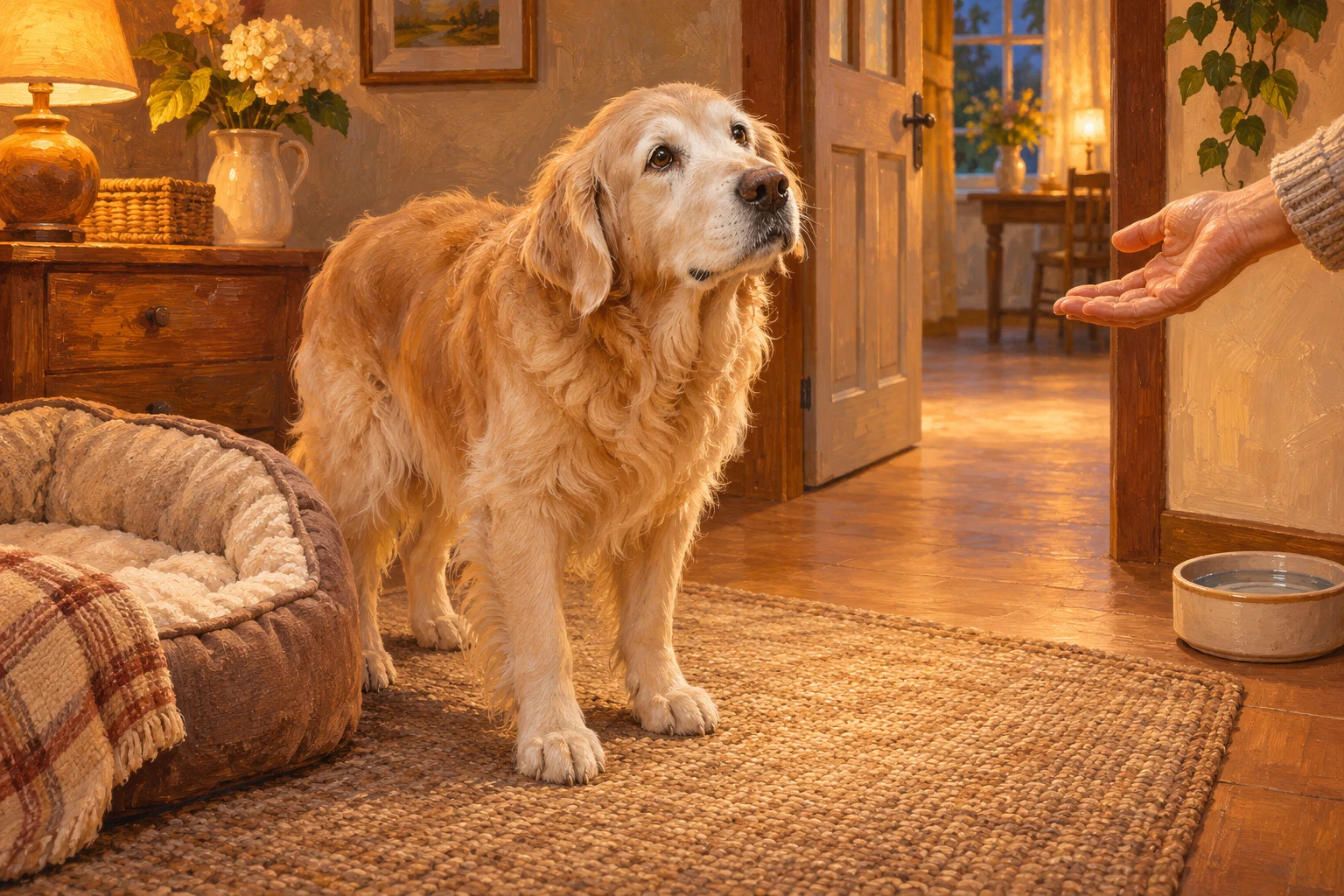
Imagine an older dog who always had a fixed place in the stable. In the evening he no longer lies relaxed on his blanket at home, but gets up, runs to the door, and turns around again. Sometimes he waits on the wrong side even though the door has long been open. He sleeps a lot more during the day.
Such changes can occur in cognitive dysfunction, often colloquially known as canine dementia. Changes in sleep times, orientation difficulties, increasing insecurity or different contact behavior are possible. They are a reason to look, not a diagnosis from a distance. [1]
Pain, loss of vision or hearing and other illnesses can also change everyday life. That's why a veterinary examination is necessary. If you suddenly lose your bearings or the dog appears clearly ill, you should contact the practice immediately. [1, 4]
Growing old may mean that we have to adapt our everyday lives. It shouldn't mean that we simply accept complaints.
Safety starts with the little things
A familiar berth, easily accessible water and reliable processes can provide orientation. A small night light and a non-slip path to the sleeping area can also be helpful. Exercise and activity remain important, appropriate to the dog's capabilities. [1]
At the stable I would therefore ask myself very practical questions: Does the dog have a quiet place? Can he keep his distance when horses come by? Does he have to constantly chase after him or can he just be there? Maybe a short walk together is now nicer than waiting in a noisy yard. Closeness doesn't have to mean that our dog should go along with everything like he did five years ago.
For me it's about quality of life. About the moment when the dog lies down again instead of constantly getting up. A small task that he still enjoys. And about people who realize: I can do something for him, even if we can't turn back the years.
Why I would also look into the bowl
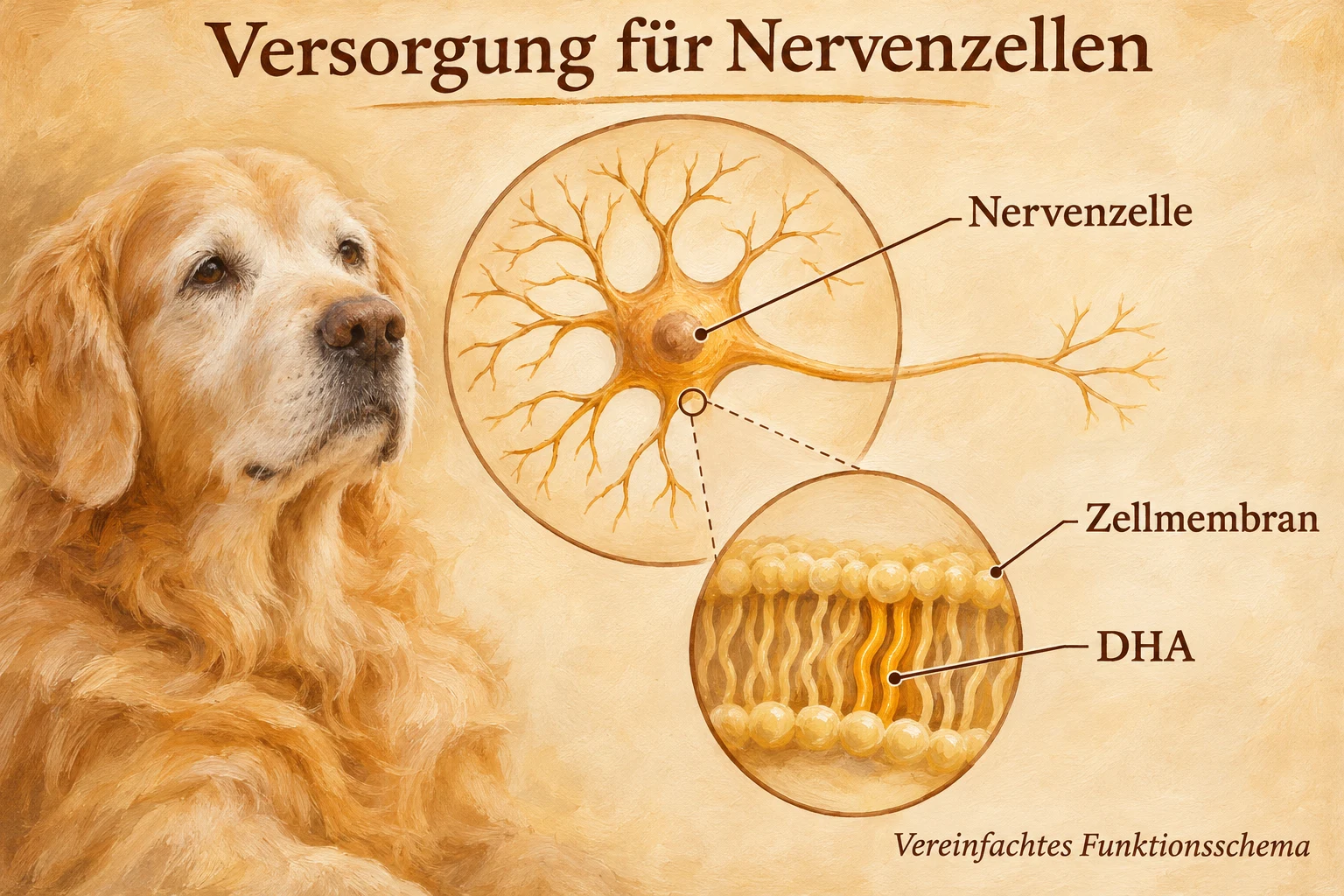
When we think of an older dog, we quickly think of joints or teeth. The brain is also part of it. Nerve cells depend on an adequate supply of nutrients. For example, DHA, an omega-3 fatty acid, is part of their cell membranes. In studies on the mental performance of older dogs, omega-3 fatty acids, antioxidant nutrients and B vitamins were examined together. [3]
Antioxidant nutrients like vitamin E are interesting because they help protect cells from oxidative damage. Studies with appropriately fortified feed provide evidence of a benefit for certain learning and memory abilities in older dogs. Nutrition and suitable employment are considered together. [4]
For me this is good news. We can take nutrition seriously as a sensible approach to support. Looking into the bowl is more than just an activity for people who want to do a lot of good for their dog. It can be part of a sensible support plan.
What the research actually shows
In a controlled study, 87 dogs with signs of cognitive changes were assigned to three feeding groups. Special diets with a mixture of nutrients and medium-chain fats, so-called MCTs, were examined. After 90 days, one of the groups showed improvements in all six behavioral areas recorded; There were also some improvements in the control group. [2]
Another study followed older dogs over six months. The group with a mix of omega-3 fatty acids, antioxidants, B vitamins and arginine performed better on certain more demanding learning tasks. [3]
This gives us the courage to take a targeted look at the supply. However, combinations were examined, not our oil alone. MCT fats are also different than EPA and DHA. Based on these results, we cannot therefore declare any individual component to be a remedy. Both studies had participation from the animal feed industry. [2, 3]
We don't have to promise to stop aging in order to provide meaningful support for an older dog.
Where an appropriate Omega-3 supplement can fit in
When it comes to an oil that we select and accompany a dog, I am interested in the specific composition and the appropriate amount. What does the daily serving of EPA and DHA provide? What other components does it bring with it? And what does the dog already get from his normal food? This is exactly where a personal conversation can be much more understandable than the next recommendation from a comment column.
We also look at tocopherols from the vitamin E group. This makes a recipe interesting, but does not automatically mean that the entire vitamin E requirement is covered. Other added nutrients, such as vitamin D, and additional energy should also be taken into account. An oil made for humans does not simply find its place in the dog bowl according to human consumption recommendations.
So it's not about randomly adding oil, vitamins and various powders together. We would like to find a supplement whose task and quantity are understandable. If a special diet recommended by a veterinarian is fed, we coordinate possible supplements with it. In this way, the supply can be supported without disrupting an already well-thought-out feeding system.
An example that makes the difference clear
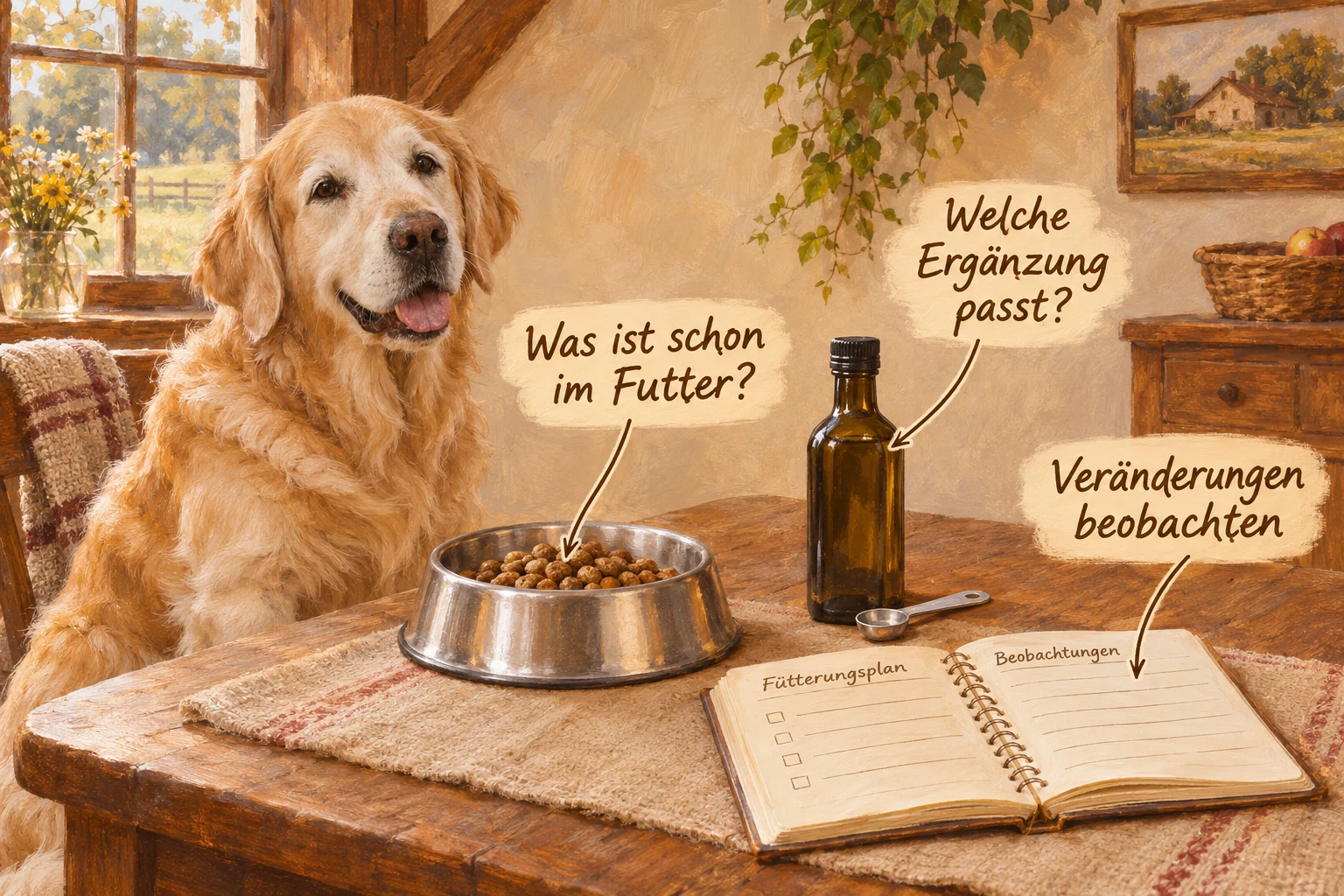
Imagine bringing a photo of the food bag with you to a conversation. Next to it is an oil and two more supplements. All of them say something about vitality or healthy aging. But you no longer know what your dog is getting and in what quantity. The question then is not: Which fourth addition could still be missing? The question is: How does what already exists fit together?
Maybe the food already provides a lot of what you're thinking about. There may be a useful place for targeted EPA and DHA supplementation. Or we notice that another question needs to be clarified first. This takes the pressure off the issue. You don't have to change everything at once for fear of getting older.
Observe, discuss and, if necessary, measure more precisely
Note when the unrest occurs and what has changed. How often does your dog get up at night? Does he find his place? What does the day before look like? A short, comparable history is much more helpful for conversations than the feeling “Somehow he is different”. The AAHA guidelines also recommend tracking changes in behavior over time. [1]
If we want to take a closer look at his fatty acid supply, we can also talk about a suitable blood profile that is professionally classified for dogs. This answers a nutritional question. It is not a dementia test and does not show whether nighttime restlessness will improve with a specific supplement. Your observed course and veterinary care remain important.
A coordinated change can take time. Together we look at what can be meaningfully observed and when feedback or control is appropriate. This makes the first attempt an understandable path instead of constantly switching between different products.
Your old dog is still part of it
Our dogs are often by our side for years. They accompany us on our journeys, wait for us and are there when a day in the stable goes completely differently than planned. As they get older, I hope that we can give them some of this reliability back. Through patience, a suitable everyday life and care that suits them.
If you are worried about your older dog, write to Sandra and me. Tell us what has changed, what has already been examined and what ends up in his bowl so far. Together we will see whether a targeted omega-3 supply or other coordinated adjustment can usefully supplement the existing support. You don't have to search for the right information from lots of different advice alone.
Read more and deepen
If your dog can no longer keep up in the stable: osteoarthritis and omega-3
Read the ProBalance article
Skin, itching and feeding in dogs
Read the ProBalance article
Sources and further literature
-
AAHA (2023): Senior Care Guidelines for Dogs and Cats - professional guidelines for clarifying changes, the living environment and monitoring the progress.
-
Pan et al. (2018): Clinical study on a special diet for cognitive changes. Randomized, double-blind study with 87 dogs over 90 days; Combination of MCTs and multiple nutrients, with industry participation.
-
Pan et al. (2018): Nutrition and learning performance of older dogs. Six-month controlled study of a nutrient combination; Improvements in specific tasks, no isolated Omega-3 detection.
-
VCA / Canadian Academy of Veterinary Nutrition (2025): Nutrition for cognitive changes - veterinary overview of antioxidant nutrition and supplementary employment; no independent clinical study.
https://vcahospitals.com/know-your-pet/nutrition-for-dogs-with-cognitive-dysfunction-syndrome-cds
The everyday scenes described are illustrative examples. They are not a medical report about Benny or Nala.
The nutritional studies examined specific nutrient combinations with industry participation, not the effectiveness of our oil alone. A fatty acid profile is not a test for dementia.
The painting-like motifs are AI-generated illustrations with an exemplary older retriever. The cell picture is a simplified functional diagram, not a scaled-up anatomy.
Free introductory talk at your location (German)
Grow older healthily. Take a closer look together.
Would you like to talk to your stable, club, veterinary practice or animal physiotherapy about older dogs, their everyday life and appropriate nutrition?
Then bring us to you for a free introductory talk (German). We make connections understandable and provide space for your questions. We will coordinate the topic, scope and date together.
Select the introductory talk (German) in the form and tell us briefly who you are planning it for.
What does your older dog need now?
Tell Sandra and me about your dog, its changes and its previous feeding. Together we will clarify how a suitable supplement or a specific question about fatty acid supply can usefully complement the existing support.
Contact: marc@probalance24.com · Write to us via our contact page.
If you would like to know which products we use, please take a look here in the ProBalance shop .
Would you like to find out more about the topic and also read the scientific evidence and studies on this article? Click here.