

Vitamin D in fall: What to know about supplements and blood tests

Sandra Timmerherm
Vitamin D in autumn: Now it's worth taking a look at your supply
Go to the office in the morning, grab something quick for lunch, and go shopping after work. And at some point you realize: you haven't actually been outside much today. As the days become shorter, the question of vitamin D becomes very relevant to many people's everyday lives.
Maybe you already have a pack in your cupboard. You may hear very different recommendations: be sure to take it, measure first, dose as high as possible or don't supplement at all. I would like one thing above all: understandable guidance that will help you move forward.
For me it starts with your starting point. How much time do you spend outside? What supplements are you already taking? Are there any medical recommendations or existing findings? This creates a more meaningful conversation than asking which product is currently being recommended most frequently.
Autumn is a good opportunity to take a conscious look at your vitamin D supply. By itself it is not proof of a defect.
Why sun, season and everyday life play a role
Vitamin D is mainly formed in the skin under the influence of UV-B radiation. In Germany, according to the German Society for Nutrition, solar radiation from October to March is not sufficient to ensure adequate body formation. At the same time, the body can store vitamin D and use these reserves in winter. That's why people start the darker season with different conditions. [1]
As we age, the skin's ability to produce vitamin D decreases. Even those who don't go outside much over the long term should keep a close eye on supplies. The estimated value of the DGE for adults is 20 micrograms daily if the body does not produce it. This describes the appropriate intake under this condition and is not an automatic tablet recommendation for every person. [1]
A walk during your lunch break remains a good opportunity to break up the workday. However, it is not a guarantee of a specific vitamin D value. You also shouldn't risk sunburn for vitamin D. [1]

What vitamin D does – and why more is not automatically better
Vitamin D is involved in the regulation of calcium and phosphate metabolism and is important for bone health. It also supports the normal functioning of muscles and the immune system. However, it does not follow from this that additional large quantities provide additional protection against disease when there is already sufficient supply. The Federal Institute for Risk Assessment expressly distinguishes between these questions. [2]
Therefore, if you feel exhausted, “It will be vitamin D” is not a sufficient conclusion. Persistent or new symptoms should be clarified by a doctor. A single nutrient value does not replace this look at possible causes.
A helpful question
What suits my starting position?
Consider existing values, previous products and your personal situation together.
A common abbreviation
More must be better.
A higher number on the package does not mean that you need that amount.
The BfR recommends a maximum of 20 micrograms of vitamin D per daily dose for over-the-counter dietary supplements and warns of the health risks of high intakes. A distinction must be made between treatments prescribed by a doctor. [2]
Vitamin D3 and magnesium: An addition from our portfolio
We have a dietary supplement in our portfolio that combines vegan vitamin D3 from lichen with magnesium. According to the German product data sheet contains one tablet 12.5 micrograms of vitamin D3, equivalent to 500 international units, and 87.5 milligrams of magnesium. The magnesium blend includes magnesium hydroxide, magnesium citrate, magnesium malate and magnesium bisglycinate. [4]
When you look at the drugstore shelf or in an online shop, you will be particularly helped by comprehensible information: What nutrients are contained, in what quantities per tablet and per daily serving? Which other products do you already use? The place of sale alone does not say how well a product suits you. A high dosage is also not a quality feature. We will be happy to advise you on tailoring the composition and dosage to your personal situation.
Vitamin D can be overdosed. Therefore, you should not increase the amount on your own. Before supplementing, we clarify together what findings are already available and whether a blood test makes sense. [2]
When it comes to a combination product, it is important to me to consider both nutrients. If you increase the number of tablets, the magnesium intake also increases. If you also take other products, their quantities should also be taken into account. The consumption range on a pack is therefore not automatically your personal recommendation.
We will discuss whether this product is right for you based on your previous care and your questions. In the case of illnesses, medication or a deficiency that requires treatment, the dosage decision belongs in the hands of a doctor. A dietary supplement does not replace a varied diet or necessary treatment.
I want you to understand what you're supplementing and why - before it becomes a daily habit.
In practice, this means: For your own overview, first photograph the nutritional information of the products you already use. This way you can add up vitamin D and magnesium from different products. This overview can then be specifically discussed in a personal conversation.
When is a vitamin D test useful?
A blood test can reveal your current vitamin D status. Whether the measurement makes sense for you depends on which question you want to clarify and what consequences the result would have.
The Endocrine Society's 2024 guideline recommends against routine vitamin D screening in healthy adults without specific medical indication. It also does not recommend regular control tests according to a rigid schedule for everyone. This concerns general precautions; A medically justified examination must be distinguished from this. [3]
For our support, this means: We clarify your concerns first. If you already have a current value, bring it with you to the agreed meeting. If it concerns complaints or a medically suspected defect, the examination should be coordinated with the treating practice. You don't have to take another test just because a new article comes out about it.
Vitamin D blood test at home: This is how the sample is taken
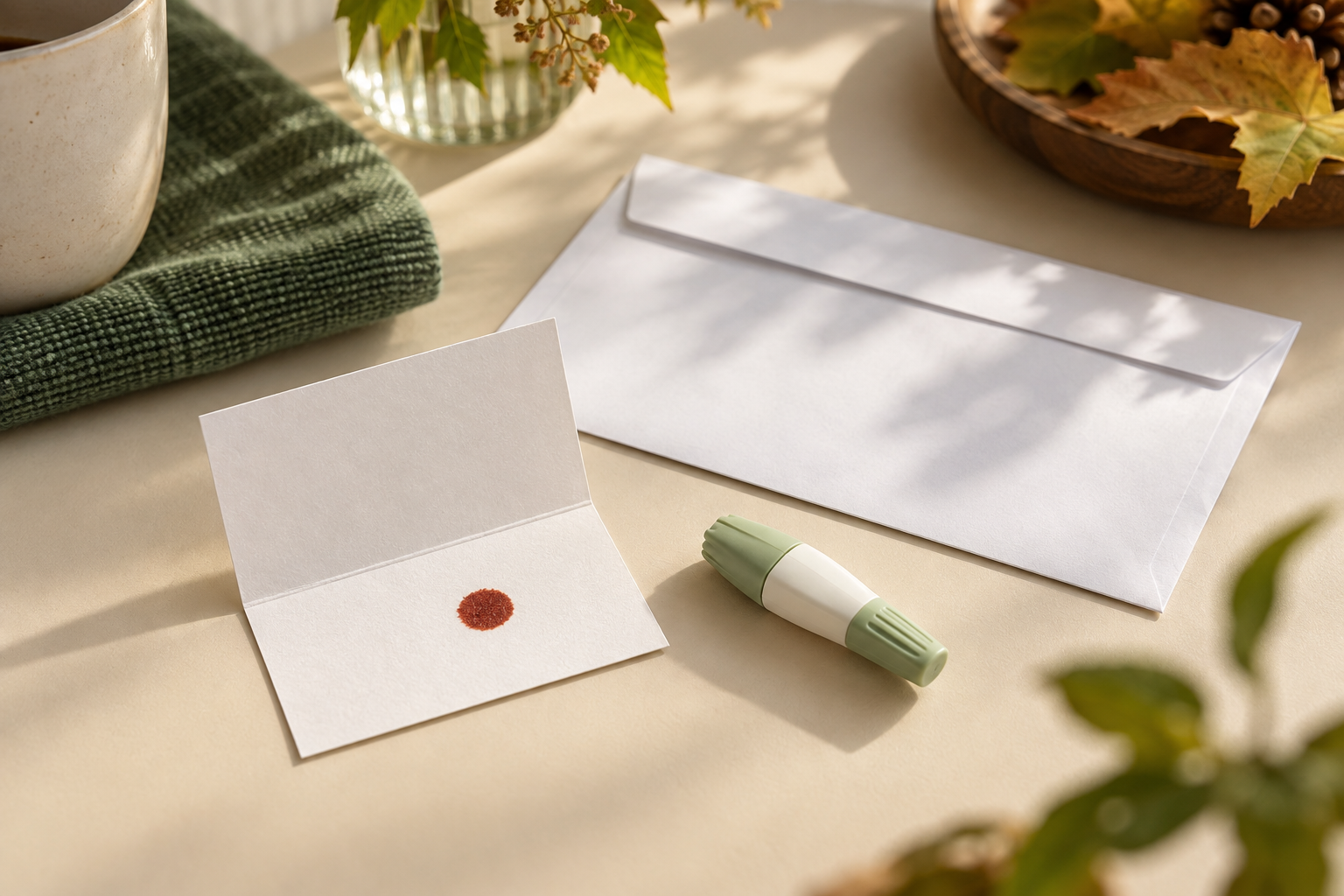
If you would like to have your value determined by taking a sample at home, you can contact us. In the procedure we support, capillary blood from the fingertip is placed on a filter card intended for this purpose. The dried sample is sent to an independent laboratory for evaluation. Is measured 25-hydroxyvitamin D, or 25(OH)D, the common marker for assessing vitamin D status.
So the sampling takes place at home; the analysis takes place in the laboratory. It's not an instant test where you read a value directly on the card. The instructions provided apply for removal, drying and shipping. We will explain the process to you in advance and discuss with you how the evaluation can be classified afterwards.
A measured value describes the care at the time of the examination. It does not automatically explain complaints or say that you now need a specific product. If there are any abnormal findings, medical attention is the next step.
Would you like to do the vitamin D test at home?
Then get in touch with us directly. You can select “Vitamin D blood test at home” using the contact form. We will clarify the next steps and your questions about the process with you.
Your next step doesn't have to be complicated
Imagine you're already taking a multivitamin and want to supplement with vitamin D for the fall. Before you add anything, look at the information on the existing package. Does it already contain vitamin D? How much do you actually take? And maybe there is already a recommendation from your doctor’s office?
This simple, made-up example shows why I want to start with an inventory. The conversation is not about as many products as possible, but rather about making a comprehensible decision for your everyday life.
If a test seems useful, the question of the evaluation is also clarified beforehand. If you are already adequately supplied, there is no need for supplementation just for the sake of supplementation. And when medical questions come to the fore, we involve the appropriate medical expertise.

Vitamin D, supplement and test: Let us answer your questions
Would you like to know how you can tackle your care in the fall? Do you have questions about the right supplement or are you interested in taking a vitamin D blood test at home? Write to us about the topic that concerns you. You do not need to submit any diagnoses or laboratory results for the first inquiry.
In ProBalance health management we look at nutrition, nutrient supply and everyday habits in context. Personal support should help you classify information and prepare concrete next steps. Medical diagnosis and treatment remain where they belong.
If you would like to look at your diet beyond that, see the article “Does our modern diet have an omega-3 problem?” another entry. Whether omega-3 is an additional issue for you can be considered separately from your vitamin D question.
The first step is a question. About that Contact form you can reach us directly. We also offer free on-site introductory talk (German) for institutions and practices - with understandable classification and space for questions from your audience.
Sources & deepening
Background information
- [1] German Society for Nutrition: FAQ Vitamin D – education, storage and supply
- [2] Federal Institute for Risk Assessment (December 30, 2025): Vitamin D – sun and exercise promote good supply
- [3] Endocrine Society (2024): Vitamin D for the Prevention of Disease – Guideline on Supplementation and Testing
- [4] Manufacturer information on the composition of the vitamin D3 magnesium product described - no independent proof of effectiveness
Research and technical classification: September 21, 2026. The information on the home test is based on the tested manufacturer documentation; Contact for interested parties is made via the academy.
If you would like to know which products we use, please take a look here in the ProBalance shop .
Would you like to learn more about the topic and see the scientific evidence? To the original article by the Timmerherm Academy.