

Everyday bloating: The role of stress, eating habits and fiber

Sandra Timmerherm
Lunch is barely over when your stomach starts to feel tense. The waistband of your pants is tight, the next conversation starts in ten minutes, and you actually want to concentrate on your work. Instead, you think about what you couldn't tolerate again this time. Maybe the salad? The bread? Or was the whole morning just too hectic?
Such questions deserve a reasonable answer. I'm interested in the interaction: What do we eat, under what conditions do we eat, and how do we deal with our body's signals? Especially when the calendar is full, your own health quickly becomes a task for later. You can start taking a closer look today. Without having to change the entire menu.
Bloated stomach in the office: what's behind it?
A certain amount of gas formation is part of digestion. We swallow air, and intestinal bacteria produce gases when they utilize certain undigested carbohydrates. Eating hastily, chewing gum and carbonated drinks can also play a role. A bloated feeling does not automatically mean that there is something fundamentally wrong with the intestines. It doesn't always have to be visibly larger. [1]
If the symptoms regularly determine your everyday life, it is worth classifying them. Constipation, intolerances and other illnesses are also possible causes. Irritable bowel syndrome can also be associated with flatulence, but includes a specific, long-standing pattern of symptoms. The sentence “It’s definitely just stress” would therefore be too short-sighted. [1] [2]
Can stress make your stomach bloated?
The brain and intestines are in close contact. If this interaction is disrupted, intestinal movement and the perception of stretching can change, among other things. For people with irritable bowel syndrome, even a normal amount of gas can be uncomfortable or painful. This explains why the strength of the pressure sensation does not simply reflect the amount of gas. [2]
Stress and discomfort can reinforce each other: a stressful day may make your stomach more sensitive, and worrying about the next unpleasant moment creates additional tension. This means that complaints are not imaginary. For me this means looking at nutrition and stress together. In addition to meals, a food diary can also record your daily routine and stress at work. This makes possible patterns easier to recognize. [3]
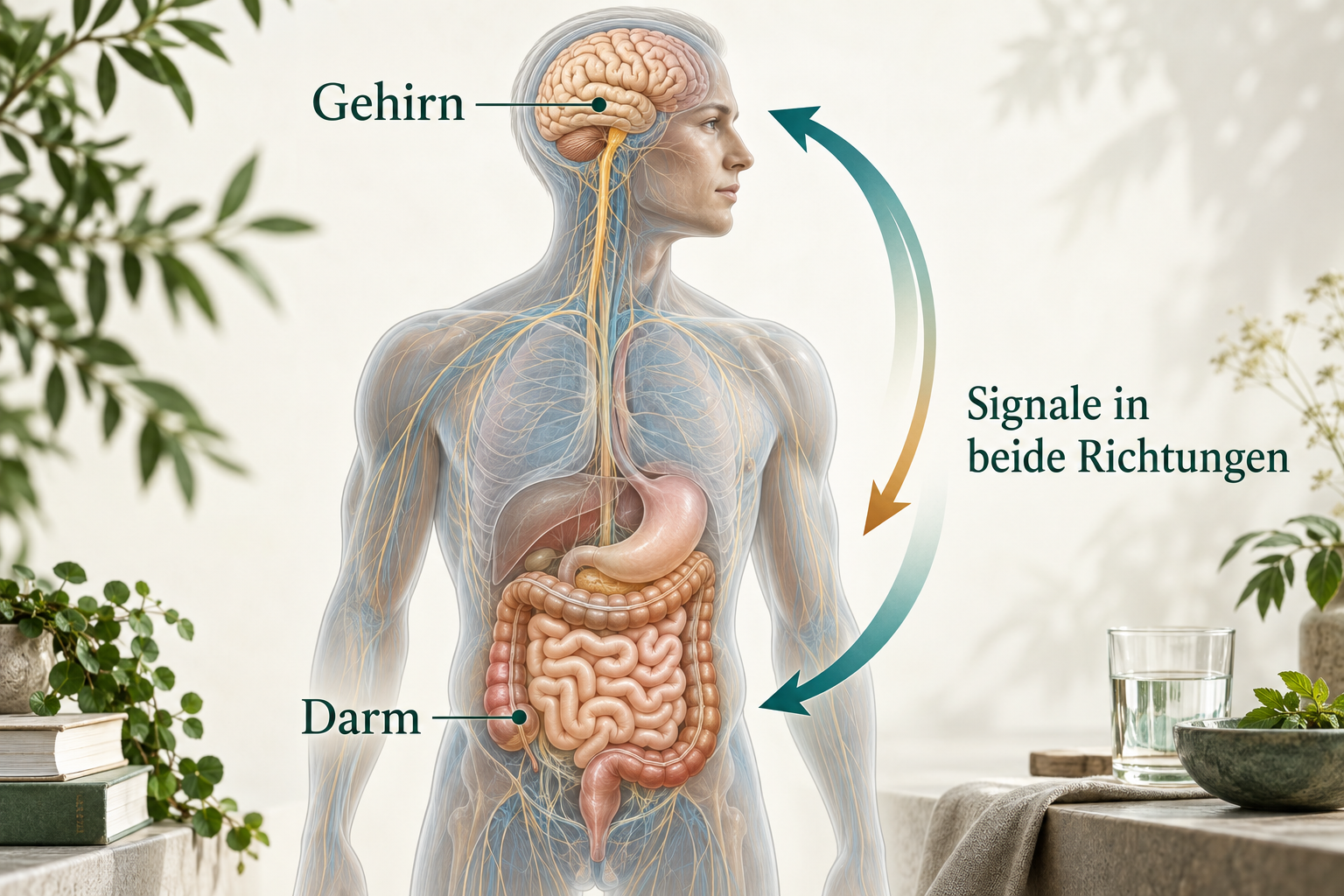
Several things often come together in the office: eating between two appointments, little exercise and a break during which emails are answered. I would therefore first ask: Does the meal even have its own place in the day? This is a question of self-care, but also of work design. If you only allow breaks on paper, you won't be able to have a good rest.
Why fiber is important – and can still make you bloated
Fiber is a component of plant foods that our digestive enzymes do not break down or only break down incompletely. The German Nutrition Society specifies at least 30 grams daily as a guideline for adults. Whole grains, legumes, vegetables, fruits, nuts and seeds can contribute. If you currently eat little of it, you should gradually increase the amount and drink enough. The individually tolerated amount varies. [4]
Not all fiber is the same. Some fibers bind a lot of water, others are quickly fermented by intestinal bacteria. This fermentation also produces gases. Inulin and psyllium husk can therefore behave significantly differently in the intestine. This is exactly what makes blanket advice like “just take more fiber” unhelpful if you already have a bloated stomach. [5]
A small randomized study with 19 people with irritable bowel syndrome illustrates this difference: more intestinal gas was produced with inulin than with psyllium husks. The combination of both reduced gas formation compared to inulin alone. Individual test drinks were examined over a few hours, not long-term treatment with a commercially available mixture. What I take away from this in practice is that composition and compatibility deserve more attention than making the biggest possible promise on the packaging. [5]

Prebiotics, probiotics and fiber blends: the difference
The terms sound similar, but mean different things. Probiotics contain living microorganisms that must be proven to have health benefits in sufficient quantities. Prebiotics, on the other hand, are substances that are used by certain endogenous microorganisms and thereby provide proven health benefits. To put it simply, they provide food for certain microbes. Not all fiber automatically meets this definition. [6]
There are plant-based blends with fiber from eight sources. The product documents I viewed describe, among other things, resistant starch from corn, potatoes and green bananas, oat beta-glucans, inulin and oligofructose as well as psyllium husks and partially hydrolyzed guar gum. Such a mixture provides different fibers; it does not introduce live bacteria into the intestines. [7]
What's interesting to me is whether a supplement can close a specific gap in everyday life. The number of fibers contained alone does not answer this question. If your food is already varied, the initial situation looks different than with permanently low-fiber meals. And if you react with discomfort to certain fibers, that should be part of the selection and quantity planning. More complaints are not a reliable sign that a product is working particularly well.
Testing gut-related markers – without a stool sample
There is also a dried blood test that we can discuss during personal support. According to the instructions, a small blood sample from the fingertip is placed on a sample card and sent to the laboratory. A stool sample is not required. This can make it easier to do at home. [7]
Tryptophan, kynurenine and indole-3-propionic acid, or IPA for short, are measured. The latter arises from the metabolism of certain intestinal bacteria. Further key figures are calculated from the values. The report provides insight into selected intestinal-related metabolic processes. It does not cover all intestinal bacteria or the entire intestinal function and does not in itself explain a bloated stomach. [7]
When it comes to quality, the current manufacturer information mentions an independent, GMP-certified laboratory. The sampling kit is described as CE marked; The production therefore takes place under a quality management system certified according to ISO 13485. This information relates to the laboratory or test set. They are not proof that the cause of your symptoms can be diagnosed. [7]

Why does IPA concern research? In an analysis of the Finnish diabetes prevention study, a higher value was associated, among other things, with higher fiber intake and a lower later risk of diabetes. This is an interesting connection, but not proof that a single test or supplement prevents diabetes or eliminates bloating. [8]
That's why we measure and don't guess - where a measurement fits the question. A laboratory value can only be meaningfully discussed in connection with nutrition, symptoms and initial situation. Before a test, we therefore clarify what additional information you can expect from it. You don't necessarily need a blood test to get a first look at your eating habits. And if a medical examination is necessary, it takes priority.
Where Omega-3 fits into the bigger picture
If you take a more comprehensive look at your diet, the fatty acid supply can also be interesting. EPA and DHA are among the building blocks of cell membranes and are involved in the formation of messenger substances. However, it cannot be concluded from this that an omega-3 supplement generally improves nutrient absorption or eliminates a bloated stomach. [9]
I would also consider this question: Which sources do you already use, and is there reason to take a closer look at your supply? A suitable algae oil can also provide EPA and DHA. A fatty acid profile answers a different question than the analysis of gut-related metabolic markers. You can find out more about this in the article “Does our modern diet have an omega-3 problem?”
What you can actually do in your everyday work
I would start with a manageable change. If you change your diet, start three supplements and change your entire daily routine at the same time, it will be difficult to tell afterwards what helped you. For a first organized look, these steps are recommended:
- Record patterns. Note meals, complaints, bowel movements and special stresses. Compare working days and days off. This is a basis for discussion, not a self-diagnosis. [3]
- Plan a real meal break. Leave your screen and phone aside for meal time. Eat in peace and see if less carbonation or chewing gum makes a difference. [1]
- Change fiber gradually. First, choose an appropriate food source and a tolerable portion. Don't increase everything at once and make sure you drink enough. [4]
- Make interruptions possible. Plan short distances and breaks between appointments. Going to the toilet also needs a place in everyday working life.
I recommend this guide to help you deal with short interruptions consciously “Microbreaks” from our colleague Barbara Röss. It contains suggestions for small moments of relaxation in everyday life. This fits in well with an understanding of health that looks at nutrition, stress and breaks together.
Your next step
You don't just have to come to terms with it
If your gut regularly determines how you get through the workday, it's worth taking a closer look. You don't need a perfect nutrition plan or a drawer full of supplements. You first need clarity about what you want to change and which step suits your situation.
That's exactly where we can start together. We look at your diet and your everyday life, discuss open questions about fiber and check whether a supplementary analysis or a targeted supplement seems useful. Write to me using the form if you would like to take this first step. It is enough if you briefly say what you would like to find out more about.
Sources & deepening
Scientific background
- [1] NIDDK: Gas in the digestive tract - symptoms and causes ↗
- [2] NIDDK: Irritable bowel syndrome - symptoms and interaction between brain and intestine ↗
- [3] IQWiG: What helps with irritable bowel syndrome – and what doesn’t? Classification of food diary and treatment approaches ↗
- [4] German Society for Nutrition: Questions and answers about fiber, guidelines and tolerability ↗
- [5] Gunn et al. (2022, online 2021): Psyllium reduces inulin-induced colonic gas production in IBS. Gut 71:919–927 – small randomized crossover study ↗
- [6] ISAPP: Scientific consensus definitions on probiotics and prebiotics ↗
[7] Additional product and process information: available fiber presentations as well as current manufacturer information on the composition and the dried blood test verified on September 11, 2026. Information on the laboratory, test set and quality management comes from the manufacturer's information; they are not independent proof of effectiveness. We will explain the specific documents in a personal conversation.
- [8] de Mello et al. (2017): Indolepropionic acid and novel lipid metabolites are associated with a lower risk of type 2 diabetes in the Finnish Diabetes Prevention Study. Scientific Reports 7:46337 – association analysis ↗
- [9] NIH Office of Dietary Supplements: Omega-3 Fatty Acids - technical information on cell membranes and supply ↗
- [10] NIDDK: Medical diagnosis if irritable bowel syndrome is suspected and there are indications of other diseases ↗
Research and technical classification: September 11, 2026.
If you would like to know which products we use, please take a look here in the ProBalance shop .
Would you like to learn more about the topic and see the scientific evidence? To the original article by the Timmerherm Academy.