

Does our modern diet have an omega-3 problem?

Sandra Timmerherm
When people talk about their diet, the following sentence often comes up: “Actually, I eat quite healthily.” And to be honest: that's often true. Many cook fresh, eat vegetables, nuts, whole grain products, perhaps use linseed oil or generally make sure not to only eat highly processed foods.
Nevertheless, a question remains unanswered when it comes to omega-3, which I now find quite exciting: Do we really know what our body's supply of fatty acids looks like?
Because Omega-3 is not just Omega-3. There are clear differences between linseed oil, walnuts, fish or a dietary supplement. And at the same time, our diet has changed significantly over the past few decades.
Our diet looks different today than it used to
I don't want to turn it into a story along the lines of "everything used to be better." That would simply be wrong. Our current food supply has enormous benefits.
Nevertheless, we eat differently today than people did a few generations ago and certainly differently than during large parts of our development. Food is more frequently processed industrially, refined vegetable oils are found in many products, feeding livestock has changed, and highly processed, energy-dense foods are available at virtually any time.
This change is also evident in fatty acids. Previous human dietary patterns are often assumed in the scientific literature to have a much more balanced ratio of omega-6 to omega-3, sometimes around 1:1. For typical Western diets, however, levels of around 15:1 are often described today, and sometimes even higher.
Of course, thousands of years ago no one had their Omega-6 measured in a laboratory. The historical information is reconstructions. The fundamental change in our fat intake is well described.
And that's exactly what I find interesting: our food environment has changed very quickly. Our metabolism, on the other hand, does not run at the same pace.
Omega-6 isn't bad - but the ratio does matter
This topic tends to be oversimplified. Omega-6 is then presented as a “bad, inflammatory fat” and Omega-3 as a “good fat”. It's not that simple.
Both fatty acid families are essential. Our body needs Omega-6 just as much as Omega-3. The crucial question is therefore not so much which fatty acid is good or bad, but rather what our entire fatty acid supply is made up of.
Omega-6 fatty acids are found, among other things, in various vegetable oils and therefore also in many processed foods. Direct sources of the long-chain omega-3 fatty acids EPA and DHA are significantly more limited.
Omega-3 is not the same as Omega-3
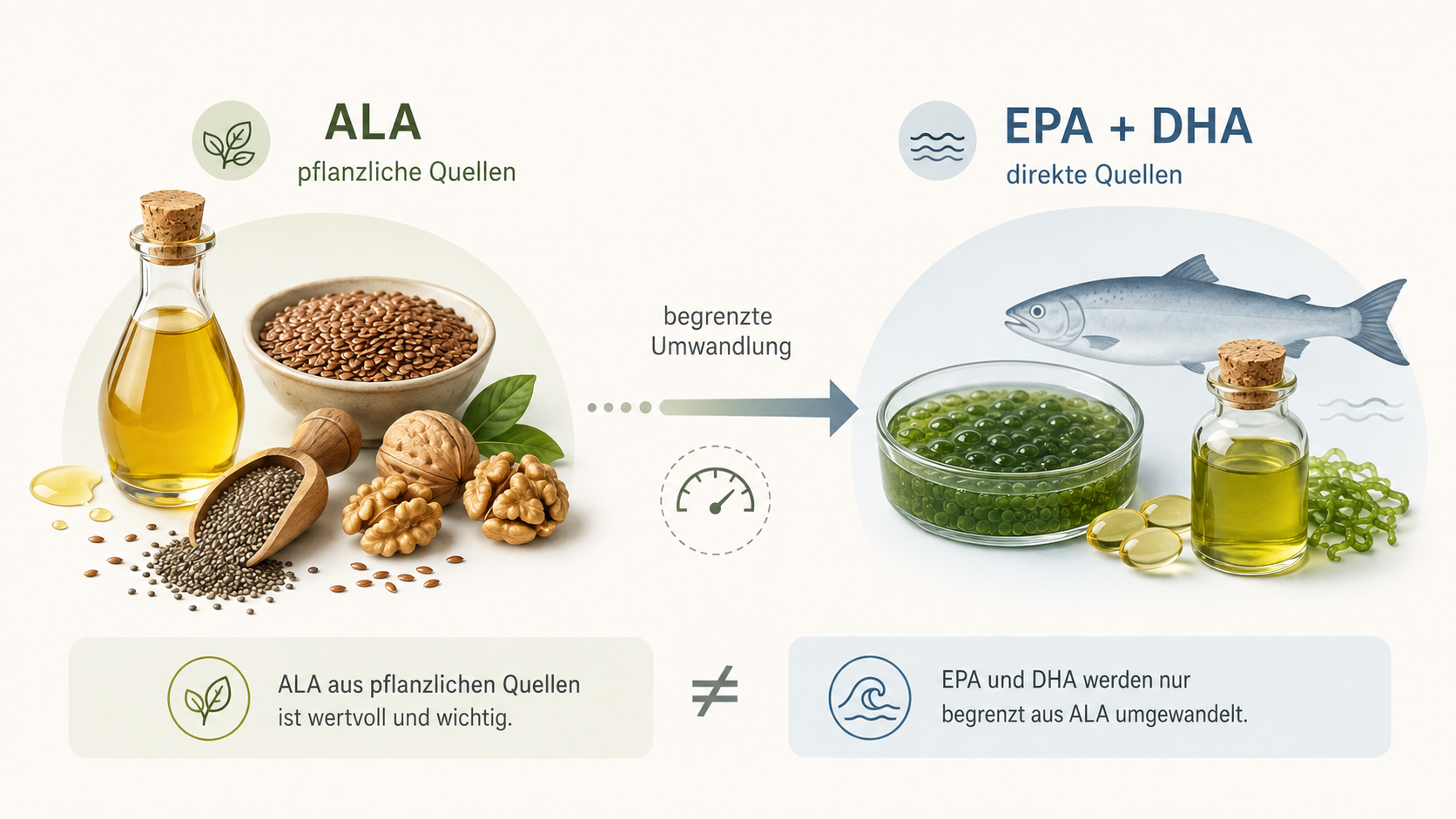
We find the plant-based omega-3 fatty acid alpha-linolenic acid, ALA for short, in linseed oil, linseed, chia seeds and walnuts, for example. These are valuable foods and ALA is itself an essential fatty acid.
Our body can basically convert ALA into EPA and DHA. However, this conversion only works to a limited extent; the production of DHA in humans is comparatively low.
EPA and DHA are mainly found in marine food chains. Fish ultimately contain these fatty acids via microalgae. That's why people who follow a vegetarian or vegan diet can also absorb EPA and DHA directly through algae oil.
That doesn't mean that linseed oil is suddenly bad. Not at all. It just means that “I use flaxseed oil” does not automatically answer the question of how well someone actually has EPA and DHA.
Why do we even care about EPA and DHA?
EPA and DHA play a role in various structures and regulatory processes in the body. Our cell membranes are particularly interesting. Their fatty acid composition influences various physical properties and signaling processes.
DHA also plays an important role in the brain and nervous system. EPA and DHA are also involved in processes that regulate inflammation.
Of course, it doesn't follow that as much omega-3 as possible automatically makes you as healthy as possible. Biology doesn't work that simply. But it explains why it can make sense to take a closer look at your own care.
The menu doesn't always tell the whole story
Someone says, “I eat fish.” Another says: “I already take Omega-3.” Another person uses linseed oil and walnuts every day. All three have every right to believe that they are paying attention to their care.
Nevertheless, their actual fatty acid levels can vary greatly. Amount, source, composition, regularity and individual metabolic conditions play a role.
That's exactly why you can derive a lot from a menu, but not everything.

And this is exactly where I think it makes sense to stop guessing at some point.
Omega-3 products are also worth taking a closer look at
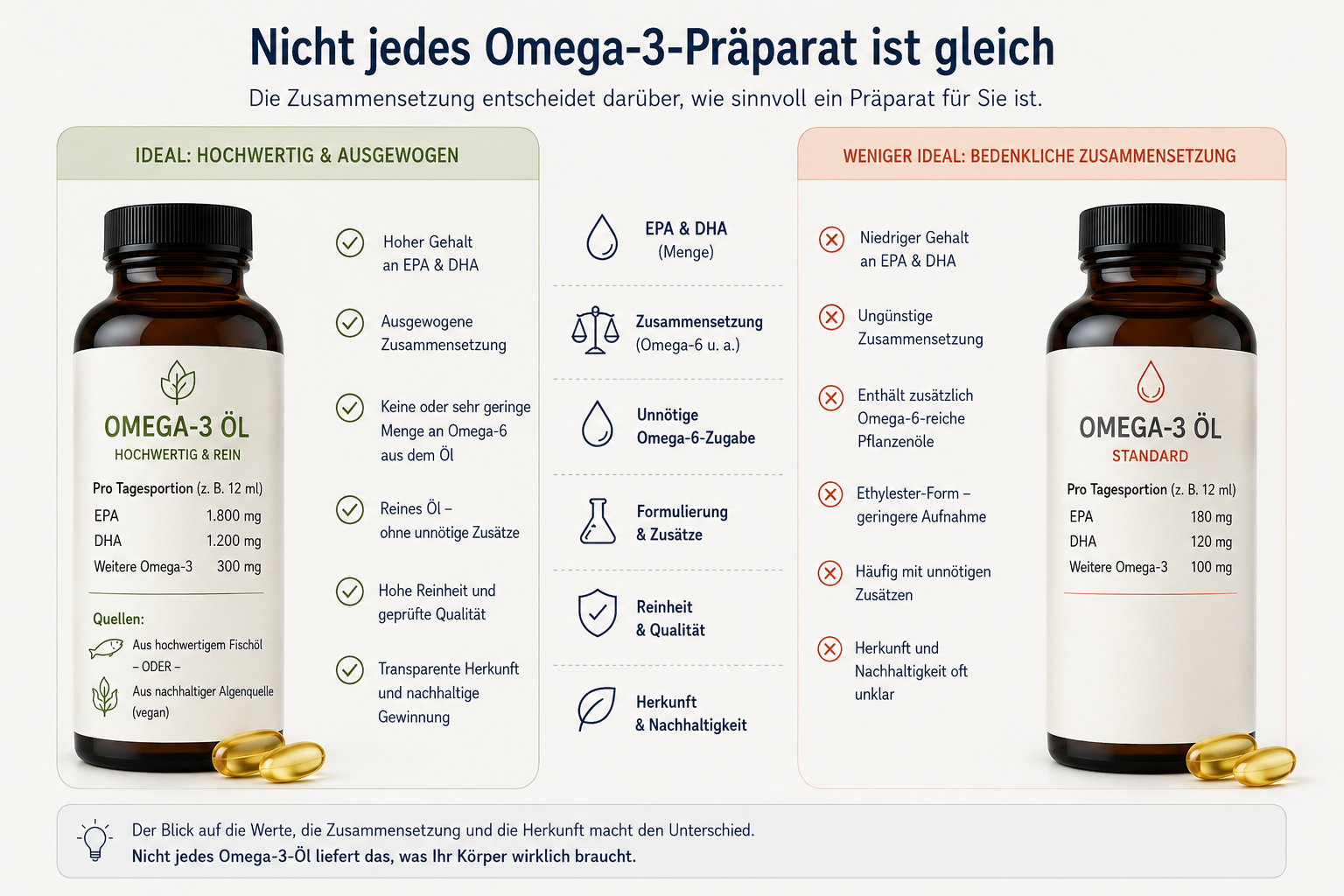
There is also something that is often overlooked when it comes to nutritional supplements: not every omega-3 product is automatically composed equally well.
For example, some products also contain omega-6-rich plant oils as carriers or additives. Others provide only relatively small amounts of EPA and DHA. Origin, composition and quality can also differ significantly.
That's why the label “Omega-3” on a package is not enough for me. You should know what is actually contained, in what quantity and whether the product fits your own initial situation.
And this is exactly where sensible advice becomes useful.
What can actually be measured?
During a fatty acid analysis, different fatty acids in the blood are examined. A well-known parameter is the so-called Omega-3 index, which looks at EPA and DHA in the membranes of red blood cells.
Since red blood cells circulate in the body for several months, this value provides a longer-term impression of supply and not just a snapshot of the last meal.
Depending on the analysis, other omega-3 and omega-6 fatty acids and the ratios calculated from them are also considered.
Such a test does not diagnose any disease. It does not say across the board whether a person is healthy or sick. But it can answer a specific question: What does my fatty acid supply actually look like?
For me, that is exactly the big difference between guessing and knowing.
Summary
Measure rather than guess
Of course, not everyone needs to take a fatty acid test right away. And just as little does everyone automatically need nutritional supplements.
If the care is good, then it is good. Then there is no need to create a problem out of it.
Perhaps an analysis also shows that the values look different than expected. Then you can first look at your diet, classify possible causes and then consider whether anything should be changed at all.
I think this order makes more sense than simply buying any product just because it says “Omega-3” somewhere.
Our modern diet has changed, and with it the type and amount of fats we consume. At the same time, people, their diets and their metabolisms differ. That's why I find the question "What actually resonates with me?" In the end, it is much more interesting than the general statement “I eat healthily.”
If we can measure something meaningfully, we don't have to just speculate about it.
If you would like to know what your own fatty acid supply looks like or whether a corresponding analysis makes sense for you, please feel free to contact ProBalance. We don't look at the results in isolation, but together with your diet, your lifestyle and your personal issues.
Because in the end it's not about taking in as much omega-3 as possible. It's about finding out what your body actually needs.
Sources & deepening
Scientific background
If you would like to know which products we use, please take a look here in the ProBalance shop .
Would you like to learn more about the topic and see the scientific evidence? To the original article by the Timmerherm Academy.