

Understanding brain health: The role of omega-3, nutrition, sleep and movement

Sandra Timmerherm
It's actually no wonder that this highly complex system reacts quite sensitively when certain conditions are permanently wrong.
Too little sleep. Ongoing stress. Too little movement. An unbalanced diet. Certain nutrients that are missing or not available in sufficient amounts.
And this begins a topic that particularly interests me:
What can we do to ensure that our brain remains efficient and healthy for as long as possible?
This is expressly not about suddenly declaring illnesses such as ADHD, depression or Alzheimer's to be “nutrition problems”. That would be far too easy.
But it would also make no sense to completely ignore nutrition and nutrient supply.
The truth, as is so often the case, lies somewhere in between.
Brain health is more than memory
When we talk about brain health, the first thing that comes to mind for many people is whether they can remember names or where they put their car keys.
That's just a small part.
Brain health involves, among other things:
- Concentration and attention
- Learning and remembering
- emotional stability
- Motivation and drive
- Managing stress
- Decision-making ability
- Responsiveness
- Sleep
- neurological functions
- long-term preservation of our mental abilities
All of this works through an incredibly complex interaction of nerve cells, neurotransmitters, hormones, blood supply, immune processes and metabolic processes.
Of course, our brain needs oxygen and energy for this. But also very specific building materials.
Our brain needs fat
That might sound a bit strange at first.
But a significant part of the dry mass of the brain consists of lipids, i.e. fats and fat-like substances.
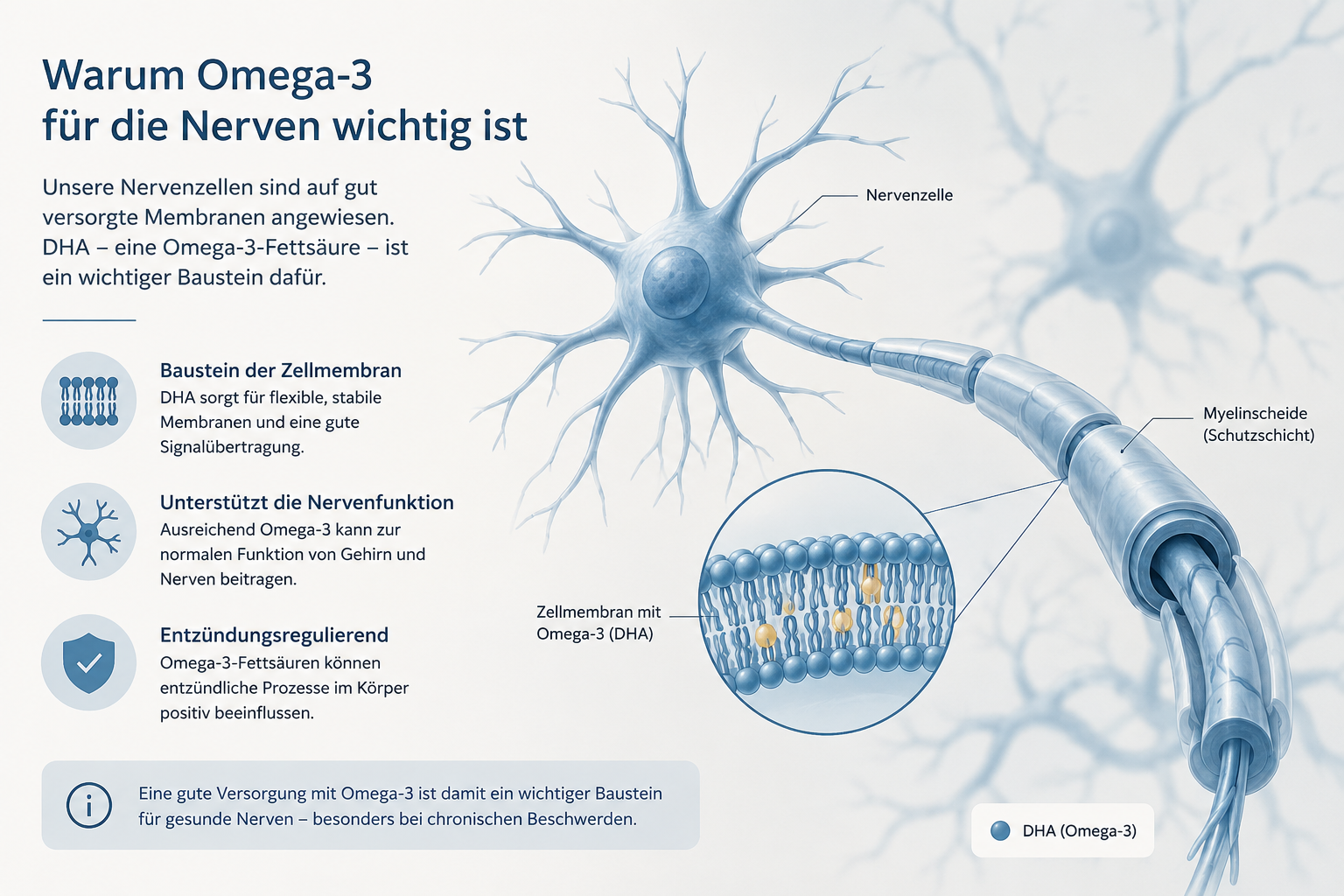
The long-chain omega-3 fatty acid DHA – docosahexaenoic acid – plays a particularly important role.
DHA is an important component of neuronal cell membranes and plays a role in their structure, mobility and signal transmission, among other things.
EPA – eicosapentaenoic acid – is also being intensively researched. Among other things, EPA is involved in processes that regulate inflammatory processes in the body.
And here the first small differentiation is worth it:
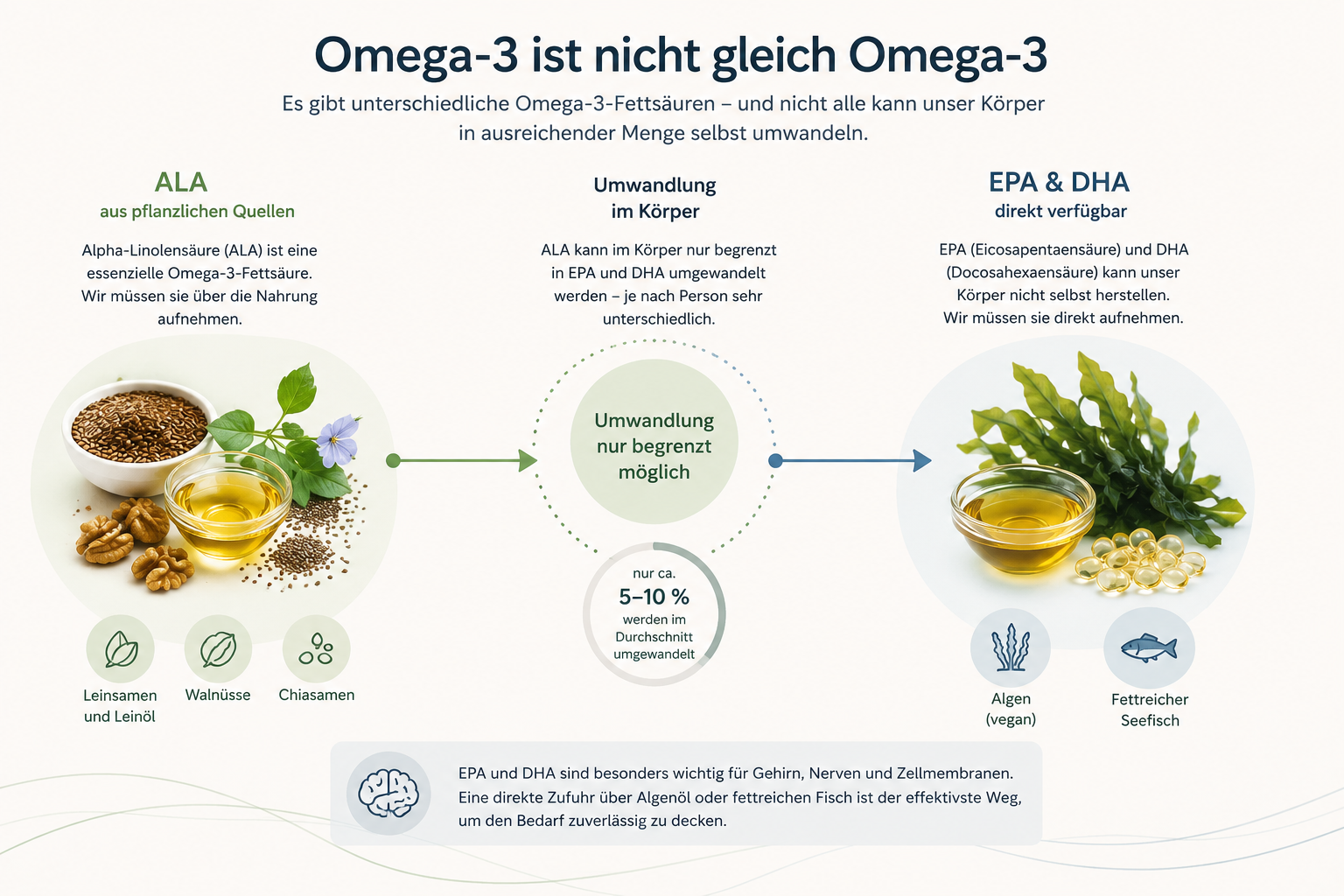
Omega-3 is not just Omega-3.
ALA from linseed oil or walnuts is different than EPA and DHA. Although our body can partially convert ALA, this conversion is limited in humans and varies greatly from person to person.
Anyone who eats a plant-based diet can also absorb EPA and DHA through appropriately prepared algae oils.
Why cell membranes are important at all
Let's imagine a nerve cell in simplified terms.
It has to absorb information, process it and pass it on to other nerve cells. To do this, it needs functioning cell membranes, receptors and numerous chemical messengers.
The composition of these membranes influences various properties of the cell. DHA is an important component here.
Of course that doesn't mean:
Lots of DHA = automatically smarter.
Unfortunately, biology rarely works that way.
However, it means that an adequate supply of certain fatty acids is one of the requirements that our nervous system needs for its normal function.
And then a pretty obvious question arises:
Am I even adequately supplied?
“I eat healthy” doesn’t say everything
I come across this again and again when it comes to health topics.
“I eat nuts regularly.”
“I use linseed oil.”
“I eat fish.”
“I already take omega-3.”
All sensible statements.
However, it is not yet possible to determine with certainty what the actual supply in the body looks like.
People absorb nutrients differently. Eating habits differ, as do metabolism, body weight, lifestyle and individual needs.
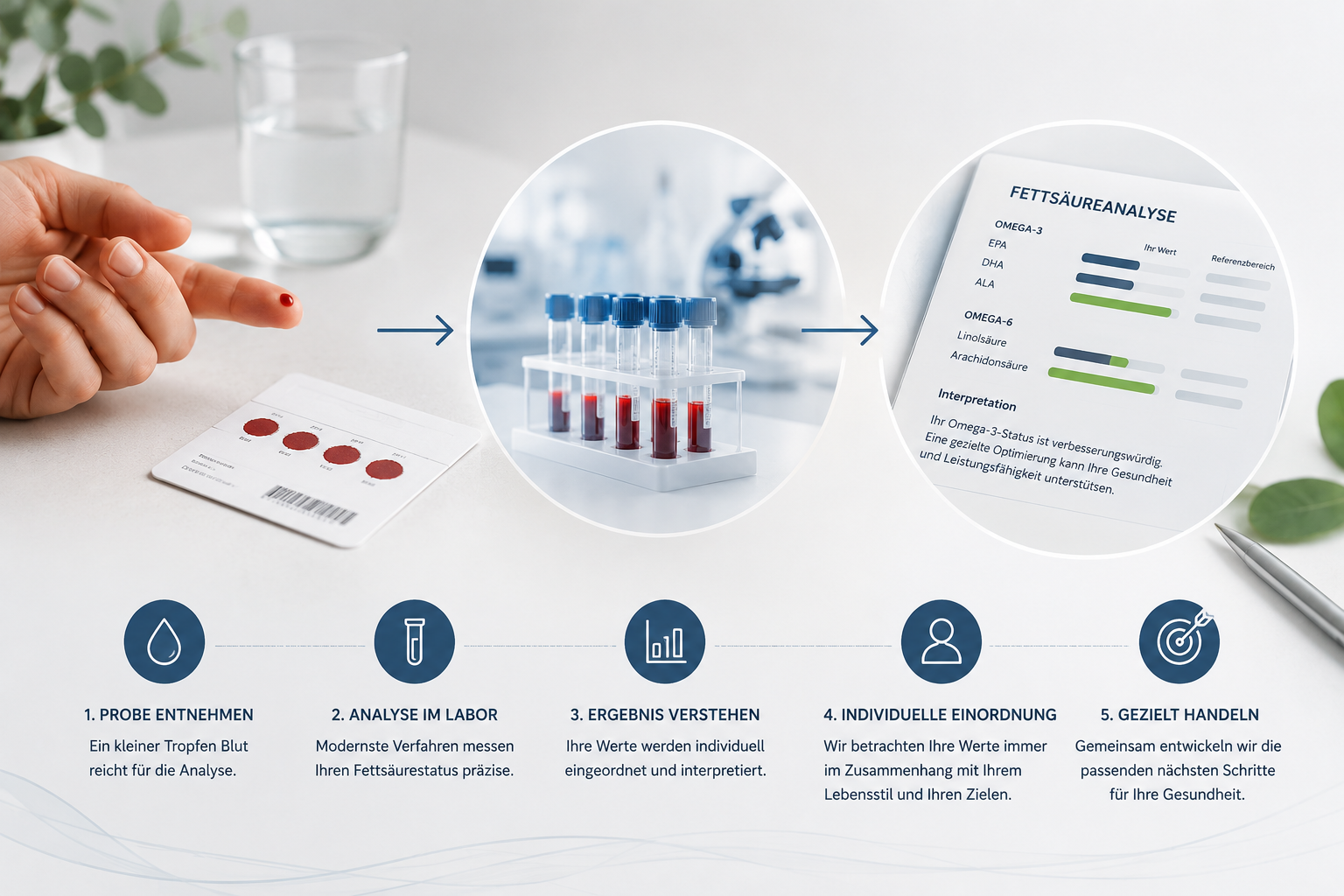
With Omega-3, for example, the composition of certain fatty acids in the blood can be analyzed. The so-called Omega-3 index describes the proportion of EPA and DHA in the membranes of red blood cells and has been scientifically studied for many years.
So we have something that I generally find very appealing when it comes to health:
We don't just have to guess. We can measure.
This does not mean that a single blood test will suddenly answer all your health questions.
Of course not.
But it can reveal part of the bigger picture.
Omega-3 and ADHD: Why this connection is interesting
In the case of ADHD in particular, research has been carried out for years into the role that fatty acids could play in attention, impulse control and various brain metabolism processes.
ADHD is a complex neurodevelopmental disorder. Genetic factors play an important role, as do changes in neuronal networks and in the regulation of various neurotransmitters - including dopamine and norepinephrine.
And now things get interesting.
In various studies, differences in fatty acid status have been observed in children and adults with ADHD. At the same time, there are studies in which targeted omega-3 intake has shown improvements in individual ADHD symptoms in at least some of the participants.
However, the results are not equally clear in all studies.
For example, a meta-analysis of randomized trials found small but statistically measurable improvements, particularly for EPA-rich products. Other larger reviews, however, were unable to find a clear effect on all core ADHD symptoms.
Now you can look at this negatively.
Or you can draw a pretty reasonable conclusion from this:
Omega-3 is obviously not the sole explanation for ADHD - but the individual fatty acid supply can be a factor that makes sense to take into account.
Especially if there is actually a significant undersupply, I think it is understandable to first recognize it and then correct it in a targeted manner.
This does not replace an ADHD diagnosis.
And it doesn't mean that medication or behavioral therapy is fundamentally unnecessary.
But there is a fairly wide range between the two extremes of “just medication” and “everything can be solved with diet.”
And this is exactly the area that interests me.
When we look at a person comprehensively, why shouldn't we also ask:
- How does he sleep?
- How does he eat?
- How does he move?
- How high is the stress level?
- And what does its actual nutrient supply actually look like?
Depression: Body and mind belong together
The situation with depression is similarly complex.
Depression is not just “not enough serotonin.”
This explanation is now considered far too simplistic.
Depression can have biological, psychological and social causes and influencing factors. Often several of them intertwine.
At the same time, we know that inflammatory processes, stress hormones, sleep, exercise and nutrition can be linked to mental health.
Omega-3 fatty acids have also been studied for years.
Some studies show interesting results, particularly with EPA-rich products, as a supplementary measure for depressive symptoms. Other studies show smaller or no clear effects.
So the following also applies here:
No miracle solution.
But possibly a building block.
And if a person is actually poorly supplied with certain nutrients, in my opinion it would make little sense to simply ignore this factor.
After all, psychotherapy, medical treatment and nutrition are not enemies.
They can be parts of the same overall concept.
Alzheimer's: Prevention doesn't just start at 75
When it comes to Alzheimer's, things get particularly exciting.
We now know quite well that not all risk factors for dementia are unchangeable.
Of course there are genetic factors.
But high blood pressure, diabetes, physical inactivity, smoking, social isolation, hearing loss, certain environmental pollution and other lifestyle factors also influence the risk of dementia.
The World Health Organization therefore explicitly pursues a lifelong approach to dementia prevention.
And that is actually the most important message:
Brain health doesn't just start when memory deteriorates.
It starts decades earlier.
Regular exercise, blood pressure control, good sleep, social contacts, mental activity and a balanced diet are among the factors that we can actually influence.
Omega-3 is also being intensively researched.
Large observational studies and meta-analyses show associations between a higher supply of omega-3 fatty acids and a lower risk of cognitive decline.
This does not automatically mean that an omega-3 capsule prevents Alzheimer's.
It would be nice that simple.
The WHO therefore does not recommend blanket omega-3 supplementation for everyone solely to prevent dementia.
But things get interesting again when it comes to the individual situation.
Because the statement “Not everyone needs a supplement across the board” doesn’t mean:
“Supply is unimportant.”
Rather, it means:
We should know whether there is actually a shortage or unfavorable supply - and then react specifically.
Unfortunately, this very distinction is lost in many discussions.
Sleep: A surprising amount happens in the brain at night
Sleep is not a break for our brain.
While we sleep, our brain processes and sorts information. Memory content is consolidated, hormonal processes are regulated and various regeneration mechanisms are activated.
Research into the so-called glymphatic system is also very exciting.
To put it simply, it is a cleaning system of the brain that is involved in the removal of metabolic products and appears to be particularly active in connection with sleep.
Many details are still being researched.
What we do know for sure:
Long-term poor sleep is not good for our brain.
For adults, around seven to nine hours of sleep is usually considered a reasonable guideline.
And for many people, a certain regularity is at least as important as the sheer number of hours.
Exercise: probably one of the best “brain remedies”
When someone asks me what they can do immediately for their brain health, my answer is pretty straightforward:
Move.
Regular physical activity affects blood circulation, metabolism, the cardiovascular system, stress regulation and various processes relevant to our nervous system.
We don’t have to run a marathon every day.
The WHO recommends adults get at least 150 minutes of moderate physical activity per week.
For example, brisk walking, cycling, swimming - and additional regular strength training.
Strength training becomes more and more important, especially as you get older.
And of course, any movement is better than none at all.
What belongs on a brain-healthy plate?
Actually nothing spectacular.
- Lots of vegetables.
- legumes.
- Nuts and seeds.
- Whole grains.
- Fruit.
- Good sources of fat.
- As few highly processed foods as possible.
Mediterranean-oriented dietary patterns are among the most frequently studied diets in relation to cardiovascular and brain health.
By the way, that doesn't mean that you have to eat fish.
A well-planned plant-based diet can also be of very high quality.
You just have to know – and this actually applies to every form of nutrition – which nutrients you should pay particular attention to.
For a vegan diet, for example, vitamin B12 and, depending on the situation, also vitamin D, iron, iodine as well as EPA and DHA from algae oil.
Nutritional supplements: not according to the watering can principle
And now we're at a point where I personally am becoming quite clear.
Simply buying any can in the supermarket, online or drugstore because it says “Omega-3”, “Brain” or “Energy” on the front is not a health concept for me.
There are different raw materials.
Different amounts.
Different formulations.
EPA and DHA in different ratios.
Different quality.
And above all:
Different people.
Therefore the first question should not be:
“Which product should I buy?”
Instead:
“What do I even need?”
This cannot always be fully answered using laboratory values.
But some things can be measured.
And if I can measure, I personally prefer measurement to guesswork.
What can a blood test do?
A blood test cannot diagnose ADHD.
It does not diagnose depression.
And it doesn't predict whether a person will eventually develop Alzheimer's.
That would be dubious.
But a corresponding fatty acid analysis can show what the supply of certain omega-3 and omega-6 fatty acids actually looks like.
And that can be an extremely helpful piece of the puzzle.
Especially if someone already believes that they are well taken care of.
Because sometimes a test confirms exactly that.
Great.
And sometimes it shows surprisingly clearly that there is a difference between what we take in and what actually ends up in the body.
Then we at least have a concrete basis on which we can continue working.
Summary
My conclusion: Understand first, then measure, then act
Brain health cannot be reduced to a single nutrient.
That would be far too convenient.
Our brain needs exercise, sleep, social relationships, mental challenges, a good metabolic situation, as little chronic stress as possible and of course a reasonable supply of the nutrients it needs.
Omega-3 fatty acids are a particularly interesting building block.
Not because they would cure every neurological or mental illness.
But because they take on biologically important functions and their supply can be determined comparatively easily.
And that's why I find one question much more exciting than any general supplement recommendation:
What about your own situation?
Not theoretically.
But actually.
Sources & deepening
Selected scientific notes
The study situation varies depending on the question. The following guidelines and reviews provide a more in-depth classification:
- WHO guidelines for reducing the risk of cognitive decline and dementia
- WHO recommendations on physical activity
- DHA, neuronal membranes and signaling mechanisms – review article
- Omega-3 fatty acids in ADHD – systematic review and meta-analysis
- Omega-3 fatty acids and depressive symptoms - systematic review
- Omega-3, dementia and cognitive decline - meta-analysis of prospective cohort studies
- Glymphatic system, sleep and substance transport in the brain - review article
If you would like to know which products we use, please take a look here in the ProBalance shop .
Would you like to learn more about the topic and see the scientific evidence? To the original article by the Timmerherm Academy.