

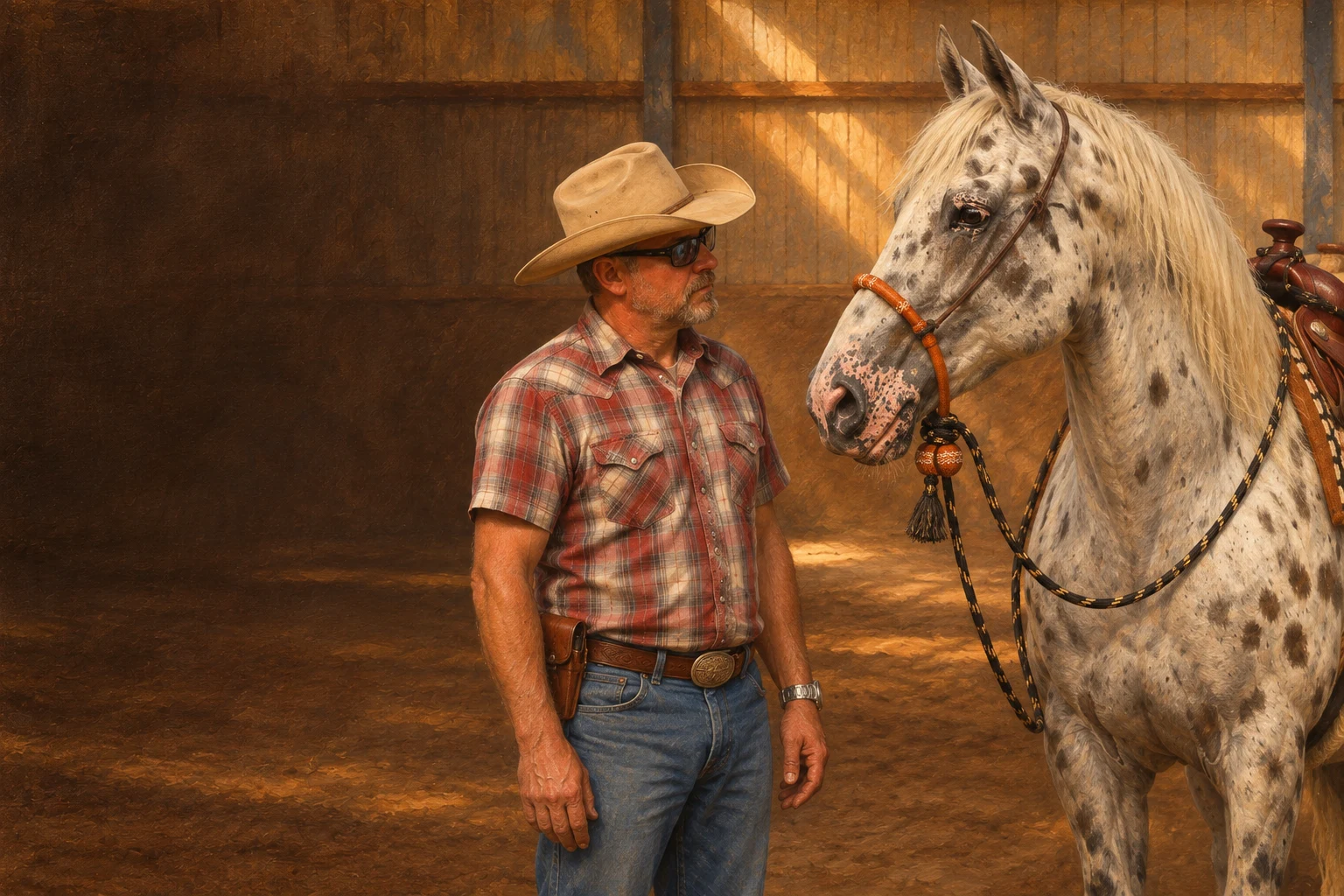
Does the bosal really fit your horse?
Understanding Equipment · Part 3 of 5. Correctly measure and shape the bosal and check for free movement.
By Marc Timmerherm · Reading time approx. 7 minutes
Part 1 · Bit or bitless? · Part 2 · Understanding the Bosal
Sometimes all I need to do is hold the bosal in the air. Our horses come on their own and push their noses into me while I'm still holding them in my hand. I love this moment. To me you can see how much they enjoy being ridden in the bosal. And before I get in the saddle, I take another look. How is the nose button positioned? How are the cheeks on the head? Does the bosal have enough space under the jaw to come to rest when it gives way?
Maybe you know this: everything looks neat from the side. Then you take a step forward and see that the nose button only rests on its ends. There is air in between. At the slightest movement, the bosal turns to the side. I'd rather stay next to my horse for a moment. A few minutes fitting can make a big difference to how our first aid feels.
In the second part we saw how the bosal moves and what happens when the hand gives way. Today we take a step back. We look at what shape your horse's head has, how you take measurements and what else you can change about the bosal.
Where should the nose button be?
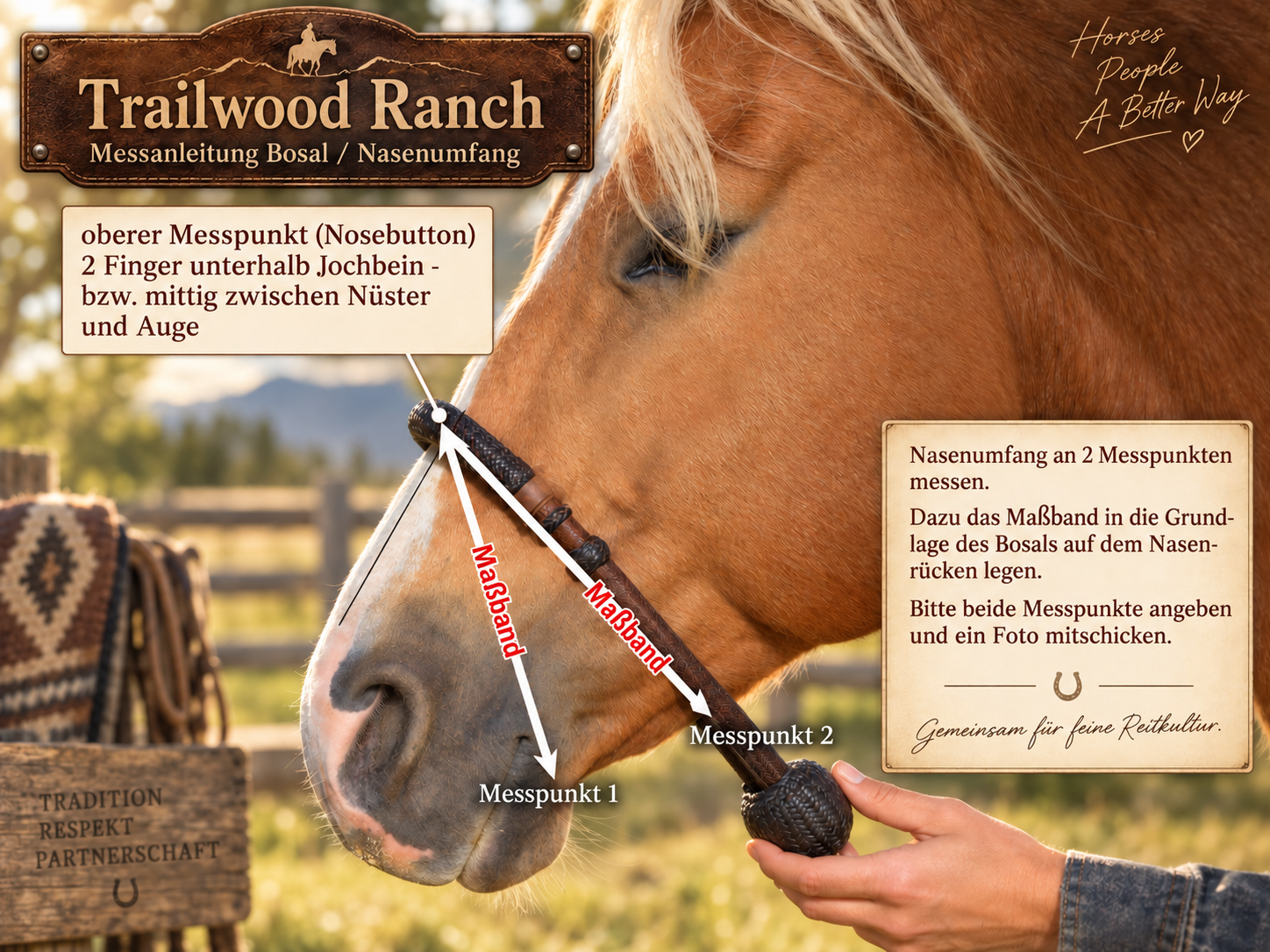
The nose button is the thickly braided section of the noseband that lies across the bridge of the nose. The two sides are called cheeks and meet at the heel knot. When choosing a bosal, I first identify where the nose button should sit on the bony part of the nose. Farther down, toward the nostrils, this firm support gives way to softer tissue. The nose button must not slip onto that area, even when the bosal moves in response to an aid. The hanger — the strap over the poll — also helps determine where the bosal sits. The eyes must remain unobstructed. 1
In our graphic you will find two starting points: approximately two finger-widths below the bony prominence that can be felt on the side or approximately in the middle between the eye and the nostril. Depending on your head, these are approximations. What matters is where the nose button actually rests on the solid nasal bone for this horse. 1
This is how you measure the two circumferences of the horse's head
Take a soft measuring tape and have your horse keep his head relaxed. The band lies close to the fur without constricting it. Both measurements start at the same point at the top of the bridge of the nose, where the nose button will later be located.
- Measurement 1 goes diagonally forward to the chin crease. Guide the band diagonally forward from the top measuring point, under the head and back to the starting point on the other side. Write down the entire circumference in centimeters.
- Measurement 2 goes diagonally backwards. Start again at the top in the same place. Guide the band further back around the side of the lower jaw, approximately where the cheeks go when picked up easily. Here, too, you note the entire scope.
- Take a photo from the front and one from the side. From the front you can see how wide the head is and how the lower jaw branches run. On the side it becomes clearer where you have placed the band and how deep the jaw is there. The best way to see the course of the band is in the pictures.
I measure the inner circumference of the bosal
Place the flexible tape measure all around the inside edge of the bosal. Measure without the mecate tied, leaving the bosal in its natural shape. This is how you get it Inner circumference in centimeters. During the fitting I look at how the cheeks run along the pine branches and how much space remains under the lower jaw with the mecate tied.
We like to work with more flexible bosals on the ranch. I have had good experiences with this with our finely reacting horses. After shaping, I can carefully reshape the curve of the nose button or the shape of the cheeks by hand if necessary. If I squeeze it a little sideways, it becomes narrower and can become longer in the other direction. That's why I use the inner circumference as a starting point for these bosals. When I try it on, I look at how this circumference is distributed across width and depth. 3
With a dimensionally stable bosal, the distances tend to remain the same when measuring. There are Inside length and inside width useful measurements. You measure the inside length from the inside of the nose button to the inside of the heel knot. You measure the inside width across the cheeks at the point specified by the manufacturer. When comparing models, make sure that both measurements were taken in the same places. 1
To make the selection, we look at both measurements and the photos. Depending on the shape of the head and the tied mecate, around five to six centimeters can be added with our method. For other combinations it can be six to eight. The addition leaves space for the windings and for the movement of the bosal. We assess which initial size and which addition makes sense for your horse together with the shape of the head and test it on the horse. 1, 2
What five eighths mean on the bosal
When a bosal says “5/8 inch,” it usually means the thickness of the side panels. Two bosals with the same strength can be shaped differently and fit differently on the same horse. When I try it on, I look at how the curve of the nose button and the shape of the cheeks fit the head. 1
Imagine two horses with similar nose circumferences. One has a rather narrow bridge of the nose and a deep lower jaw. The other is wider at the top and flatter at the bottom. With the first you may need more depth, with the second a different curve at the top. This is where the photos get interesting. They show how the scope is distributed across width and depth.
When shaping you shape the support
First look at the bosal on the horse from the front and from both sides. Where is the nose button? Does it lie evenly or is it mainly supported at the ends? Does one side part stick out far while the other is pressing? Also check the hanger so that you don't try to compensate for a crooked suspension with a new shape. 1, 3
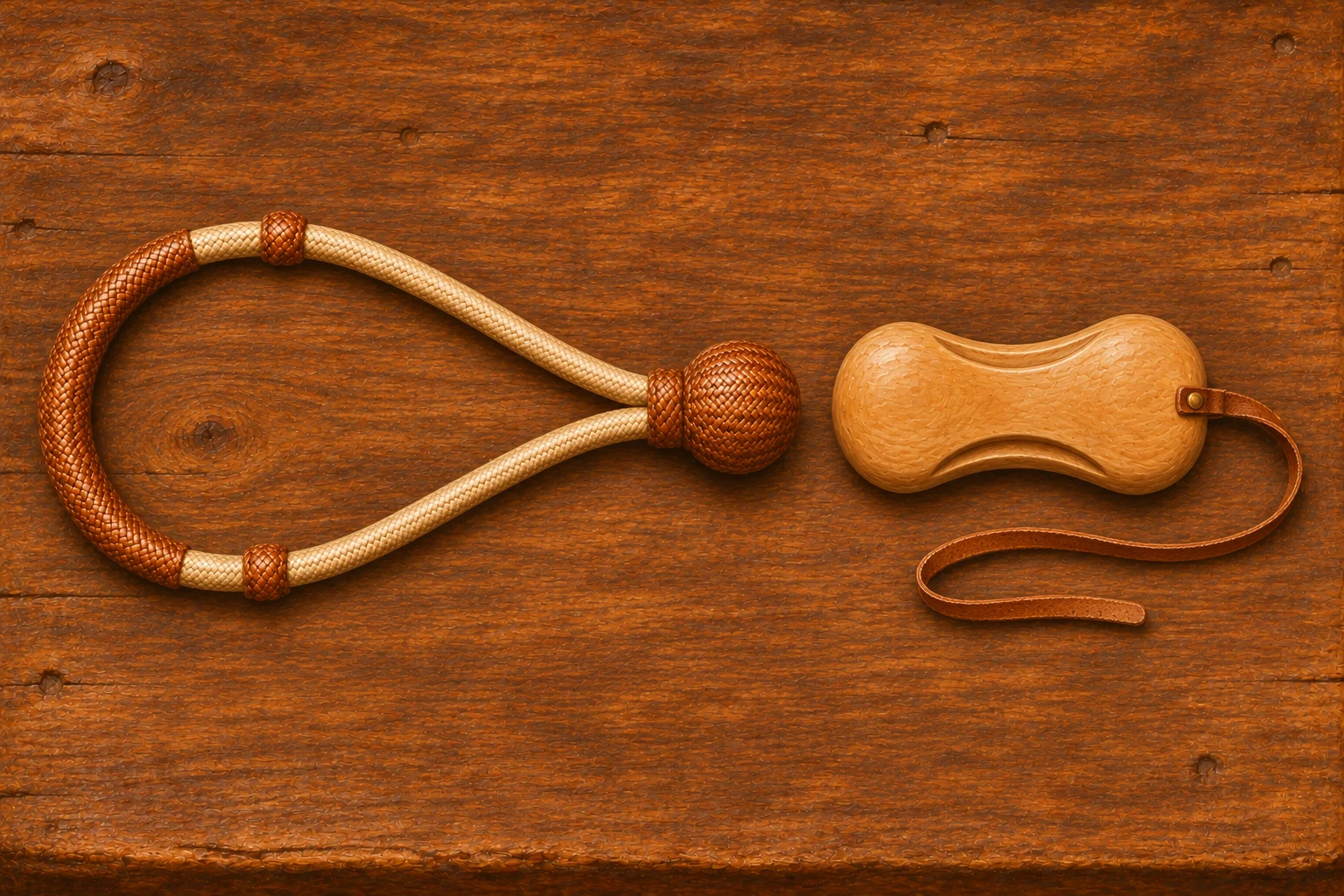
To shape, take the bosal from the horse. With a suitable, flexible rawhide core, small changes can be made carefully with your hands. The curve of the nose button should follow the nose and the cheeks should run along the head without pinching the jaw. In a fitted form block, the middle is narrower. From above, the contour is reminiscent of a flat eight. Depending on the design, the cheeks sit in side guides and a leather strap holds them to the block during shaping. This means that the shape can be specifically adapted to the nose and jaw. You then check the result again on the horse. 3, 4, 5
How strongly a bosal can be formed and how long it should remain on the molding block depends on the core and the braiding. For a stiff or unfamiliar model, follow the braider's instructions. A hard bend on the nose button or compressed side panels can create exactly the areas you actually wanted to relieve. If the basic shape of the bosal lacks significant width or depth, it is worth choosing a different size. 1, 3, 4
Flexible or dimensionally stable – which does your horse understand more easily?
There are different preferences among riders. I like to use the more flexible Bosal for our horses because they react well to even small riding aids. If you have a different horse, it may be worth trying out a more stable model. By dimensionally stable I mean that the bosal holds its shape more strongly when helped. Maybe this will make the signal easier for your horse to understand. When trying it on, see how it reacts to a little help and how quickly the contact subsides when you give in. If you are unsure, have both options shown to you and try them out with your horse before you decide.
I would take a closer look at a very affordable model, especially with the first Bosal. Ask for the core and check that the braid is even and smooth on the supporting surfaces. Poorly processed areas or an unsuitable shape can cause pressure and make it unnecessarily difficult for the horse to get started. A good first experience starts with the bosal fitting the head and your horse being able to differentiate between help and yield. 3, 4
Now the Mecate is added
You see the final seat with the hanger and the mecate that you actually want to use. Let's take a 5/8 inch bosal with an equally strong mecate. The rope is nominally just under 1.59 cm thick. Three closely spaced windings are mathematically round at the bottom end of the bosal 4,76 cm a. How much smaller the free inner circumference becomes depends on how the windings are positioned and how the opening changes as a result. 1, 2
The thickness of the Mecate and the number of wraps also change the weight at the bottom of the Heel Knot. This affects how the bosal moves and returns to its rest position when it gives way. Three to four windings and about two fingers of space above the top winding are a first orientation in our example. On the horse I check how much space there actually is under the lower jaw and whether the bosal can swing freely. 1, 2, 3
If you have to keep wrapping so that a bosal that is too deep sits halfway, take another look at the basic size. And if the coils are already resting against the lower jaw, the bosal lacks the space it needs to move. The horse should be able to move its jaw freely. 1
This is how you check the seat while moving
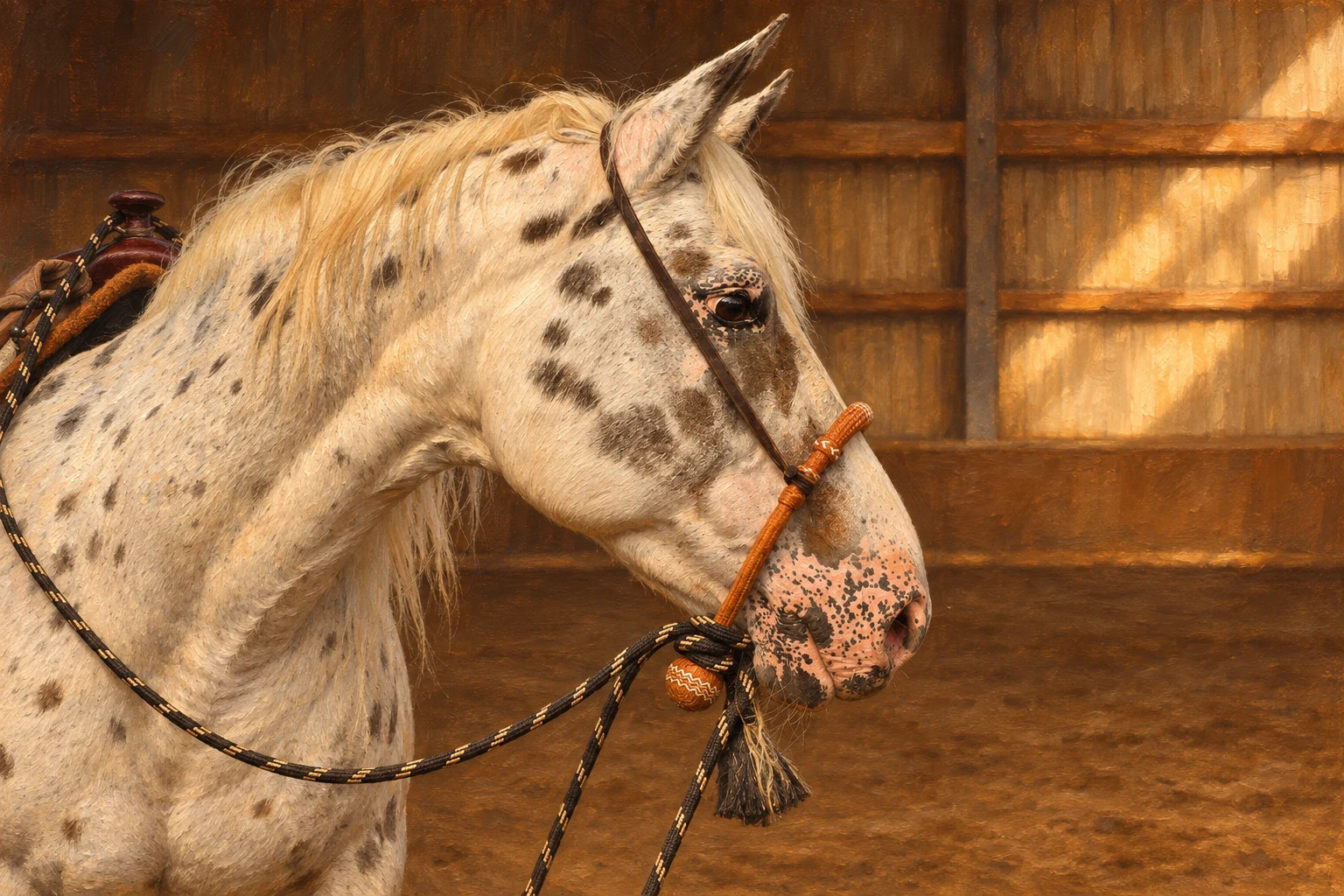
First look with the Mecate released. The nose button sits quietly on the bony bridge of the nose. There is no place on the side that pinches the horse. There is space left under the lower jaw. Then pick up the mecate slightly while standing and then let it loose again. Observe from the side how the heel knot lifts, how the contact on the nose part and the cheeks changes and whether the bosal returns freely to its resting position when it gives way. 1
If the bosal twists a lot, slips towards your nostrils or if the contact remains after giving way, check the seat height, shape and binding again. After the first short sessions, also look at the fur and skin. If there are chafing, tenderness or swelling, remove the Bosal and determine the cause before using it again. 1, 3
For me, this is the best moment when fitting: you pick up the mecate a little bit, see how the bosal moves, and when it gives in, your horse immediately becomes calm again.
If you fluctuate between two sizes for your horse, please write to us about it Contact form. Name both dimensions. We can then add photos via email. If you already have a bosal, show us how it sits on the horse with a hanger and tied mecate. Then we can look together to see whether the basic shape fits and where an adjustment is worthwhile.
The painting-like illustrations are AI-generated. The measurement graphic shows the measurement routes of Trailwood Ranch.
Read more and deepen
Sources and further literature
The measurement methods and additions describe our selection method at the ranch. Trying it on with the mecate tied shows whether the bosal fits.
The linked instructors and outfitters demonstrate their respective practice in fitting and shaping.
Passive Horsemanship describes your own fitting practice with photos, internal dimensions, hanger, rolling movement and space under the jaw.
Fitting a hackamorePassive Horsemanship explains how rope thickness and number of wraps affect the weight and balance of the hackamore.
The MecateInstructor Ali Kermeen uses actual horses to show how she checks the fit and adjusts bosals by hand or with a mold.
Book excerpt on the traditional hackamoreJohn Brand shows the seat before and after molding as a practical example from an outfitter.
Shaping a BosalAmedeo Ramazzotto shows a mold block with side guides and explains how his model recreates the jaw shape.
Shaping the Bosal
For stables, clubs and practices
Free introductory talk at your location (German)
understand bridles. Communicate more finely with each other.
Do you run a riding stable, are you involved in a riding club or work in a veterinary practice, in animal physiotherapy or animal osteopathy? And would you like to give your adjusters, members, customers or your team understandable knowledge about horse-friendly equipment?
Then bring us to you for a free introductory talk (German). We talk about bridles, how they work, the importance of a light hand and the possibilities of the bosal - with reference to everyday stable life and space for your questions. We will coordinate the topic, scope and date together.
In the contact form, write “Free introductory talk (German) for stable, club or practice” in the subject line. Tell us where you are and who you want to reach.
Request a introductory talk (German) for youIf you would like to know which products we use, feel free to explore our shop.
To the original post by Timmerherm Ranch
Which Bosal suits your horse?
Would you like to buy a Bosal, need help measuring or are you unsure whether your existing Bosal will fit? Tell me about your horse and, if available, name the two measurements. We can then add photos via email.
Please do not send emergencies or sensitive findings using the form.