

Pastern dermatitis in horses: What can help now
Supporting affected skin now and in the longer term — with a practical look at skin care, husbandry and nutrition.
By Marc Timmerherm · Reading time approx. 7 minutes
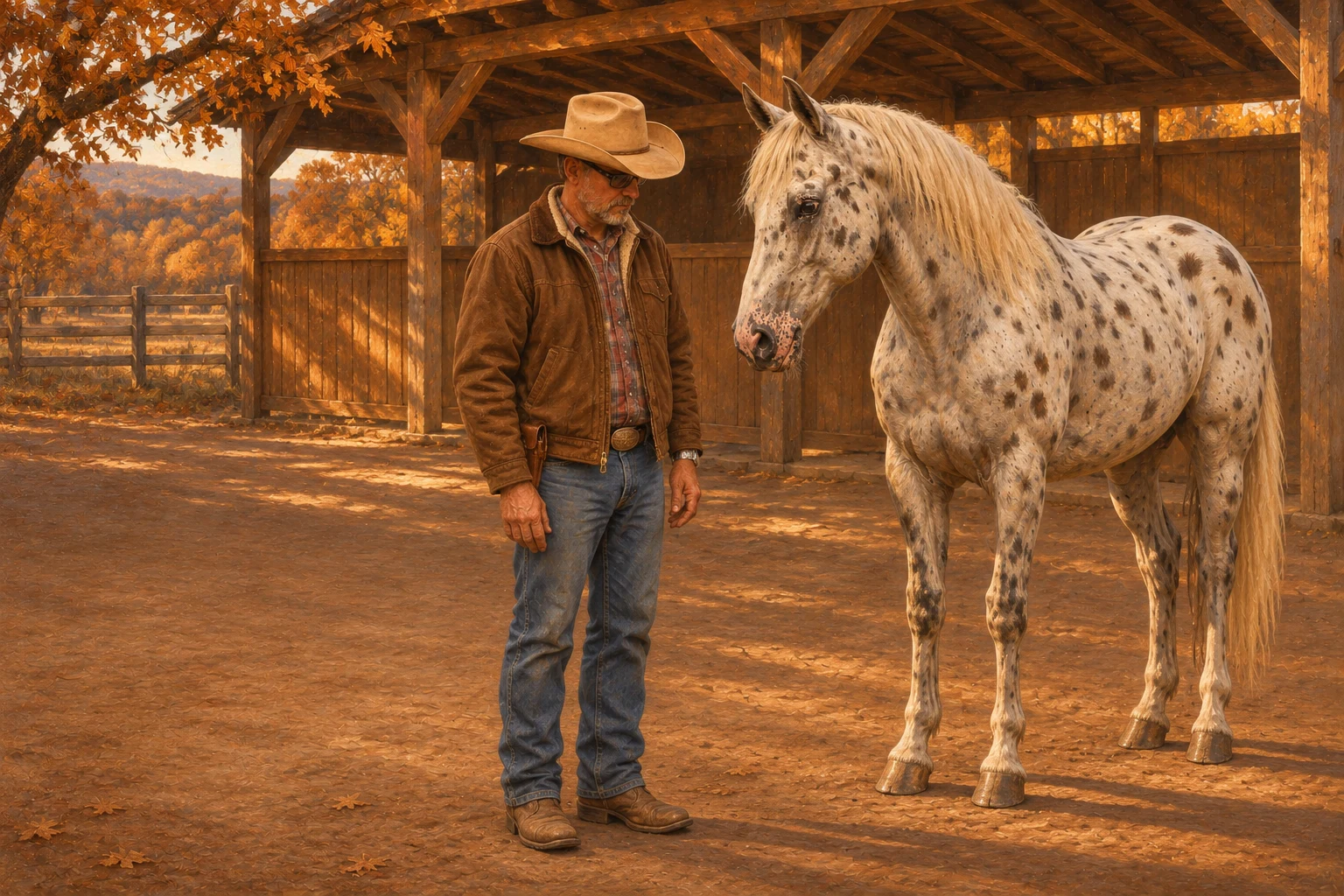
While picking out your horse’s hooves, you run a hand over the back of the pastern and feel them: those little scabs. Perhaps your horse pulls the leg away; perhaps the skin underneath is already red. The questions immediately start running through your mind. What should I put on it? Does it need washing? Why does this keep coming back?
Anyone who has horses wants to help. I can well understand that you are happy about every tip that finally gives you some hope. At the same time, I want to know what my horse needs at the moment. In the case of pastern dermatitis, it is worth taking a close look at the affected skin and tailoring the treatment accordingly. We can then ensure that she has better conditions to stay healthy in everyday life.
Look closely before treating
Pastern dermatitis describes inflamed skin, often on the back of the pastern. It may be red, oozing or crusty. Different triggers can look similar. Among other things, skin irritation, mites, bacterial involvement and, in the case of white legs, certain sun-dependent changes are possible. 1
Check all four legs. Where exactly are the affected areas? Is the leg more swollen than usual? Does your horse react with pain? Take a photograph before applying anything, and note which products have already been used. This information helps your vet assess the situation.
Call your veterinary practice promptly if there is significant swelling, heat, pain, lameness, fever or rapid spread. If symptoms are severe, call immediately.
Recurring or poorly healing areas should also be examined. Depending on the findings, a skin scraping for mites or a sample to test for bacteria may be necessary. Sometimes further diagnostics are needed. This creates a basis for selecting the treatment specifically. 1
What you can contribute to acute care
For the next care steps, I would look for a clean, dry place and have everything ready that is needed according to the treatment plan. Then you can stay with the horse. Especially when the skin hurts, it makes a difference whether we work in peace or switch back and forth between washing, searching and holding on.
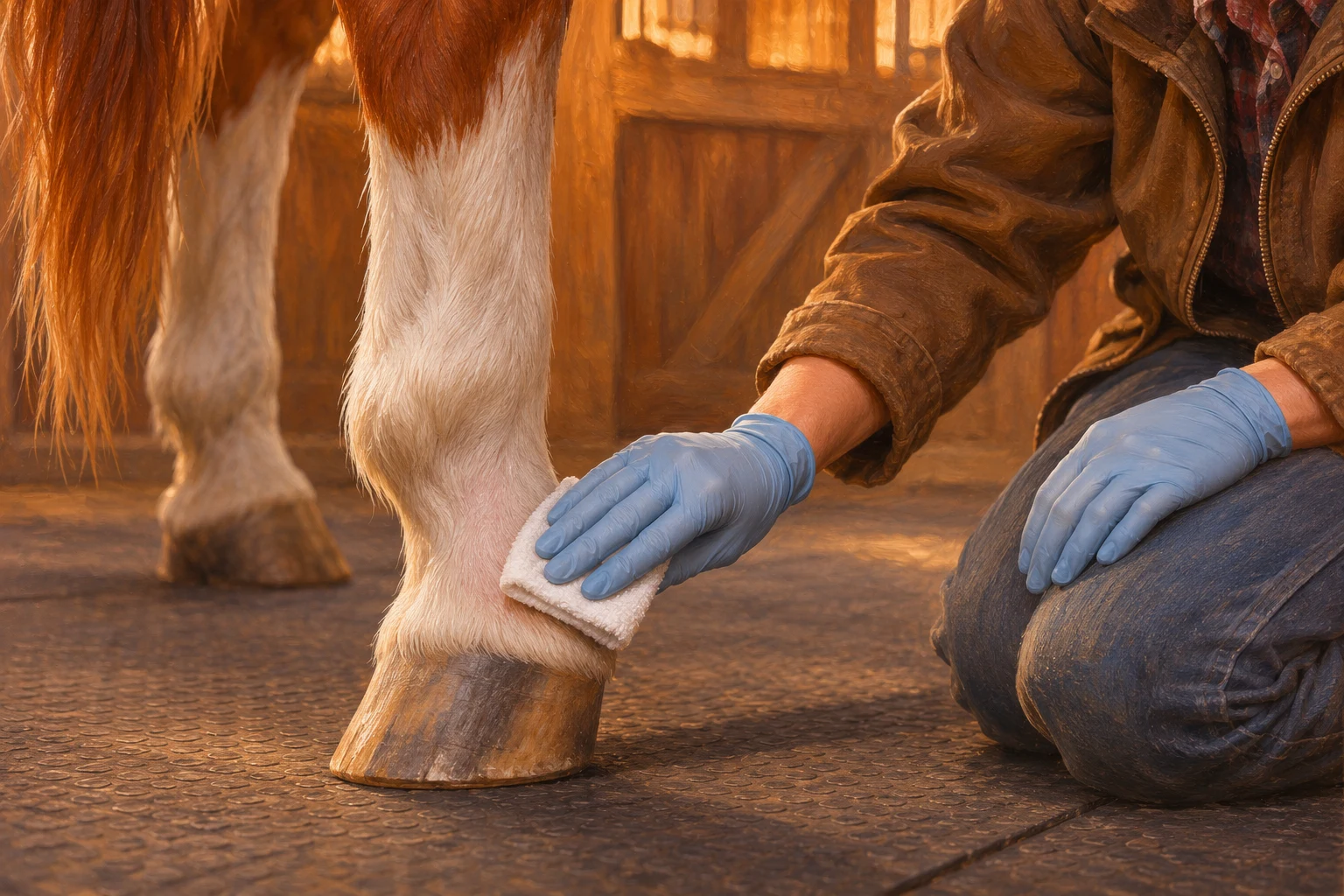
Dissolve dirt gently. Whether the area should be washed, and what to use, depends on the condition of the horse’s skin. If washing is needed, use the recommended product at the specified dilution and dry the area carefully with a clean towel. Moisture can remain trapped beneath thick feathering. 2
Handle firmly attached scabs gently. Pulling firmly attached scabs off can hurt and injure the skin again. Scabs that have already loosened may sometimes be removed carefully. Ask your vet to show you whether and how firmly attached crusts should be softened and loosened as part of treatment. 2
Implement the agreed care plan. Which cream, cleansing or other treatment is suitable depends on the findings. Write down how often you should use something and when it should be checked. If the skin reacts irritably to a product or worsens, discuss this with the treating practice as soon as possible.
Why the treatment must match the cause
Imagine two horses on which you find similar scabs. One keeps rubbing and stamping with her legs. In the other, the focus is primarily on the reddened skin on a white leg. These are observations that you should pass on. They can lead to different examinations and therefore different treatments.
Depending on the cause, treatment against mites, targeted local therapy against bacterial involvement or anti-inflammatory measures may be required. Antibiotics for oral administration or injection are not an automatic standard treatment for pastern dermatitis. The veterinarian will assess whether they are necessary based on the course and, if necessary, suitable samples. 3
Treatment also involves the horse’s environment. Persistently damp skin and poor hygiene can keep the problem going. Ask your vet how to keep the affected skin clean and dry until the next check, and whether the feathering needs attention. 3
How you recognize progress
A photo in the same light and from the same direction helps with comparison. Note whether your horse tolerates touch better, what swelling and oozing look like and whether new spots appear. This is much easier to discuss at a check-up than an uncertain “I think it’s a little better”.
Agree on the next steps and a follow-up date with your veterinary practice. Contact them sooner if the expected improvement does not occur or things get worse, so treatment can be reviewed in good time. 2
Then give the skin good conditions
Once the skin settles, you naturally want it to stay that way. Take a look at everyday conditions together. Where does your horse stand after a rainy day? Can it rest on dry ground? Is moisture trapped under brushing boots, bell boots or thick feathering? Are any areas repeatedly rubbed?
A brief daily check helps you spot changes early. Gently part the feathering to inspect the skin underneath, and keep grooming and care equipment clean. If pastern dermatitis keeps returning, work with your veterinary practice to identify contributing factors in this particular horse. The specialist review also discusses differences related to breed, feathering and skin pigmentation. 4

Resilient skin needs appropriate care
Healthy skin includes its external protective barrier, normal immune defense and the ability to renew itself. We can also create the conditions for this through feeding. The horse needs enough energy, usable protein and a needs-based supply of minerals and vitamins. What already comes from hay, mineral feed and all supplements should be considered together. 5
For me, it starts with a manageable list. What does my horse get every day and in what quantity? What is on the labels? What addition was added at some point and why? It's easy to lose track, especially after several well-intentioned recommendations.
Zinc fulfills important tasks in the body, but an additional dose should fit into the entire ration. The copper supply must also be taken into account. A red pastern alone does not tell you whether there is a supply gap. If a gap becomes apparent, a targeted addition can have its understandable place. 5
Appropriate care supports the conditions for healthy skin. Whether pastern dermatitis develops depends on the individual triggers and the conditions in the stable. That's why Sandra and I like to look at the whole picture with you. The treatment of the acute skin areas and the accompanying care check can be sensibly integrated into one another.
Look at your horse's care together
The three painting-like images are AI-generated illustrations.
Read more and deepen
Sources and further literature
The sources deal with different causes and care situations. A personal examination will clarify which of these play a role in your horse.
UC Davis School of Veterinary Medicine · Equine medical classification of signs, possible causes and targeted diagnostics for fetlock dermatitis.
Open original sourceBritish Horse Society · Practical recommendations for gentle care, dealing with crusts and controlling the progression.
Open original sourceAustralian Veterinary Prescribing Guidelines · Veterinary guidelines on cause-related treatment and the importance of skin care and living conditions.
Open original sourceGerber, Kaiser-Thom and Oesch (2023) · Specialist overview of pastern dermatitis. It describes the interaction of various risk factors and the limited study situation.
Open original sourceMerck Veterinary Manual, as of February 2026 · Basics of needs-based horse feeding including protein, minerals and the total intake from all feedstuffs.
Open original source
Free introductory talk at your location (German)
Healthy skin begins in everyday stable life
Would you like to better understand how skin care, husbandry and feeding work together in the stable, club or practice team? We'll look at typical questions from everyday life with horses with you.
Then bring us to you for a free introductory talk (German). We talk about skin health, needs-based care and observations that will help you notice changes early on. We take time to answer your questions. We will coordinate the topic, scope and date together.
Write to us using the contact form with the subject “Introductory talk (German)” and tell us briefly who you are planning it for.
Ask about an introductory talk (German) ↘If you would like to know which products we use, feel free to explore our shop.
To the original post by Timmerherm Ranch
What does your horse’s skin need?
If you would like to take a closer look at the care of your horse, write to Sandra and me. Tell us what has already been clarified by the vet and what your horse gets every day. Together we look at feeding, existing supplements and possible next steps.
Please do not send emergencies or sensitive findings using the form.