
There is a salt lick. But is your horse getting enough salt?
What the salt lick tells you and how you can check the salt, feed and water on your next tour of the stable.
By Sandra Timmerherm · Reading time approx. 5 minutes
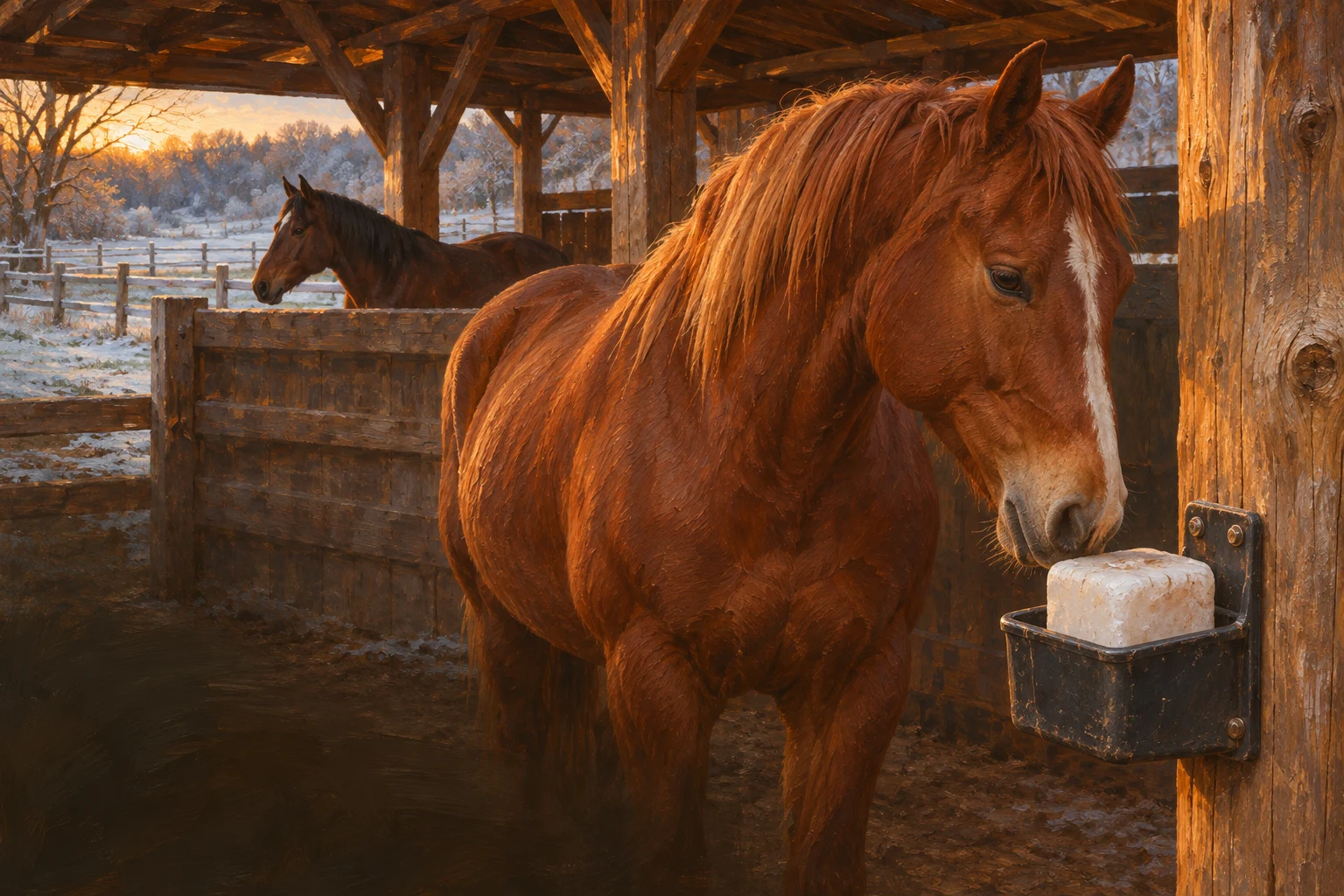
You go through the stable again in the evening. It's already freezing outside, but inside you're checking the water. And there it is, the salt lick, hanging almost as squarely as it did on the first day. Two boxes further on, the stone is already half gone. You quickly ask yourself: Does my horse need more salt? Or has it already had enough?
I would look at three things the next time I go to the stables: What does your horse get in his feed? How much does he sweat during his work? And is there always a good supply of salt and water? This allows you to better classify the almost untouched stone.
What the lick stone tells you
A pure salt lick provides mainly sodium and chloride. Your horse needs both. How much it absorbs through the stone can vary significantly from horse to horse. In the open stable there is something else: If five horses use the same stone, its consumption cannot be assigned to any individual horse.
In a 2026 study, two researchers compared loose salt and salt blocks in 16 adult horses. In this experiment, no statistically proven difference in the amount absorbed could be shown between the two forms. However, there was a big difference between the horses. More than half consumed less of the salt offered than the researchers estimated to meet their needs. An older study with six sport horses also found large differences in voluntary admission. Both groups were small. What your horse needs depends on his own ration and workload. 1 2
A salt lick shows you that salt is being offered. How much reaches your horse is a separate question.
Two horses, two different starting points
Imagine a leisure horse that mainly goes for walks in winter and hardly sweats. It is fed a mineral feed with sodium listed on the label. I would first check how much of this food actually ends up in the trough every day. A figure per kilogram only tells you what the portion delivers together with the amount fed.
Next to it is a horse that works regularly even in winter and sweats noticeably under its winter coat. It has a salt lick and on some days it also gets an electrolyte mix. Here I would write down when it sweats, how much, what mixture it gets and what the rest of the ration contributes. This way you can see from which sources sodium and chloride come and where the gifts overlap. A mineral lick can contain other minerals. In the case of an electrolyte mixture, the composition depends on the respective product. So look at the label.
When it's frosty I start at the waterer
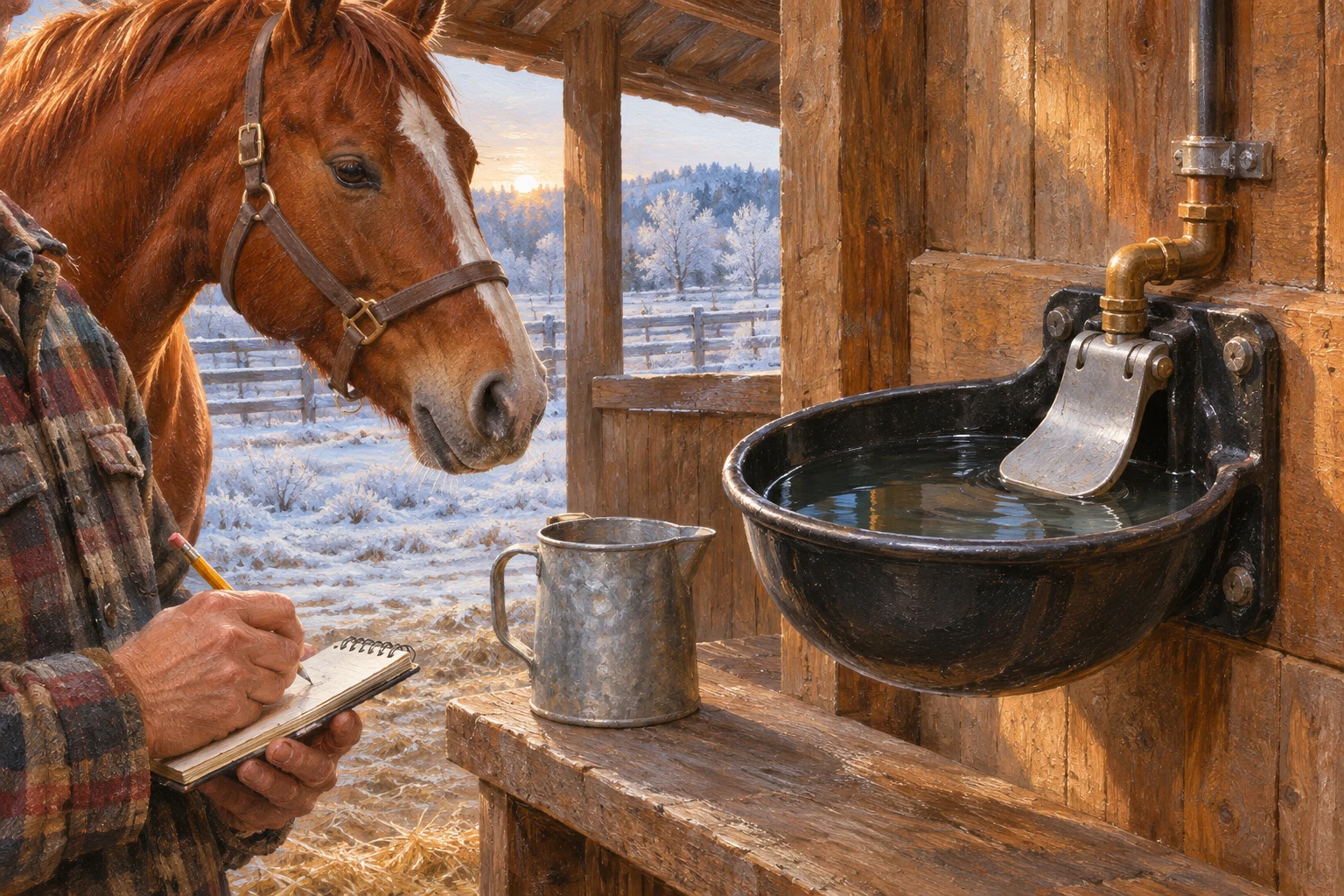
A self-drinker can look full and still barely run. On your next lap, press the lever once and see if water comes quickly. When it's frosty, check the pipes and in the open stable whether your horse can get to the water when others are standing in front of it. Water should be available for free consumption all year round. 4
In two small winter experiments, a total of 14 ponies drank an average of more warm water than almost freezing cold water. If your horse is hesitant to drink when it's cold, you can also offer tempered water and see whether he accepts it better. You leave your usual access to fresh water open. 3
Your stable check for the next round
- Check the salt lick. Is it pure salt or a mineral lick? Is it hanging dry, clean and in such a way that your horse is comfortable?
- Watch which horses use it. Check it out on a few different days. A visible drop on the shared stone only tells you something about the group.
- Write down the feeds. Write down the daily amounts and take photos of the labels of mineral feed, concentrated feed and supplements. Sodium, chloride or table salt can appear in several places on the list.
- Add work and sweat. How often does your horse work and how wet is the coat afterwards? Write down which days you give additional electrolytes.
- Test potions. Is it clean, ice-free and accessible? Does the self-drinker run out of water? At a communal trough, the water level alone says little about how much your horse drinks.
If after the check it remains unclear whether the ration provides enough salt, you can check the quantities with us. If a gap becomes apparent, a measured addition can be planned specifically. If your horse suddenly drinks significantly differently, doesn't eat or shows signs of colic, contact your veterinary practice directly.
Ask about your horse's salt intake
The cover image and drinking trough scene are AI-generated illustrations.
Read more and deepen
Sources and further literature
Murphy & Catalano (2026) · Four short experimental periods with 16 adult horses. The study compared loose salt and salt block and found big differences between horses.
Open original sourceJansson & Dahlborn (1999) · Small study on six trained horses in which the voluntary sodium intake from the salt block varied greatly.
Open original sourceKristula & McDonnell (1994) · Two small winter trials with a total of 14 ponies consuming drinking water at different water temperatures.
Open original sourceLower Saxony Ministry of Agriculture · Recommendations for free-range horses. Water must be available for free consumption all year round.
Open original source
Free introductory talk at your location (German)
What really resonates with your horse?
In the stable you have the same questions and everyone has a different answer? If you would like to talk to your stable, club or practice team about salt, feed and water, we would be happy to come to you.
Then bring us to you for a free introductory talk (German). We go through typical stable situations and look together at what you can observe and check when caring for your horses. We take time to answer your questions. We will coordinate the topic, scope and date together.
Write to us using the contact form with the subject “Introductory talk (German)” and tell us briefly who you are planning it for.
Ask about an introductory talk (German) ↘If you would like to know which products we use, feel free to explore our shop.
To the original post by Timmerherm Ranch
How does your horse look?
Write to Marc and me what your horse gets every day, how much he works and how he gets salt and water. If you have the daily amounts and food labels to hand, feel free to write them down. Together we'll see what's worth checking first.
Please do not send emergencies or sensitive findings using the form.