

Cushing’s in horses: Should you feed less now?
Why an overweight pony and a thin senior may need different feeding despite the same diagnosis, and how to keep track of feed, omega-3 and supplements.
AI-generated illustration based on personal reference photographs of Sandra and Marc. The scene illustrates planning an individual feeding program together.
By Marc Timmerherm · Reading time approx. 7 minutes
You come away from a conversation with your veterinarian with a diagnosis. Cushing’s. Perhaps you already suspected it because the winter coat would not shed. Perhaps it comes as a complete surprise. Before you have had time to take it in, the advice starts around the stable. ‘No more sugar!’ ‘That horse needs a diet now.’ ‘I know a supplement you should try.’
You look at your horse. Feed less? Your horse has already lost condition. The back looks narrower and the ribs are easier to see. Or perhaps you have the opposite problem, a pony that has carried too much weight for years.
This is a good moment to take a breath. The diagnosis matters. To make a sound feeding decision, we also need to look at the individual horse, including body condition, muscle, teeth and test results.
PPID does not automatically mean that a horse needs to lose weight. 1
What happens in a horse with Cushing’s?
The more precise name is PPID, pituitary pars intermedia dysfunction. It is a disorder affecting the middle part of the pituitary gland. This small gland sits beneath the brain and plays a role in hormonal regulation.
Normally, the chemical messenger dopamine keeps this part of the gland in check. In PPID, that control weakens. The affected part of the gland changes and releases more hormones or hormone precursors. These include ACTH, which is an important measurement in veterinary testing. 2
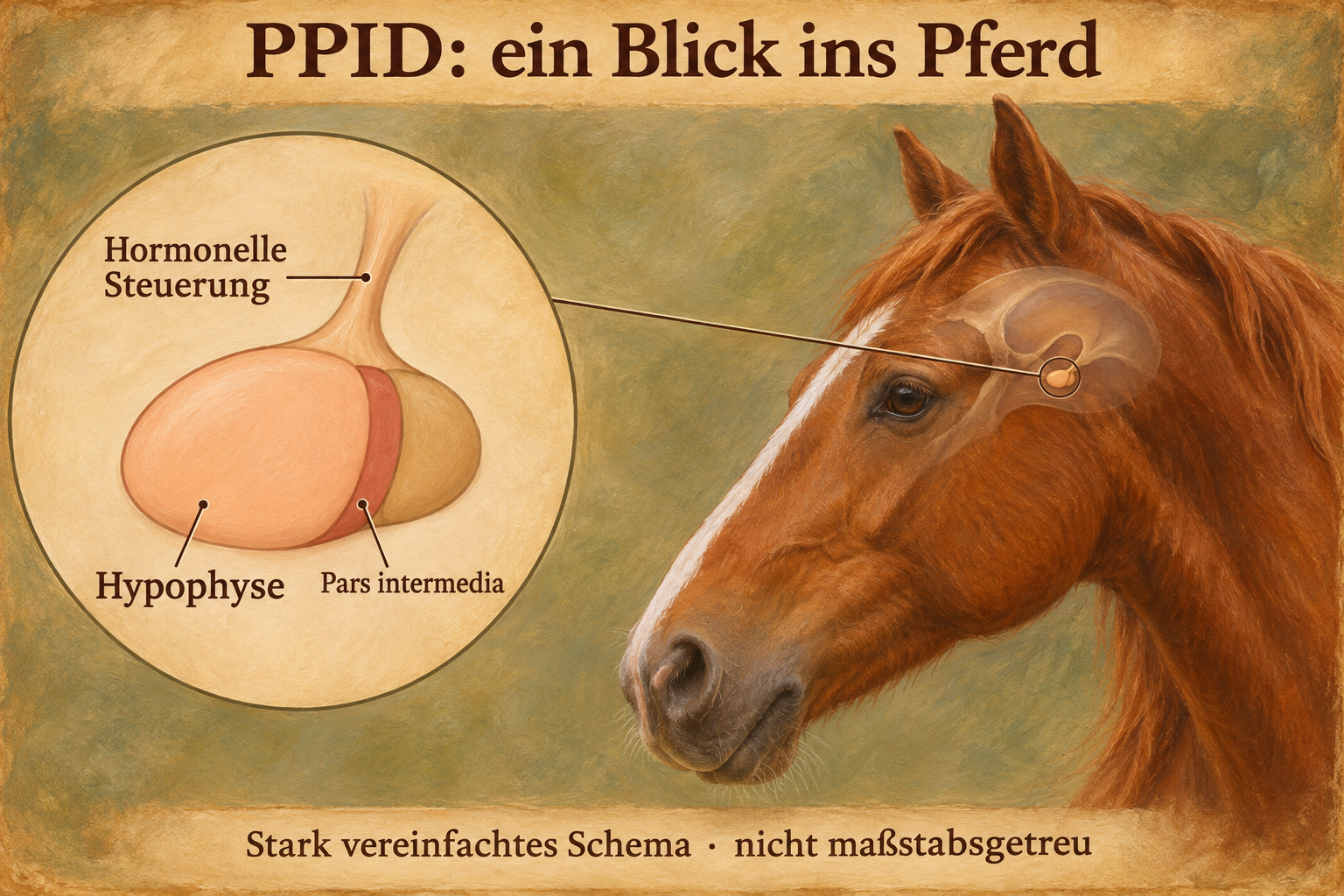
Signs may include delayed shedding, coat changes, muscle loss or increased drinking. Such changes call for an examination. They cannot be diagnosed from the stable fence. Diagnosis and medical treatment belong with your veterinarian. Pergolide is a medicine commonly used for treatment. 8
This matters to me. Even after a diagnosis, you can support your horse in everyday life. That includes providing what your horse actually needs.
The crucial additional question is how insulin responds
PPID and disturbed insulin regulation can occur together, but they are different conditions. Insulin helps regulate blood glucose. In insulin dysregulation, the insulin response to feed may be inappropriately high. This matters because high insulin levels are associated with a greater risk of laminitis. 4
That is why insulin regulation needs to be discussed when a horse has PPID. Your veterinarian decides which test is appropriate. Being thin does not automatically remove the risk. An ACTH result alone cannot answer this feeding question. 1
Knowing both body condition and insulin regulation is what turns a general stable tip into a workable plan.
Two horses, the same diagnosis, two different needs
Imagine two fictional stable neighbors. One is an older pony with a round belly, obvious fat deposits and confirmed insulin dysregulation. Next door is a senior losing weight and muscle along the back. The senior’s insulin regulation has been assessed by a veterinarian and found to be normal. Both have PPID.
For the pony, a controlled reduction in excess weight and an appropriate restriction of sugar and starch make sense. Forage and pasture need to be included in the plan. The same blanket calorie restriction would miss the thin senior’s needs. This horse needs a ration that actually meets its energy and nutrient requirements. 3
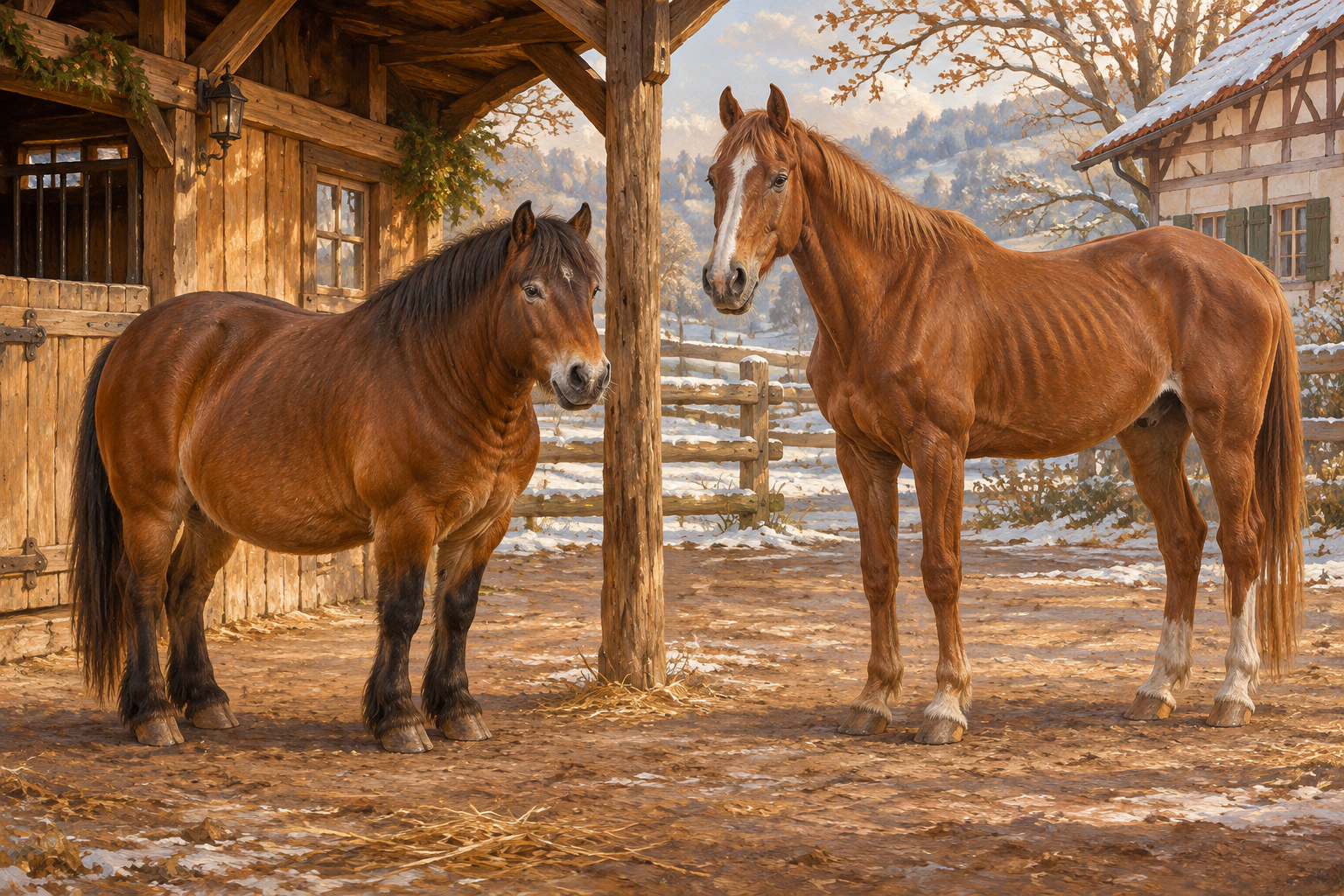
Then there is the horse that is thin and also has insulin problems. Appropriate feeding can be planned for this situation too. It requires enough energy alongside suitable feed choices. ‘Less of everything’ is no more helpful than ‘Anything, as long as the horse gains weight.’ 3
For Sandra and me, good support starts here. We first understand what this horse needs, then discuss a suitable supplement.
A full feed bucket does not tell you how much reaches the horse
With older horses, it is worth looking closely at actual feed intake. Can the horse still chew well? Are there dropped balls of partly chewed hay? Can the horse eat peacefully in a group? An offered amount only helps if the horse can actually eat and use it. Suitable soaked forage replacements may form part of the plan when dental problems are present. 4
When muscle is being lost, protein supply also matters. The body needs the amino acids in protein as building blocks. Oil supplies energy but no protein. It can serve one purpose while being unable to replace the building blocks needed for muscle. 7
Here is a practical example. An extra portion is written into the feeding plan, but when you watch the senior eat, the horse chews for a long time and leaves some behind. My first question would be how to make this meal easier to eat. That is often more useful than immediately adding another supplement.
Where a suitable oil may have a useful role
If a horse is losing weight, an appropriate fat source can add energy to the ration. This may be particularly useful when extra cereal-based feed would be unsuitable because of insulin regulation. The amount and gradual introduction need to suit the horse and the rest of the ration. Extra calories are not the first goal for an overweight pony. 4
We distinguish this from a second question, which fatty acids the horse receives. For a targeted supply of the omega-3 fatty acids EPA and DHA, their actual amounts in the chosen oil matter. Any vitamins in the product also need to be counted. An oil used as a targeted supplement is not automatically the right choice for providing a large amount of extra energy. 7
A small study of ten horses with EMS, a different metabolic condition, is interesting in this context. DHA-rich microalgae changed blood fatty acid levels, among other findings, and lowered triglycerides. This makes omega-3 interesting for research. The study did not investigate treatment of PPID or the effects of any arbitrary oil blend. 5
In practice, this means we can also assess whether omega-3 intake is appropriate. We do not turn that into a promise to lower ACTH or prevent laminitis. We give the supplement a clear role within the overall feeding plan.
What about selected fiber ingredients?
You may have heard about blends containing inulin, fructooligosaccharides, psyllium husks or other fiber ingredients. My first question would be which specific problem we want to address. A PPID diagnosis does not automatically mean that a horse needs an additional fiber powder.
There is interesting research here. In a study of 15 horses with EMS or a history of the condition, a blend of mannan- and fructooligosaccharides reduced the insulin response in geldings. This effect was not found in mares. The result cannot be transferred to PPID or to blends with a different composition. 6
Results like these give us a reason to look more closely. They do not justify grouping every fiber under the label ‘good for metabolism’. The complete formulation, an amount appropriate for a horse and the intended purpose all matter. A powder’s recommended human serving does not provide a dosage for horses.
If digestive problems are also present, we work with the treating veterinarian to consider their causes and the existing diet. A supplement can then be discussed for a specific purpose. Sufficient suitable forage remains the foundation. A few scoops cannot replace it. 7
Your stable checklist after the diagnosis
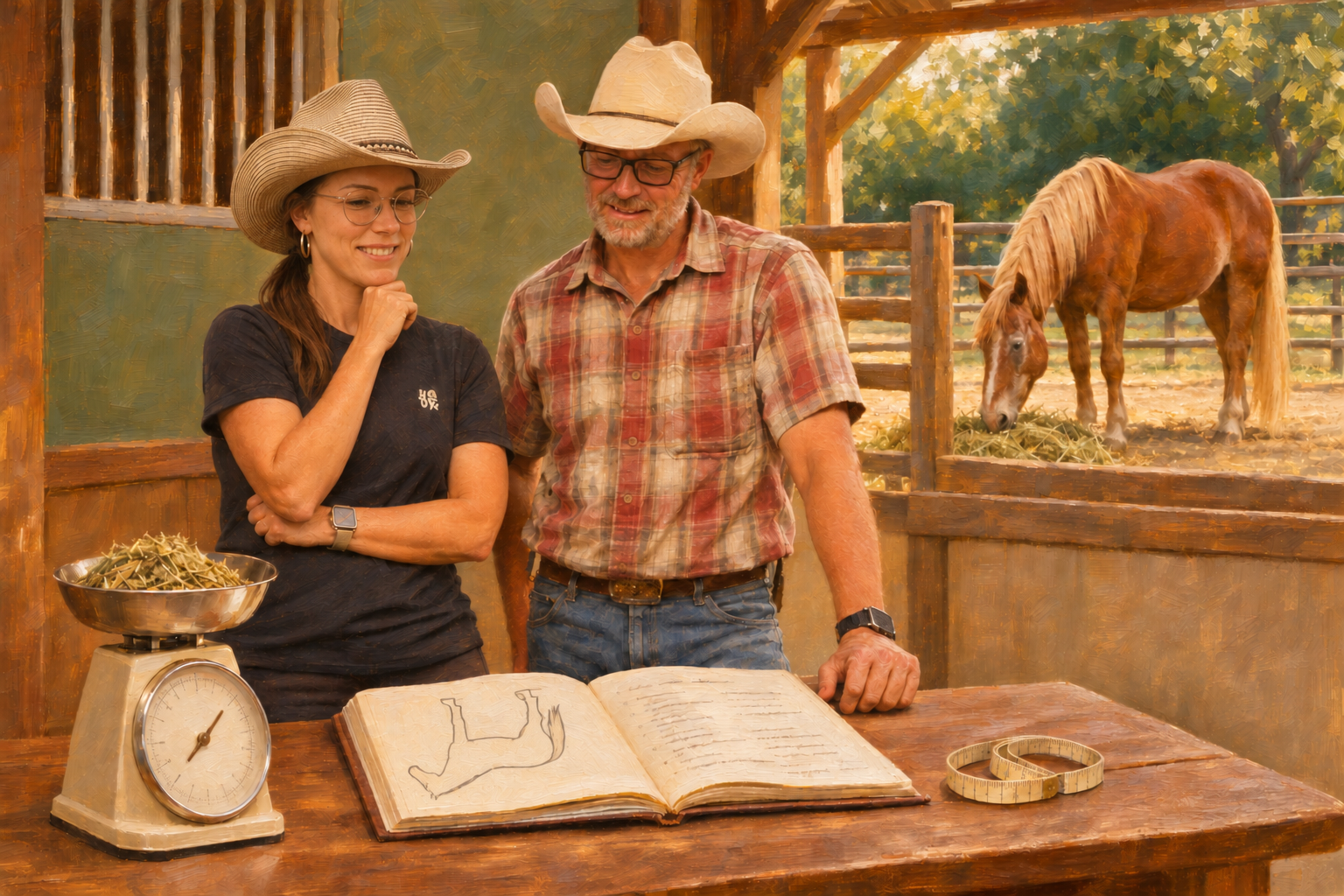
- Record body condition. How are weight, the rib area and the back muscles changing? Photos taken from the same angle and a consistently used weight tape can help track changes. Assess fat deposits and muscle separately.
- Discuss insulin regulation. Ask your veterinarian whether it has already been appropriately assessed and what the results mean for forage, pasture and bucket feed.
- Watch an entire meal. Can your horse chew well? Is feed left behind? Does the horse have enough peace and access to eat?
- Write down the full daily ration. Include quantities, supplements, treats and product ingredient information. Add the oil already being fed to the list as well.
- Give every supplement a specific purpose. Extra energy, targeted fatty acid intake or another justified question. What should improve, and how will we assess it?
- Arrange the next review together. Monitor appetite, body condition and wellbeing, and keep veterinary checkups. Discuss any change in medication with the treating veterinarian.
If your horse suddenly walks tenderly, is reluctant to turn or noticeably shifts weight off its feet, this calls for prompt veterinary assessment rather than another feeding experiment. If laminitis is suspected, exercise must also follow veterinary instructions. 1
The diagnosis can be the start of a good plan
I can imagine how much a diagnosis can stir up at first. Your horse is still there in front of you, with its preferences, its expression and its habits. None of that disappears behind four letters.
Appropriate treatment and coordinated care can help maintain quality of life with PPID. 8 There are practical feeding steps you can take. Enough suitable food for the thin senior. A controlled plan for the overweight pony. In both cases, the diet should be based on the horse’s actual needs.
If you would like support, Sandra and I will be happy to review the current ration and your veterinarian’s recommendations with you. We can discuss which supplements might be useful and what question a test could actually answer. A fatty acid profile, for example, describes one aspect of nutritional status. PPID diagnosis and monitoring require the relevant veterinary tests.
You do not have to try every stable tip after the diagnosis. You can start with a plan you understand.
Let’s review your horse’s feeding together ↘
Read more and deepen
- When an older horse loses weight despite eating
- Looking at excess weight and metabolism together
- Oil and vitamin E: the whole ration matters
Sources and further literature
PPID recommendations and studies on EMS answer different questions. Keeping this distinction matters when assessing omega-3 and fiber ingredients too. Updated November 2026.
Equine Endocrinology Group · 2025 recommendations · Expert consensus on diagnosing and managing PPID, revised in October 2025. Particularly important, assess insulin regulation and adapt feeding to body condition and test results. This is not a feeding trial of a particular product.
Open original source (opens in a new tab)Equine Endocrinology Group · PPID explained · Expert explanation of changes in dopamine regulation and the affected pars intermedia of the pituitary gland. The basis for the simplified anatomical illustration.
Open original source (opens in a new tab)Galinelli and colleagues (2023, online 2021) · Review of individualized nutrition in PPID. Body condition, muscle, insulin regulation, energy and protein are considered together. An overview of existing evidence, rather than proof for individual supplements.
Open original source (opens in a new tab)Michigan State University · PPID · Veterinary information for horse owners on signs, tests, treatment and everyday management. Also explains different feeding needs in horses with weight loss and impaired insulin regulation.
Open original source (opens in a new tab)Elzinga and colleagues (2019) · DHA in EMS · A 46-day pilot study involving ten horses with EMS. DHA-rich microalgae changed blood fatty acid and triglyceride levels, among other findings. Neither PPID nor the oil blends discussed here were studied. It provides no evidence of laminitis prevention.
Open original source (opens in a new tab)von Münchow and colleagues (2023) · Oligosaccharides in EMS · Crossover study involving 15 horses with EMS or a history of it. A blend of mannan- and fructooligosaccharides affected the insulin response in geldings but not mares. This was a different formulation from a general fiber blend, and it was not a PPID study.
Open original source (opens in a new tab)Merck Veterinary Manual · Nutrient requirements · Veterinary review of energy, protein, fat and vitamin requirements in horses. Helps put a supplement in the context of the complete ration.
Open original source (opens in a new tab)British Horse Society · Cushing’s / PPID · Practical information on signs, veterinary treatment and regular care. A diagnosis does not automatically mean the end of a good quality of life for a horse.
Open original source (opens in a new tab)
Free introductory talk at your location (German)
A Cushing’s diagnosis: What can we do day to day?
A PPID diagnosis brings up many questions around the stable. Would you like to understand together what matters in body condition, feeding and appropriate support?
Invite us to give a free introductory talk at your venue. We make feeding questions understandable, put supplements into context and explain which observations can help when talking to the veterinarian. There is time for your questions. We agree on the topic, scope and date together.
Use the contact form with the subject ‘Introductory talk’ and tell us briefly who the talk is for.
Ask about an introductory talk (German) ↘If you would like to know which products we use, feel free to explore our shop.
To the original post by Timmerherm Ranch
What does your horse actually need now?
Tell Sandra and me what concerns you about your horse’s feeding. Together, we look at the current diet, body condition and veterinary recommendations. This helps us assess whether a supplement or targeted test could answer a useful question.
Please do not send emergencies or sensitive findings using the form.