

How much does your horse weigh? Our new horse weight calculator
A measuring tape, a few quiet minutes and a closer look at your horse: our free horse weight calculator is here. It turns a rough guess into an estimate with a basis you can understand.
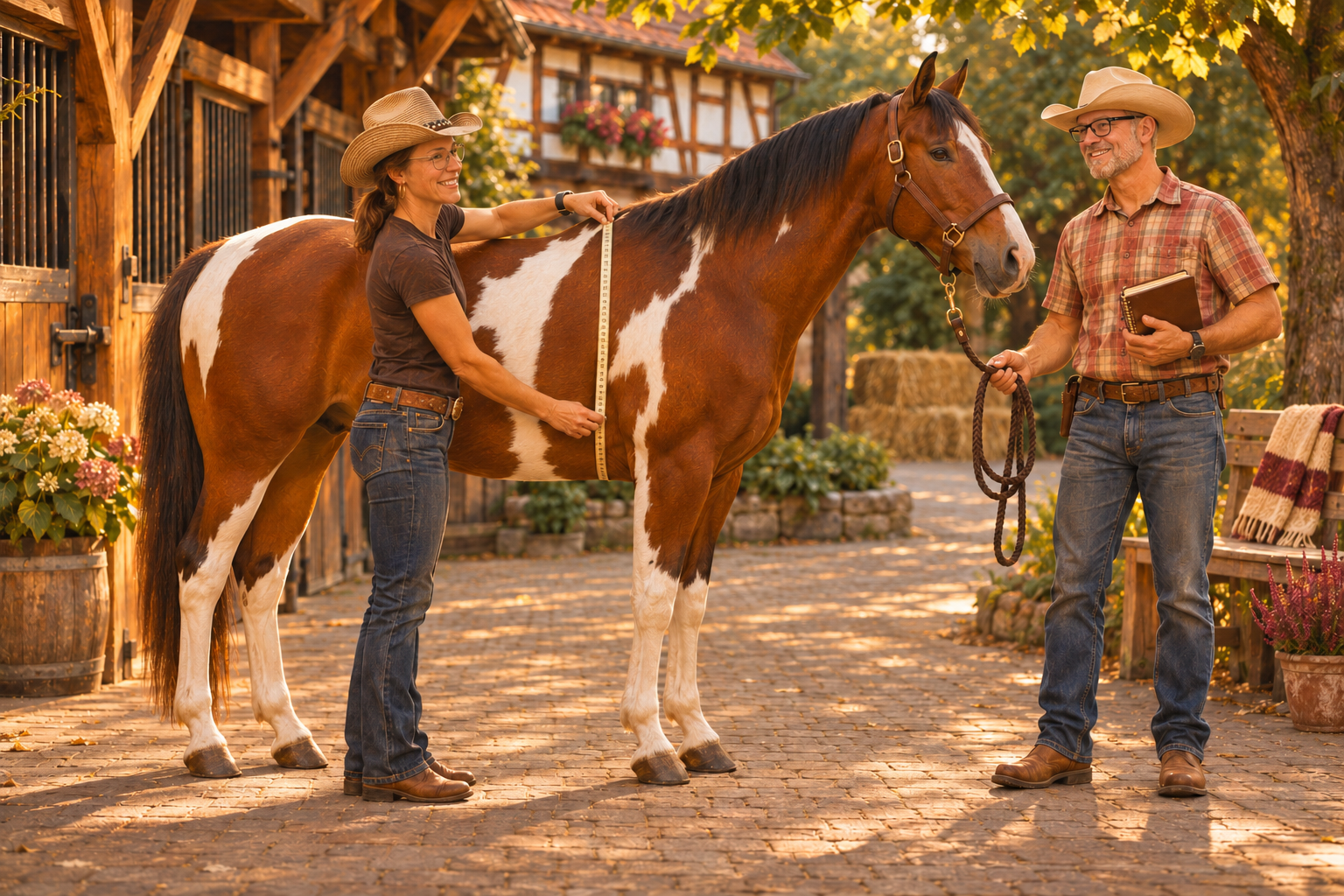
The illustrations depict example scenes with Sandra and Marc and were generated with AI using personal reference photographs. For the exact measuring method, follow the guide in the calculator.
‘He must weigh around 500 kilos.’ Perhaps that sounds familiar. You know your horse, see it almost every day and eventually settle on a number. But when did you last check that number? And what is it based on?
Because our horses are so familiar to us, small changes can take time to notice. The girth fits differently. The topline looks narrower. Or the pony starts winter looking a little rounder after the grazing season. Recording what you observe and having an understandable starting point can help.
That is why we have added a horse weight calculator to ProBalance. You will find it under ‘Knowledge & Inspiration’. It is free and requires no account. It estimates current bodyweight from your measurements and shows which calculation model it uses.
Open the free horse weight calculator ↗
A Quarter Horse is not a warmblood
Two horses can be the same height and still have very different builds. Our calculator therefore offers models for stock-type horses such as Quarter Horses, Paints and Appaloosas, for Arabians or Arabian-type horses, for ponies, warmbloods and draft horses. Choose according to build. A western saddle does not turn a warmblood into a stock horse.
For these horse types, the calculator uses four measurements: height at the withers, heart girth, body length and neck circumference. Under ‘Other’, there is also a simple two-measurement formula using heart girth and body length. Follow the relevant body-length instructions carefully. The models’ measuring methods should not be mixed.
The breed-type models are based on published research by Martinson and colleagues and Catalano and colleagues. The researchers compared body measurements with actual weights measured on a livestock scale. This gives the estimate a scientific basis. It does not guarantee accuracy for an individual horse. 2 3
How to turn a measuring tape into a useful estimate
Before you start, choose a quiet moment and level ground. Your horse should stand as squarely as possible. A soft measuring tape, a measuring stick for height and a second person make the job easier. If your horse is unfamiliar with the tape, introduce it calmly and keep the situation safe.
- Choose the appropriate horse type. Consider the horse’s build and read the note for the selected model.
- Follow the measuring guide. The calculator explains the measuring points and provides a schematic illustration. The correct body-length method is especially important.
- Replace every example value with your own measurements in centimeters. The prefilled values simply demonstrate how the calculator works.
- Repeat the measurement. If the tape slips or your horse changes position, measure again before recording the value.
- Record the result, the date and your observations. Next time, use the same method under conditions that are as similar as possible.
Bodyweight, body fat and muscle are different things
A horse may become lighter because it loses fat. It may also lose muscle. And if fat decreases while muscle increases, the scales may show little change. Bodyweight alone therefore cannot tell you how well your horse is fed or trained.
That is why the calculator also includes a Body Condition Score slider, or BCS, on a scale from 1 to 9. You enter your own assessment of body fat. The calculator does not assess your horse from a photograph or evaluate muscle. Importantly, BCS does not change the weight formula. Estimated bodyweight and body condition remain separate entries.
If you are unsure how to assess body condition, ask a qualified professional to show you on your horse. Together with photos taken from the same angle and your observations during grooming, feeding and exercise, this gives a more useful picture than a single number.

Your measurement record stays with you
Use ‘Copy measurement result’ to transfer the information to your own notes. ‘Print measurement record / PDF’ opens the print view, so you can print the record or save it as a PDF if your browser supports that option. It is useful for your stable records and for a conversation about your horse’s care.
The calculation runs in your browser. The calculator itself does not store your measurements or send them to us. This also means that you need to save your results yourself if you want a record over time. It will not have an automatically maintained horse diary waiting for you on your next visit.
When a horse scale gives the better answer
Our calculator is intended for adult, nonpregnant horses aged three years and older. The multi-measurement models are available from 112 cm height at the withers. Foals, donkeys and miniature horses are outside its intended scope. Unusual conformation and major changes in body condition can make the estimate less dependable.
We therefore do not promise a fixed percentage accuracy or a kilogram range within which every result will fall. If exact bodyweight matters, use a suitable horse scale. Do not base medication doses solely on the calculated result. If your horse gains or loses weight noticeably, the calculator does not replace veterinary assessment.
A useful starting point for everyday horse care
Sandra and I want knowledge to be useful in everyday life. You do not need to memorize every formula. You need a calm look at your horse, carefully taken measurements and a willingness to treat a number as one part of the bigger picture.
Next time you have a quiet moment at the stable, take a measuring tape, open our horse weight calculator and try your own measurements. It may support your current estimate. It may give you a reason to look more closely. Either way, it is a useful starting point.
Estimate your horse’s weight now ↗
Related reading
Sources and further literature
- ProBalance · Horse weight calculator and measuring guide
- Martinson et al. (2014) · Bodyweight models for adult Arabians, ponies and stock horses. Journal of Animal Science 92, 2230–2238. DOI: 10.2527/jas.2013-6689.
- Catalano et al. (2016) · Bodyweight models for adult warmblood and draft horses. Journal of Equine Veterinary Science 39, 38–43. DOI: 10.1016/j.jevs.2015.09.002.
- University of Minnesota Extension · Body measurements and the research behind bodyweight estimation.
If you would like to know which products we use, feel free to explore our shop.
Would you like to take a closer look at your horse’s feeding?
If you have questions about your horse’s current diet or would like to discuss your observations, write to Sandra and me. A measurement record can be a useful starting point for a conversation. The appropriate next steps depend on your horse and its situation.